WHEN EGO RUNS THE SHOW

Do you ever catch yourself needing to be right about something? Or needing to win an argument that didn’t really matter? Or maybe craving recognition for something you did? We all have these moments. This is our ego rearing its head. Our ego is not inherently a bad thing. It’s actually a survival mechanism built into us. The problem is when our ego starts running the whole show instead of being just one factor that drives our behavior.

I wanted to talk about this idea of the ego and how we can work to tame it so to speak. One of my core values is humility, but I often struggle with this living in the type of culture we live in now – with social media being so pervasive. First, let’s talk about what the ego is. A lot of people think ego is vanity or arrogance, but in reality it’s more of a mental construct of “self” that needs protecting, proving, and comparing. The job of our ego is to defend our image, seek validation, and avoid being wrong or feeling small. In our own heads, the ego convinces us that we are “the ego” side of us and so we tend to not evaluate its motives.

It is all too easy to allow our ego to quietly run our lives. The ego operates in several different aspects of our lives. It is present when we are having conversations, wanting to listen to respond rather than listen to understand. It is present in our decisions and can sway us to make decisions that make us look good or make it seem like we are doing the right thing or what others would approve of instead of what is actually the right thing to do. The ego operates in our relationships. It is that side of us that needs to be right in conversations and holds grudges to protect our pride. It also shows up in our work or achievement – causing us to chase status and recognition over meaning. And the ego is especially present when we are challenged as we react to criticism. It tends to cause us to have a defensive or emotional response rather than actually evaluating the criticism to see if there is something we need to work on or change.

It can be very difficult to pay attention to these ego responses and to push against them where necessary, actively seeking to live a life of humility. Humility is hard. Especially in our culture where so many people share their highlight reels and something so simple can get you “cancelled.” Humility requires putting the self down for a moment, while social media rewards the opposite. Social media platforms are actually engineered around self-preservation, curated highlight reels, likes as validation, and therefore comparison built into the scroll. There is a feedback loop at play, which is why it is so difficult to get perspective and really question the ego. It goes: you post something, you get validation, this reinforces your ego, which leads to the need for more validation, so you post again. Even “humble-bragging” or performative humility gets absorbed by the ego – which is why it can be so sneaky! It even hijacks virtue! And the reality is, we have all resorted to participating in this cultural noise: everyone is a brand, everyone has an opinion to share, everyone shows up as a “main character.” So if you don’t join this way of posting, where ego is driving, it can feel like you’re falling behind. The question I am often wrestling with as a content creator myself is how can I share in an authentic way that allows humility instead of my ego to lead? I feel like humility has a bad reputation. It needs a rebranding! Or at least a reframe. Humility is not self-deprecation or low self-worth. Instead it is an accurate self assessment! Having humility means being open-minded. Being willing to be wrong, to not know, or allowing someone else to be right. Humility is being curious and listening to others to understand not just to respond. Humility isn’t weakness, it’s being secure enough in the value you have to be okay if you aren’t right. Humility is quiet confidence over loud self-promotion which is anything but weak.

In order to live a life of humility, we must intentionally evaluate the motives of our ego. We must learn to practice self awareness and ask ourselves: “is this me or my ego protecting my image?” when we are challenged and tempted to just react defensively. We can look for opportunities to practice saying “I was wrong” or “I don’t know.” We can also pay attention to when we are mindlessly scrolling on social media, and particularly paying attention to when we are beginning to compare ourselves in the scroll. If we are having that reaction, maybe it’s time to stop scrolling. We can also pay attention to when we are seeking validation through posting on social media versus sharing to actually add value or make connections. Lastly, you can actively celebrate others accomplishments! Cheer others on, give compliments! I think one of the signs of a self-confident person is that they genuinely cheer others on!

The reality is the ego will never fully disappear. Like I said, the ego is there for a purpose – for our own self-preservation. The goal isn’t to eliminate the ego, but instead to be more aware of it and its motives. A humble life isn’t necessarily a smaller one, it just means that you aren’t performing for others or to seek validation. Instead you are living fully in your authenticity. Are there areas in your life today that you know your ego is driving? Are there any of these tips I shared that you could implement to help you become more self aware and allow humility to lead?

Here is the YouTube video I shared in conjunction with this blog post.


MINDFUL MODERATION

I was recently introduced to this Japanese practice Hara Hachi Bu, only eating until you are 80% full rather than 100%. Interestingly, Okinawa is located in one of the “Blue Zones” in the world, which is an area with usually higher longevity than other parts of the world. I find this a fascinating practice with regards to food for sure, but this philosophy of stopping before excess intrigues me. I find that this idea translates to all areas of life! It is the idea of mindful moderation.

The idea of stopping at 80% isn’t about deprivation. It could seem this way, but if you think about it in terms of food – often it takes a while for your brain to catch up to your stomach actually feeling full. If you stop at 80% it gives your brain time to catch up to feeling like you have had enough. Stopping at 80% really is less about deprivation and more about leaving margin in your life. In all areas of life, satisfaction does not equal saturation. We live in a time that pushes the idea of saturation. The other day my husband, son, and I were talking about how much entertainment is available to us these days. It is difficult to choose what to spend your free time on sometimes because of how saturated the entertainment world is now. In general, our culture glorifies the idea of “more,” “full,” or “maxing out.” If you are on social media, you are constantly being exposed to “more.” Just one more Reel, just one more Tik Tok, just one more minute of scrolling. And on social media we are exposed to so many lifestyles and things that it can make us crave more in our own lives.

Like I mentioned, this idea of 80% can be applied to all areas of life. In work or ambition, we can stop at “good enough is good enough for today.” Instead of grinding until we are depleted, we can work to 80%. I know I have experienced this with homemaking. I have had to learn the art of progress over perfection and allowing my work to be “good enough” sometimes instead of constantly pushing myself to do things even when I don’t have the energy or bandwidth that day. This can also be true with screen time or taking in information. It is all too easy to “doom scroll” – scrolling until you’re numb. It is especially difficult to put boundaries on this since we know from research that scrolling on social media is an addictive behavior. We must learn to set and stick to our boundaries with regards to social media, news, and other media intake.

Another area where mindful moderation is helpful is in our spending and consumption habits. If you have been around a while, you know I have done two no buy years. I have also done multiple no buy months. The reason I did this was to practice this idea of mindful moderation when it comes to bringing things into my home. Implementing this idea has helped me tremendously on my decluttering journey. As we slow the inflow of things coming into our homes, we begin to see the progress of our decluttering instead of just purchasing more as we declutter.

Even healthy things should be done in moderation. Exercise is a good thing, but training at 80% effort instead of training to exhaustion can help with remaining consistent and avoiding ultimate burnout or even injury. Socializing is another positive thing, but it is another area of life where 80% would be beneficial. You can leave gatherings while you are still enjoying them rather than staying until you feel drained. On social media, you can turn off notifications so you do not constantly feel the need to respond to every comment and DM. Giving yourself time away from people to recharge, especially if you are an introvert, is important.

The idea of 80% can also be translated to speaking and sharing opinions with people. Instead of dominating conversations with what you want to share, learn to leave room for listening. Actually listening to others’ ideas and opinions and not listening just to respond. Lastly, related to relationships is the area of emotional reaction. We all have reactions to certain situations and confrontations with people in our lives – our spouses, family members, friends, and co-workers. It is human nature and natural to have an emotional response to certain things, but if we apply this idea of 80% – responding at 80% intensity, this leaves room to de-escalate. 

The idea of mindful moderation works well because of the psychological lag in recognizing “enough.” For example, like I mentioned, our brains take a while to catch up to how our stomach is feeling with regards to food. But this is true in other areas as well, like dopamine or even fatigue. If we stop at 80% it gives the brain time to catch up to realizing that is enough. It is better to undershoot – in all areas of life, then to overshoot and risk burn out. Also, focusing on 80% is more sustainable. When we shoot for 80% instead of 100 it feels more do-able and therefore we are more likely to follow through consistently. Moderation is a long game strategy that will help you remain dedicated day in and day out.

Can you pick one area of life this week to consciously stop at 80%? Maybe it’s with food, or your phone, or work. Reflect on where you stopped and how you felt stopping there. Remember those people who implement the Hara Hachi Bu practice are known to have longevity, which is likely also linked to well being in their lives. Mindful moderation is less about restriction and more about restraint as a form of self respect. 

Here is the video I shared in conjunction with this blog post.

DEALING WITH NEGATIVE PEOPLE

Do you ever leave a conversation feeling completely drained – emotionally or mentally or both? I know your answer could be dependent on your personality type. If you are an introvert, being with people generally drains you. But I’m talking about being around those people who are negative and emotionally exhausting. This type of person can drain even the most people oriented extrovert! There are some people who struggle with viewing things from a negative light and often bringing others down with them. As someone who practices the Christian faith, I believe we are called to love all people. Maybe we are especially called to love those who are going through difficult things in life. But loving others, even those the closest to us, does not have to mean absorbing their emotional state. I think people can confuse true empathy – which is being present with someone in their pain and enmeshment – which is being pulled into their emotional state.

Empathy is a good thing. I have done a lot of research on empaths, and I really think this type of person describes me. Knowing that I am an empath has helped me tremendously as I have navigated what that means and how I can train my empathetic tendencies for good. When you don’t realize you are an empath, or you realize it and don’t work to train your heart and mind you can be susceptible to morphing your emotional state to match that of the person you have empathy for. Typically what this looks like is your energy shifts to that negative energy or you feel obligated to fix their mood. This heaviness can quickly cause your own mood to spiral. I have learned that I can have empathy for others without allowing their mood to dictate my own mood. I can protect my own peace, while being there for them in their time of need. 

You can hold space for someone without getting wrapped up in their emotional storm. I think of it like the waves of the ocean. Their mood is the waves that are ever changing – you can get caught up in that or you can be like the shore – strong, steady, unchanging, and present for them. Arguably, loving someone well looks more like being grounded for them, not matching their negative energy. I know this can be so difficult, especially if you do feel like you are an empath. You might get tired of hearing me say this, but I do feel like when you have healthy habits of your own it is much easier to deal with this sort of situation. It is easier to be more emotionally well regulated when you have proper sleep, hydration, nutrition, and exercise. I have to share with you, ever since I have changed my diet and have been counting my macros, eliminating alcohol, and being more intentional with getting my steps in I have noticed I am more clear minded and able to regulate my emotions better, even amidst perimenopause!

In addition to having your own healthy habits, there are other practical things you can do in the moment when dealing with a negative person. The first thing you can do is to have a mental phrase prepared ready to speak to yourself in the moment. You could say, “I can care about this without carrying it.” or “Their emotions are not my emotions. I can be empathetic while also staying grounded.” Something else you can do is to be hyper aware of your physical state when you encounter someone negative. Are your shoulders tensing up? Intentionally relax them. Is your breathing speeding up? Slow your breathing down. Is your jaw or fists clenching? Pay attention to these cues and unclench them. Lastly, you can have a script ready that enforces your boundary with someone when you have had enough and need to exit a draining conversation. That could be something like being direct and saying, hey can we pick up this conversation at a later time, I’m starting to feel emotionally overwhelmed. I want to be there for you in your time of need, but I want to make sure I’m fully emotionally present for you. Or it could be a redirection of the conversation. Being aware of your vulnerability towards absorbing their energy and then being prepared for what you can do in the moment can make all the difference. 

It may feel selfish to want to protect your peace and your positive mindset, but it is far from selfish. Like I mentioned earlier, loving people well means staying grounded FOR them. When you match their energy, you can’t be as level headed and present for them. Over time, consistently absorbing others’ energy leads to emotional burnout and that is good for no one! Not for you, or those around you. There is a bigger purpose at play and protecting your own peace actually helps those who need you. At the beginning of this message I asked you if there was someone who drained you. Who was that person you were thinking of at that moment? Can you love that person from a more grounded place? Dealing with negative people requires us to be aware of our tendencies towards enmeshment, and flipping that to true empathy and being present for them.

Here is the YouTube video I shared in conjunction with this blog post.

INCONVENIENCES

Picture this, you are on your commute to work and suddenly traffic stops. You hear sirens coming and up ahead you can see there has been an accident. What are you thinking? What are you feeling? Are you irritated that this will inconvenience you? That this will make you late to work, you might start your day feeling behind, your boss might yell at you for being late. Inconveniences in life can cause our blood pressure to rise and stress to settle in. But you could choose a different mindset at this moment. Yes, I said choose. We may have an immediate negative reaction to inconveniences, but we don’t have to stay there.

What if instead of getting irritated and stressed in this moment you thought about how lucky you are that you were not the one in the accident that morning? That person in the accident likely is much more inconvenienced. They may be badly injured, perhaps causing them to miss days or even months of work while they recover. Or worse, they may have lost their life. It is easy to get frustrated when we are inconvenienced, but it is just as easy to shift our mindset to a more positive outlook. I saw a post on Instagram that said, “That 30 minute workout you hate? Someone’s in a wheelchair dreaming of it. That meal prep you avoid? Someone’s scraping together money to afford their next meal. That rest day you call ‘annoying’? Someone’s body is shutting down. Taking care of your body isn’t a chore, it’s a privilege.” It’s all about mindset!

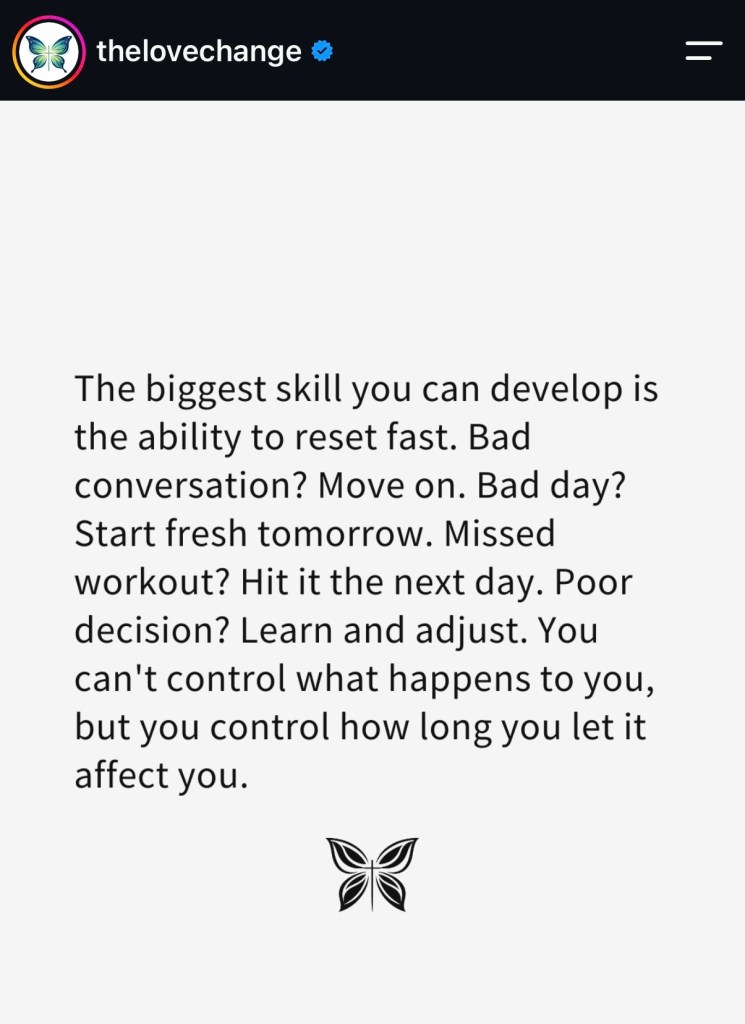
The traffic example I gave is a slight inconvenience, but I think even with bigger inconveniences we can have a more positive mindset and not let these things ruin our day or even week! Another post I saw the other day on Instagram said: “The biggest skill you can develop is the ability to reset fast. Bad conversation? Move on. Bad day? Start fresh tomorrow. Missed workout? Hit it the next day. Poor decision? Learn and adjust. You can’t control what happens to you, but you can control how long you let it affect you.” I wholeheartedly agree with this! It is natural to feel annoyed or frustrated at inconveniences or when things don’t go your way. But you do have the choice to dwell in that feeling or to choose to have a more positive outlook.

When life throws you a big inconvenience, it may take more than a moment to readjust and see the silver lining. I realize this is subjective. What is a big inconvenience to one person may not seem as big to another. But if it feels big to YOU, then it is big. There are things in life that are big curve balls. Things you did not expect or want to deal with. These things take time. Often with big inconveniences, we have to recalibrate. This often involves grieving. If nothing else you may be grieving the life you thought you would have or the person you thought you would be at this point in life.

When our kids were young, my husband and I would talk about how crazy it would be that we would be empty nesters at the age of 47. Here we are four years later and we cannot really call ourselves empty nesters yet. Currently two of our three adult children are living with us. Our oldest daughter is in a grad school program and living with us to save money as it is very expensive to live in Austin and she is paying for her grad school without debt. Our youngest son is still living with us as he just needs some extra time to grow and be ready to live on his own. This was unexpected. At first I really struggled with grieving what I thought my life would be at this age. But I was able to grieve that, and realize what a blessing it was to have extra years with two of our kids. It especially hit when our other son moved away, not just out of our house but out of the state! I appreciate the extra time I have with my two other kids! It has also been a mercy in a sense for me to ease out of being a stay at home mom. I’m still able to cook dinner for the family a few nights a week and help my kids with things.

My perspective now is that inconveniences are part of your path. When something happens that seems annoying, I like to think of it as protecting me and keeping me on the path I was meant to be on. Call it God or call it fate, or the universe… but I do think things happen the way they are supposed to happen for our higher good. Even when things seem bad in life, all circumstances can be used for good – to help us grow and become better versions of ourselves! 

Here is the YouTube video I shared in conjunction with this blog post.

VALUING WOMEN

When was the last time you were engaged in small talk and someone asked “what do you do?” If you’re like me and primarily a homemaker, it may feel almost embarrassing to admit that you stay at home. It can make you feel less than or like you are not doing enough in life. It is difficult to not minimize the work you do and answer, “I’m JUST a homemaker.” The truth is, what you are doing for your partner and your family is very valuable! Not only making their lives easier and more efficient but also if you put actual numbers on what each task homemakers do is worth, you would be surprised at the total amount you would actually make!

For me as primarily a homemaker, my day starts bright and early. I typically get up before anyone else. I have already done several tasks before anyone gets out of bed. Keeping a household running may seem simple, but it’s not as easy as it looks to actually keep track of everything that needs to get done in a day, week, or month to keep the home running smoothly and efficiently. Homemakers have to spin many plates every day, especially if their kids are still young. They simultaneously hold the roles of: chef, chauffeur, child care provider, housekeeper, laundry specialist, tutor, scheduler (or administrative needs), emotional support, personal shopper, nurse, landscaper, and the list could probably go on and on. This doesn’t even account for the time and energy you might put into your own health and wellness or self care or anything extra you might do for your household like DIY projects and decorating. None of this shows up on a resume, none of this earns a paycheck, and most of it goes completely unnoticed, until it doesn’t get done! All of this IS work, which takes time, effort, and energy, so it DOES in fact have value!

I did want to share some statistics with you to give you a picture of the monetary value. According to Insure.com’s 2025 Mother’s Day Index, if America’s mothers were paid for their work around the house, they would have earned an annual salary of $145,235 – a 4% increase from the prior year. That figure is based on how much you would get paid for each of these unpaid labor roles like cook, childcare worker, chauffeur, housekeeper, laundry, landscaping, personal care aide. For example, a mom spends about 14 hours per week preparing meals. Cooks average $17.14 per hour, which adds up to $12,478 a year for time spent in the kitchen. If you add up all of these roles you would get a 6 figure income. Another source, Salary.com has estimated the median annual value of a stay at home mom’s work at $184,820. Figures may vary from source to source, but I think the commonality is that they all land somewhere at the 6 figure mark. And here is an interesting statistic: if you were to do the same math for father’s it comes out to be somewhere around $61,000 per year, which is less than HALF of the work the mother is putting in. I recognize that this isn’t necessarily true for all families, this is just a generalization, but it does show how invisible the stay at home mom or homemaker’s contribution is!

Society has long equated value with income. I feel like this is especially true with the hustle culture in America. If it doesn’t pay, it doesn’t “count.” I do think this is what makes staying at home so difficult. You feel as though you are not contributing enough because you don’t have that paycheck coming in. On top of that, I think generally women are socialized to be humble, to not take up space, to not boast about their own worth. Whereas for men, this is perfectly socially acceptable. The “I’m JUST a stay at home mom” language is a perfect example. I know for me, I’m tempted to add that word “just” instead of proudly stating I’m a homemaker. If you recall, I talked about that word “just” a couple weeks ago when we were discussing the stories we tell ourselves. Putting that word “just” in there is a story we are accepting that being a stay at home mom or homemaker doesn’t have value. We need a mindset shift on that because our work is very valuable and not easy! This can especially come up in circles where some moms stay at home and some work outside of the home. I know from being a stay at home mom that you can feel inferior towards the moms who work. But the reality is, they are often hiring people to do the work that you are doing. They may have a house keeper, they may order food out more often, they may even have a nanny or a family member who helps with the kids and their activities. I mention this not to say one is better than the other, on the contrary – to say we are BOTH doing hard work!

I think it is really important to see your work as valuable if you stay home because it affects your confidence, sense of identity, and mental health. Seeing the value you bring to the table will help you more accurately advocate for yourself when making financial decisions with your partner. The other reason it is important to see your value is because it is often the homemaker who resists asking for help, support, or rest because they feel like they have not “earned it,” when in reality they may be more burned out than their spouse or peers who work outside of the home. This isn’t about demanding a paycheck from your spouse, but instead about an internal shift in how you see yourself. Some practical reframes you can use to help you is number one, quit using the word “just” when describing yourself as a homemaker. Also, name all of your roles out loud, or write them down. Naming all of the roles you are playing can help you to better value the work you are doing. Another important thing you can do for yourself is recognize that rest is not laziness. Rest for a homemaker is maintenance for someone whose job never stops. Building in times of rest both daily and weekly is important. I take a coffee break every afternoon, and I don’t work on Sundays to help with incorporating intentional times of rest. Lastly, remind yourself that your contribution to your family is not invisible even if it may feel that way.

As a stay at home mom or homemaker, you may not get handed a paycheck for your work, but YOU get to decide how much you value yourself – and that starts with the language you use about your own life. Where in your life have you been using the word “just” to shrink something that deserves to take up more space? Is there a role you have played where you wish you got more recognition? Do you have experience undervaluing your own work? If you feel comfortable, share in the comments!

Here is the YouTube video I shared in conjunction with this blog post.


THE STORIES WE TELL OURSELVES

We all have a narrative about ourselves living inside our heads. The question isn’t whether you have a story you tell yourself, it’s whether your story is true. Many of the limits we put on ourselves aren’t real limits we have, but rather old beliefs that probably surfaced a long time ago. I recently heard a story shared on the Mel Robbins podcast from Dr. Shade Zahrai about a study that was done by a professor at Dartmouth in the late 70’s, early 80’s. He had two groups of people and with one group he drew a very noticeable, visible scar on their face, he let them see the scar so they knew it was there. With the other group he did not put a scar on their face. Then he sent them out to have conversations with people. When they returned he asked how the conversations went. The people with the scars on their faces felt like they were judged, like their conversation partner was cold, and that they were treated differently because of the scar. While those without the scar reported that the conversations went well. While that would have been an interesting experiment on discrimination, the fascinating thing about this study was right after he showed the scar participants their scar, he said that he was going to put some moisturizer on the scar to make sure it set but he was actually removing the scar entirely! So these participants went into the conversation only believing they had a scar, which led them to have an expectation of how people would treat them, which led them to pay attention to nuances in the conversation that objectively did not exist. So it is good to think about what kind of scars you are carrying that create this narrative of who you are and how it affects how you enter each conversation or circumstance in life.

A simple definition of self narrative is the ongoing story your brain tells you about who you are, what you are capable of, and what you deserve. From psychology we know that the brain is a meaning-making machine. It is always labeling and filing your life experiences. And then these narratives become the lens through which you filter each experience moving forward. Most of us don’t acknowledge that this complex process is going on, and therefore tend to live on autopilot, basically letting old stories or narratives about you make decisions. This can show up in any aspect of your life – home life, relationships, habits, self worth, and more.

These stories that we constructed, often subconsciously, came from many origins. It could come from childhood and the messages we received from parents, teachers, siblings, or even peers, often without these individuals even realizing the impact it would have on us. These stories can also come from our past failures, especially things that we never processed and forgave ourselves for, but instead the mistakes replay in our heads over and over. Comparison is another way we construct these stories about ourselves – we see those around us, like family or friends and measure how we are doing or our worth compared to how others are doing. This often isn’t the full picture as we see the narrative they feed us about themselves. This is especially true on social media – the place that is notorious for the highlight reel. Lastly, these stories we tell ourselves could be informed by cultural messages. There is messaging that comes from society that shows us for instance how a woman “should” be, how a home “should” look, or what success “should” look like. These narratives are rarely stories we choose to believe, but instead they were absorbed, handed to us, or formed in a moment of pain. But we almost subconsciously carry them as though they are fact.

These stories hold us back from becoming the best version of ourselves. They create a ceiling so to speak of what we believe we are or aren’t capable of. They almost become a self-fulfilling prophecy as we subconsciously act in ways that confirm the story. These narratives keep us stuck in “some day” thinking – believing that some day we will be more disciplined, more motivated, have more time, or are more ready to pursue the thing we want to do. It will also show up in how we talk to ourselves. When we make mistakes or don’t follow through on the steps it takes to get to our goals we are very critical instead of self compassionate. For example, a woman who believes she is “just not an organized person” will self-sabotage every organizing system she tries to implement, not because the system doesn’t work but instead because of this narrative she believes about herself that she is “just not organized.”

There are practical ways you can identify your limiting stories. First, watch your “I just am” statements. “I’m just not a morning person.” “I’m just not disciplined.” “I’m just disorganized.” The word “just” is a story pretending to be a fact. Notice always and never statements. “I always mess up.” “I never follow through.” Usually these statements are not true, but we can be prone to use them to support our story. Another way to identify limiting stories is to pay attention to resistance. When you have a strong emotional reaction to something, like defensiveness, shame, or avoidance, there is often a story underneath. There are a couple of questions you can ask yourself. If you are serious about getting to the bottom of your false narratives, spend some time journaling and asking yourself a couple of questions. One is: “What do I believe about myself that I have never questioned?” and/or ask: “Where did I first learn this about myself and was it a reliable source?” I know that self evaluation is not easy. It can be uncomfortable and even painful, but it is worth it.

So how do we rewrite these narratives? First I want to share with you what rewriting a narrative is NOT. It’s not toxic positivity. It’s not slapping platitudes or affirmations on a wound. Instead it is about moving from an outdated, inaccurate story to a more honest and empowering one. Use this statement to reframe your beliefs about yourself: “I used to believe _________, but the truth is ________.” An example would be: “I used to believe that I was a disorganized person, but the truth is I never had the right systems or anyone to teach me.” This won’t be easy. It won’t be a singular journal entry. New stories don’t just stick immediately because old neural pathways are deep. In order to reroute these new stories in your brain, so to speak, it will take consistent effort with intentional thought. Repetition is the key to successfully rewriting these narratives. Community and accountability are important in this process. The people around you either reinforce your old story or help you build a new one. Be intentional about who speaks into your life. Also, you must celebrate the small wins! Every time you act against the old story, you collect proof for the new one! 

Did the story about the study done with the participants who thought they had a scar at the beginning of this post resonate with you? Do you have beliefs about yourself that inform the way you interact in the world? I frequently talk about decluttering our physical spaces, but the mind is one of the most important spaces you will ever declutter and organize! This week, think of one “I just am” statement that you have been telling yourself and ask if that is actually true or just a story you are telling yourself!

Here is the YouTube video I shared in conjunction with this blog post.


HOW TO STAY CALM IN A CHAOTIC WORLD

Modern life can easily pull us into urgency, comparison, distraction, and overstimulation. We must be intentional about living in a place of peace or calmness. Many people mistake calmness for weakness or passivity, but the truth is, calmness is emotional steadiness in the middle of uncertainty – which is anything but weak and passive. Calm people are not people without problems, they are people who have learned to respond rather than react. They believe the truth that they are the author of their reactions. Nothing outside of them has power unless they grant that power.

Calmness is a skill, not a personality trait. I can assure you because this is true from my own experience. I am not someone who is naturally calm, as I have dealt with anxiety most of my life. I have had to practice emotional regulation. Calmness is trained through repetition. Some people are naturally calm, and so this comes easier, but I think everyone to a certain degree has to learn emotional regulation. Staying calm does not mean ignoring our feelings. Emotional regulation involves acknowledging emotions, but not allowing those emotions to drive our behavior. A simple and practical way to implement this is to learn the art of pausing before you respond to something that is triggering. One moment of pause can completely change the outcome of a circumstance for you. Calmness often begins with slowing down our reactions.

There are several reasons why we may struggle to stay calm. The first reason being a need for control. This is probably the most common reason, and definitely the one I resonate with. It is easy to feel panic when life doesn’t match our expectations. That is why it is important to practice accepting uncertainty in life. Calmness can grow when we accept that life is unpredictable. Another reason we may struggle to remain calm is because of overconsumption. Too much noise, media, opinions, and stimulation can really trigger that feeling of overwhelm or being out of control. Our nervous system wasn’t designed to handle so much input. It is so easy these days with the internet and social media to get overstimulated. We must be intentional with our time. We must guard our time as though it is our most finite resource. It is the one thing you cannot get back. Recently I have been adding more things to my morning routine to focus on things that are beneficial and promote self growth to avoid just jumping on my phone first thing in the morning. I have been reading my Bible and praying first thing in the morning for many years, but last fall I added taking a morning walk with no headphones/input, and recently also added journaling. I don’t look at my phone until I have been awake for a couple of hours.

Another reason we may struggle to stay calm is because of internal pressure. We may put expectations on ourselves that we don’t even need. It could be because of a struggle with perfectionism and therefore having standards that are too high, it could be a fear of failure, or a feeling of falling behind in life compared to our peers. We must self reflect and evaluate if any of these things are serving us, or just causing us undue stress and anxiety, and then move forward being aware of the reality and what are the next best steps to take towards the life we want. Lastly, we may struggle to stay calm because of unhealed emotional patterns. Past experiences can make present situations feel bigger than they are. We must work through our emotions – whether that is through journaling, praying, talking to a friend or mentor, or seeking professional help.

There is a cost if we continually live in reactivity instead of responsiveness. Many people who do not learn the skill of emotional regulation end up living in a constant state of emotional exhaustion. They are constantly living on edge and allow notifications to control their lives. They feel burnt out from mental overstimulation. In addition to this, living in a state of reactivity can lead to poor decision making. Fear creates impulsive choices instead of thinking through the decision and weighing pros and cons. For someone who lives in a reactive state, anxiety narrows their perspective, making it difficult for them to make logical decisions. And, these individuals often struggle with anger because they feel so out of control. When we make decisions in anger, they are often not decisions informed by wisdom but instead by impulse. Lastly, not living in a calm state typically leads to loss of being present in the moment. Someone who lives in a reactive state misses the moment they are in because their mind is elsewhere. They are constantly anticipating the next thing – the next crisis, the next terrible thing, which steals their current peace. Calmness on the other hand allows us to actually experience life.

There are some practical ways you can cultivate calmness. First is probably obvious: slow down physically. Breathe deeper, walk slower, and stop always multi-tasking. You can also be intentional to protect your mental space. Reduce unnecessary noise and information. Set boundaries for yourself with your phone or screentime. Create intentional moments of quietness, like taking a walk with no headphones. Create daily grounding habits that will organically help you with these boundaries, like morning routines with journaling, prayer or mediation, and exercise or movement. Another practical way you can practice calmness is to learn to sit with discomfort. Choose voluntary difficulty. We were made for excellence not for ease. Calmness comes when you learn that not every uncomfortable feeling is an emergency and you can survive difficult things. The more you do difficult things, the easier those things become. And as I frequently say on these Thoughtful Thursday messages, focus on what YOU can control! Your effort, your mindset, your response. When you begin to focus on what is in your control instead of what you can’t control you feel empowered which leads to the feeling of calmness.

We must learn to accept that life will always be uncertain. Calmness doesn’t come from perfect circumstances, but instead from trust in ourselves. We must trust that we have the ability to adapt in all circumstances. We must trust that we have the ability to do hard things, and that those hard moments will pass. That is what life is all about. The quicker you accept that, the easier it will be to feel that calm state. Marcus Aurelius, a famous stoic said, “You have power over your mind – not outside events. Realize this, and you will find strength.”

This is the YouTube video I shared in conjunction with this blog post.

IT IS WHAT IT IS

One of the most difficult life lessons as a human is acceptance. There is so much we can’t control in life. And if you really think about it, it can start to feel debilitating. There are things that happen to us that we don’t like, we don’t want, and we didn’t ask for. I think there is a common misconception that acceptance is weakness, complacency, or defeat, but what if those things we don’t like are exactly what can help us grow and become a better version of ourselves? 

I was recently talking to a friend about this idea of acceptance. I don’t know about you, but there are some ongoing things in life that at times I will feel like I have fully accepted, but then at other moments – I guess moments of weakness, maybe when I feel tired, or lonely, or hormonal – where I don’t want to accept what is. Instead I want to try to fix or control the situation. There is a quote by Eckhart Tolle that says, “It may look as if the situation is creating suffering, but ultimately this is not so, your resistance is.” When we don’t accept what is, we will continue to suffer. Acceptance isn’t about liking or agreeing with reality, but instead acknowledging it so you can move forward with strength and clarity.

There are several reasons we tend to resist accepting things as they are. These may be cultural reasons, or just human nature. It is natural for us to want control and certainty in life. For some this is more true than for others and that is why some people are labeled control freaks. But it is probably true for everyone to a certain degree. Another reason we may resist acceptance is believing if we don’t accept what is, there is still a chance things could change. Once we truly accept what is, we quit fighting for change. It could also be emotional resistance. We may be in denial, or we may be bargaining to try to change the circumstance. Or we could just be trapped in the cultural message that we should never give up and fight for what we want. 

But there is a cost of not accepting. Not accepting what is can be hard on our mental and emotional health. We can get stuck in mental loops, replaying decisions, wishing, and thinking about the “what ifs.” Not accepting what is can also delay healing, which can prevent moving forward in life. Both of these things can lead to emotional exhaustion and prolonged suffering. It is easy to confuse the pain (which is inevitable) with suffering (which is often prolonged by the resistance).

So what does acceptance mean? Acceptance is acknowledging reality for what it is without distortion. Like I mentioned, it’s not liking the circumstances or agreeing with them, but instead acknowledging them. We must learn to separate the facts from the story we attach to them. It’s easy to have an entire narrative around the circumstances, but when we just look at the facts it can help us to have clarity. Also, it is important to allow ourselves to experience the emotions without being controlled by the emotions. It’s okay to feel sad, upset, disappointed, or hurt. It is good to work through those feelings in order to get to a place of healing and wholeness in order to move forward.

Acceptance is different from giving up. Giving up says, “Nothing is going to change, so why try?” while acceptance says, “This is what is right now, what is my next move?” When you focus on your next move, you are focusing on something that you are in control of. Acceptance is the starting point for intentional action, not for giving up. You can accept reality and still desire change. You need to construct a plan moving forward from the reality of the circumstances you are in. And that is the paradox really, acceptance actually creates freedom! When we stop resisting what is, we are able to reclaim our energy. We are able to make choices moving forward. When we focus on our next steps and our plans moving forward, clarity can replace that emotional chaos that we were living in. You begin to respond (by creating that intentional plan) instead of reacting. True change becomes possible only after you face and accept the reality.

In order to practice acceptance we must name the reality honestly: saying, “This is what is happening.” We then must let go of the need for it to be different (at least for the time being). We must learn to sit with the discomfort without immediately trying to fix it. Then we are able to choose our response instead of fighting the fact that things are the way they are. Ultimately, we want to reframe acceptance as a strength, not a weakness. As something that is good and beneficial for us. We must focus on the fact that peace comes from alignment with reality, not control over it. You don’t have to like your reality, but you do have to face it. Acceptance isn’t the end of control in your life, instead it’s the beginning of it!

This is the YouTube video I shared in conjunction with this blog post.

GOOD ENOUGH IS GOOD ENOUGH

Lately I have been thinking about the idea that sometimes good enough is good enough. I tend to have pretty high standards for myself and for me that can lead to burnout. For some people that can lead to giving up completely. I feel like I share about balance a lot on these Thoughtful Thursday posts and I guess it’s because I struggle with that, so I’m thinking about it a lot!

I have always kept a schedule to keep my house clean. Each day I have one or two weekly chores that I do. I also choose one room per week to deep clean and declutter. This has helped me to stay on track with keeping my whole house clean, but as a homemaker it has also given me structure, something that I crave. But the downside to this is that I can be very strict with myself and clean things even if it doesn’t make sense just because it’s “time to do it.” I feel like generally I’m not always efficient at what I am doing because I am too focused on doing it the “right” way. Whatever that means! It is some arbitrary, self-imposed way of doing things.

My friend Jessica, one of my YouTube friends who I went to Vegas with, is an inspiration to me in this area. We had a conversation about taking photos and videos while on a vacation or while doing something fun and I mentioned sometimes I’m really bad at taking photos and videos. She said she just snaps a bunch and usually some come out good. It got me thinking about how maybe even subconsciously I’m concerned about taking the “right” or “perfect” photo or video to share on social media and it prevents me from taking them.

Another conversation that recently happened that had me evaluating my behavior was with my husband. The other day I took a shower late in the day after my workout, and I put on athletic shorts primarily to be comfortable. When evening rolled around and I was getting ready for bed, I told him maybe I should just sleep in these athletic shorts because I was going to do a workout first thing in the morning anyway. I know this might seem SO silly to some people, but it just made me realize how I can be inefficient because of my arbitrary rules for myself like, “thou shalt wear pajamas to bed.” I just wondered how much time I wasted in my life doing stuff like that. Now, I get that it would not take long to change into pajamas that evening and then back into workout clothes the next morning, but it was just the principle of it that got me thinking.

This week my deep clean and declutter space was my kitchen nook, which is basically my office space. I have noticed ever since I painted the wainscoting, that area has not been as dusty as it once was. It used to be necessary for me to dust the wood paneling every few months. But I noticed this time that it really didn’t need it. SO, I decided I am just not going to do it! A while back in a video where I was washing down the walls in my game room, which is also wood paneling, I got a comment from one of my regular viewers, Jenny, suggesting that I just use a dry mop to get the dust off the walls instead of washing it down with soapy water. Her reasoning made sense – we are not smokers and we don’t have young children touching the walls. I had never thought to clean differently because this was always the way I cleaned these walls. But, good enough is good enough!

In a recent post, I shared how I have been tired of cleaning this house, or at least this large of house. And how I am ready to downsize so I have less to take care of. But I am realizing that I need to be more realistic about what actually needs to be cleaned and how often. Maybe I don’t need to keep the same schedule I kept when I had three young kids and two dogs running around my house! Maybe I am wasting some of my time with these arbitrary routines I set up for myself. I think routines can be helpful, especially for someone who likes structure, but it is good to revisit it from time to time.

This is the YouTube video I shared in conjunction with this blog post.

OVERCOMING ADDICTIONS AND BAD HABITS

If you don’t follow me on Instagram you might not know that I just returned from a trip to Vegas! I met up with a couple of my YouTube girlfriends, Tiffany and Jessica. We had such an amazing time! It is always so fun to hang out with them! I had actually never been to Vegas, so it was interesting getting to experience a new city! Vegas is not a city I would necessarily choose on my own to go to, but it was fun to experience it at least once. Maybe this is obvious to most people, but actually being there – immersed in everything that goes on in Vegas – I realized that it is a place that caters to every sort of bad habit or addiction you can think of! There of course is gambling, but there is alcohol, drugs, food, shopping, lust or sex, and entertainment generally. I hope this doesn’t sound judgmental, because I have no judgement. Most people have some vice or vices we turn to for comfort, and for most people Vegas is just a weekend of debauchery and fun! But there are people who truly struggle with any one of these addictions. I know that some of it is brain chemistry as some people are wired to struggle more with addictive behavior. But for many, we turn to different “comforts” in order to escape the problems of life. 

One thing I have learned in my life is that when you are struggling with a bad habit, it’s really not enough to just remove it from your daily life. I think the key is to REPLACE the bad habit with a good habit. Find something that you are interested in, a hobby or getting involved in some sort of organization/volunteering. This will redirect your time towards the positive. But I do want to preface this whole conversation by saying, if you are truly struggling with an addiction, the best thing to do is get help – see a therapist or counselor, or get involved in a recovery group. Also, for some of these deeper conversations I do like to remind you that I am not any sort of professional or expert on this topic. I am only sharing what I have learned from my own research on this topic. I find that the goal in life is to create a healthy life that you don’t want to escape from. Recovery isn’t just about changing behavior, but also about building a new life. This makes it easier to stay sober.

Why is it important to create a life you don’t want to escape? I think the most important reason is so that you feel good about the way you spend your time and are proud of the life you are leading. Often when we are struggling with a bad habit or addiction, we feel bad about ourselves. We recognize deep down that we are not living our best lives. We may go through cycles of eliminating the bad behavior for a while, but we always circle back to it. Oftentimes, we keep turning to these coping mechanisms because it is so difficult to self evaluate. But once you realize that you are using that addiction to escape becoming more self aware, you begin to realize that it is a toxic pattern that you want to get out of. Once you start doing the hard work of self-evaluation, reflection, and devising a plan for change, you realize how much more fulfilling life can be!

There are several tools for resilience when it comes to these bad habits. As I previously mentioned, replacing these bad habits with good habits is one technique that can be effective. You can definitely get “addicted to” healthy or positive habits. Another thing you can do in the moment when you are tempted to follow through on your bad habit, is to stop and visualize the consequences of giving in. Think about it from the first 5 minutes of pleasure all the way through the hours after and the regret and potential fallout that will follow. Sometimes doing this will give you the motivation you need to say no. Another technique is being aware of your “HALT”signals. HALT stands for hungry, angry, lonely, or tired. If you are more self-aware of what state you are in and take care of your basic needs, you are less likely to follow through on these bad habits. Lastly, you can use positive self-talk and mindfulness to remind yourself that a craving is like a wave that will eventually peak and subside, rather than a permanent feeling that must be acted upon. When you think about this truth, it can help keep you more grounded and give you the wherewithal to say no.

Something else I wanted to talk about is the idea that the opposite of addiction is connection. Feeling isolated can contribute to giving into our bad habits. When we have a social network with people who we can talk through issues and problems with and who can hold us accountable, it is easier to make better choices. Obviously, recovery groups are great for people who are really struggling, but just having some friends, even just one friend who you can confide in can really help! Oftentimes addictions are fueled by secrecy. If we have friends who we can be radically honest with, this can help to keep us on the right path.

Lastly, as I often say in these Thoughtful Thursday videos, success is more likely to happen when we have a progress over perfection mindset. We are human so we are going to fail at times. Shifting the focus away from “all-or-nothing” thinking, and recognizing that a single slip up doesn’t mean failure, it is just a data point to learn from!

This is the YouTube video I shared in conjunction with this blog post.