CHEER OTHERS ON

Can you remember the last time someone cheered you on, spoke words of encouragement, or supported you? How did that make you feel? It can be such a blessing to have friends or family members who are in your corner and consistently cheering you on in life. You know how good it makes you feel to be supported. That’s why it is so important to cheer others on! Encouragement is contagious, and you never know how a simple statement of affirmation could make someone’s whole day! And since it’s contagious, it could have ripple effects into the future.
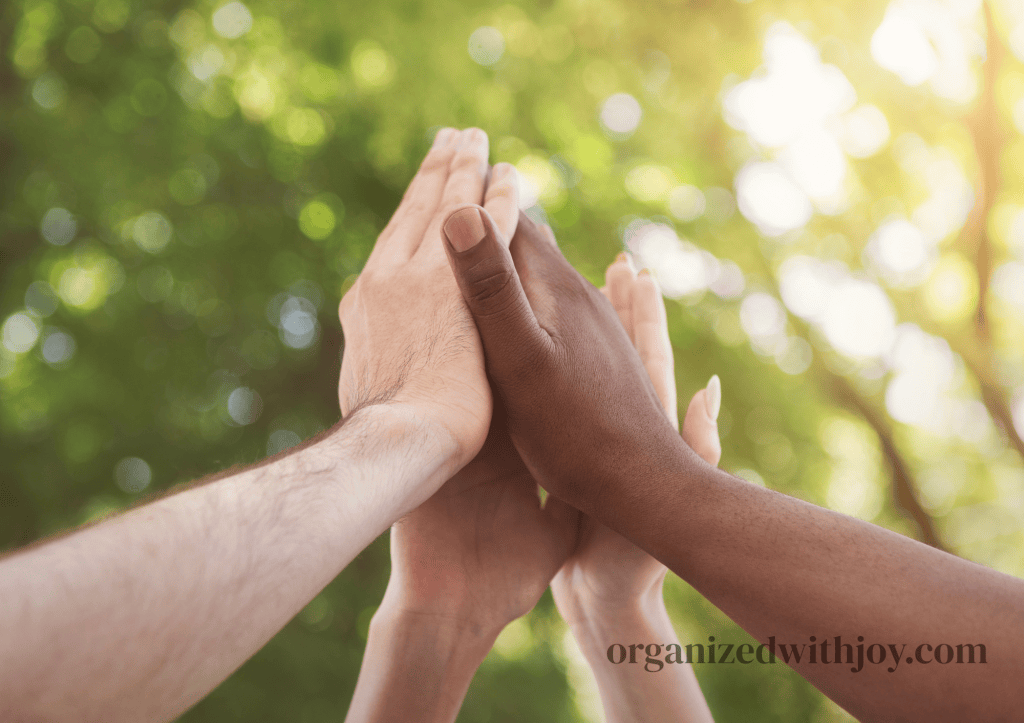
I wanted to talk about what this looks like in practice. There are a variety of ways we can support others. First, we can celebrate others’ wins, both big and small! We must do this without comparing ourselves. When we begin to compare ourselves while supporting, envy or resentment can creep in. Keep the focus on the other person! We can also support others by showing up consistently – offering a listening ear, encouragement, or advice. A true friend is available consistently, not just when it’s convenient. Another thing we can do is to offer specific and genuine compliments. Notice something specific about their success and give a compliment. A generic “good job” doesn’t feel as authentic as saying something like, “I love how you handled that.” We can also be a safe space for someone who wants to process something in their lives – if they are having a hard day, or if they want to express excitement and joy for something going on.

I do think this can be a difficult thing for some people because they believe that someone else’s success takes away from their own wins. But here is what people often miss: some people lift others up so well that they forget themselves, or they quietly turn down their own brightness so they don’t make anyone feel uncomfortable. Because of this I want to encourage you to also not dim your own light!

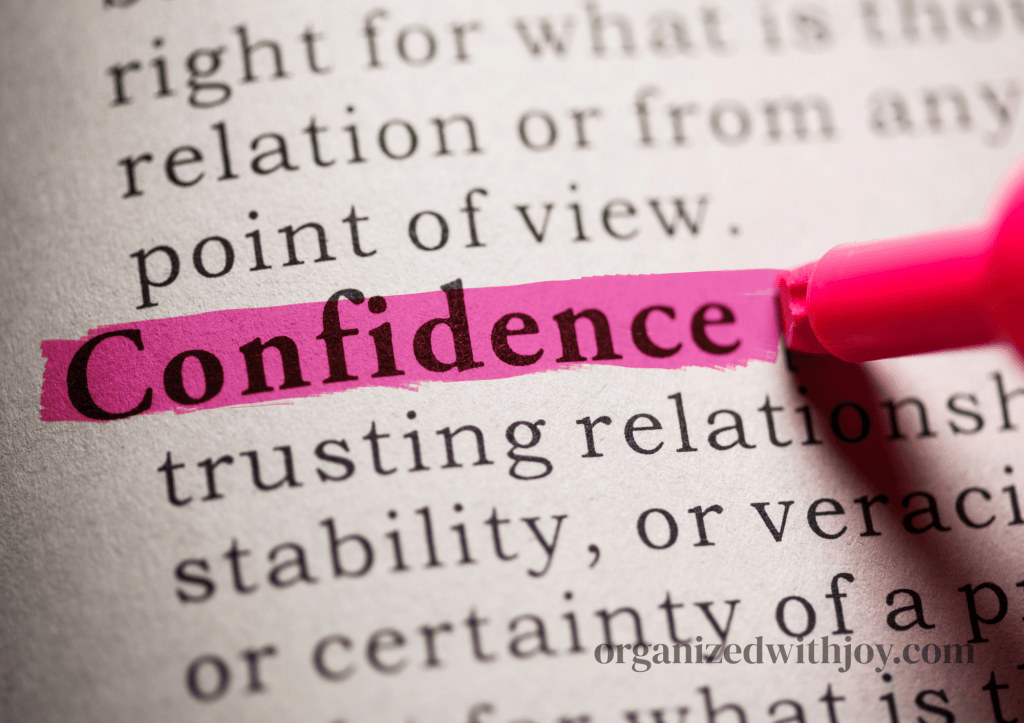
Dimming our light shows up in different ways. It may be downplaying your achievements, staying quiet with a good idea, not sharing your own wins, hiding your own passions, or shrinking to keep the peace. If you think about it, dimming your own light doesn’t make someone else’s light brighter, it only makes the room dimmer. When you are fully yourself, not only are you true to yourself but it actually gives others permission to be authentically themselves as well. Some people think confidence is arrogance, but it actually isn’t. If you look at the definitions, you realize there is a difference. Confidence is a feeling of trust, a firm belief in one’s abilities, and a strong sense of certainty that something (or you) are reliable, while arrogance is an overbearing, insulting attitude of superiority or self-importance. You can be proud of yourself and proud of others at the same time.
Lifting others up and shining yourself aren’t opposites. Instead they work together. Have you ever been to a Christmas Eve candlelight service at church? If not, let me just paint the picture. One person has a lighted candle, then that person passes the flame onto the person next to them, and then that person passes it on to the person next to them, and so on until the entire room is illuminated with lights from the candle flames. It’s actually quite a spectacular sight to see. But I thought of this when thinking about supporting others. It doesn’t take away any light from your flame to light the wick of the person next to you. In the same way, it doesn’t dim your light to cheer others on! Instead passing on the light only makes the room brighter as each additional candle gets illuminated.

Okay, so I have a couple of different challenges for you this week. You can do one or both. I challenge you to encourage one person this week. Not just saying, “good job” but sharing a specific and genuine compliment. The other challenge I have for you is to do something that is unapologetically you. Share the idea, wear the outfit, take the compliment without deflecting. Do something that leans into your own identity proudly. Lift other up, show up as yourself, the world needs both!

TRUST THE PROCESS

Have you ever felt like others have life figured out while you are still struggling? You feel like some sort of instruction manual must have been passed out at adulthood and you missed that line. Or maybe you just generally feel behind in life. You feel you should be further along. You look at your peers and feel like they are succeeding and progressing in life while you feel stuck. I’m here to tell you that this is more common than you think. Feeling off track or experiencing failure in life is not the exception. So many people feel this way. We often just don’t see the behind the scenes work it took someone to get to where they are today. And what if these failures and side tracks are not detours from your path, but rather the path itself?

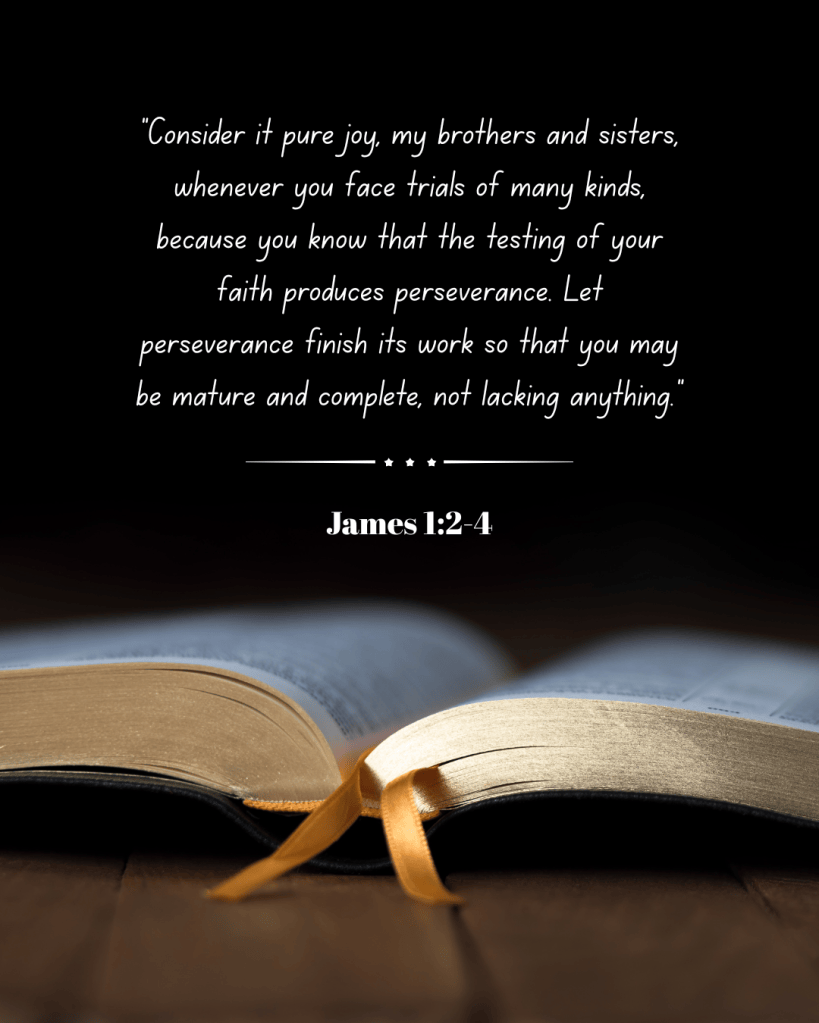
Y’all, lately I have felt stuck. Just waiting in a holding pattern to execute our move. (We will be moving from Austin, Texas to the Pacific Northwest next spring!) But I am trying to reframe this time of life as part of my path that I need to be on. I fully recognize that the struggles, setbacks, and “wasted” seasons are often building something in us that we will need later. As I look back over my life and evaluate the hardships and failures I have endured, I also see the strength of character that was built in me through those experiences. Since I am currently kind of obsessed with gym life, I will use the analogy of growing muscle. In order to build muscle, it must be broken down first. As you lift weights it stresses those muscles fibers and actually breaks them down so they can get stronger and grow. And being all in on gym life, I can tell you that this is a very slow process! It does not happen overnight and it may take years to get to where you want. I also want to share a Bible verse that has encouraged me when it comes to trials in life. It is in James 1, verses 2-4 “Consider it pure joy, my brothers and sisters, whenever you face trials of many kinds, because you know that the testing of your faith produces perseverance. Let perseverance finish its work so that you may be mature and complete, not lacking anything.” This reminds me to reframe the trials of this life as something that is producing perseverance which ultimately will help me to grow.


I think one of the biggest reasons we question where we are in life when we feel behind or have experienced failure is because we compare ourselves to the journey others are on. I think this has become much more prevalent with the origin of social media and how pervasive it has become in our lives. Often we are comparing our behind the scenes to someone’s highlight reel. In addition to that, I truly believe that we are all on our own unique journey. Everyone’s timeline, lessons, and path are different. Someone else being “ahead” in your eyes says nothing about your own pace and purpose. So trust the process! Instead of saying to yourself: “Why am I behind?” reframe this with “What is this preparing me for?” Replace your thought: “Why do they have it (whatever you want that you see someone else have)?” with “This is my own unique path, not theirs.” Another Bible verse that is encouraging with regards to this topic of comparison comes from Galatians 6:4-5, “Each one should test their own actions. Then they can take pride in themselves alone, without comparing themselves to someone else, for each one should carry their own load.” We really weren’t designed to be exposed to so many people’s lives, but because of social media we see all kinds of people’s lives, creating more opportunities for comparison. But if we take the advice of this Bible passage, we must focus on our own journey.

I know all of this is not easy. Particularly if you are currently in a difficult season of life. But what if the thing you are going through right now isn’t a set back, but instead a set up? Focus on what you are learning in this season, and think about what it might be setting you up for! Which could give you the hope for the future you need right now. Can you think of something specific that you could do today if you are in a season of feeling stuck or set back? Perhaps you could journal about what this season is teaching you, or you could let go of comparison by saying (maybe even out loud) when you are comparing yourself to someone: “I am on my own unique and beautiful path and it’s okay it’s not like theirs.” Or maybe even unfollow those who make you feel discouraged. Even in a season of stagnation or failure, we can look for the silver linings and enjoy each moment of our lives. All we have is the present! When we focus on the past we feel regret, when we focus on the future we feel anxious. Focus on what is right in front of you today and view each day as a blessing! Because no matter where you are in life, if you woke up and are breathing, that is a blessing!

This is the YouTube video I shared in conjunction with this blog post.

FEELING OVERWHELMED

Do you ever feel like no matter how much you do or how hard you work your to-do list just keeps growing instead of shrinking? It feels like having too many tabs open on your computer. It feels like dishes that keep piling up even though you swear you just cleaned the kitchen. It feels like laundry that never ends. Your chest feels tight, and if you paid attention you would notice that you are breathing quickly. It’s Overwhelm. We all have seasons where we are overwhelmed. Where it just feels like there is too much to do. Too much for one human to possibly ever get done. But most of the time this is just a season. Overwhelm is not a personal flaw, instead it is just a signal to us to evaluate how we are managing life.

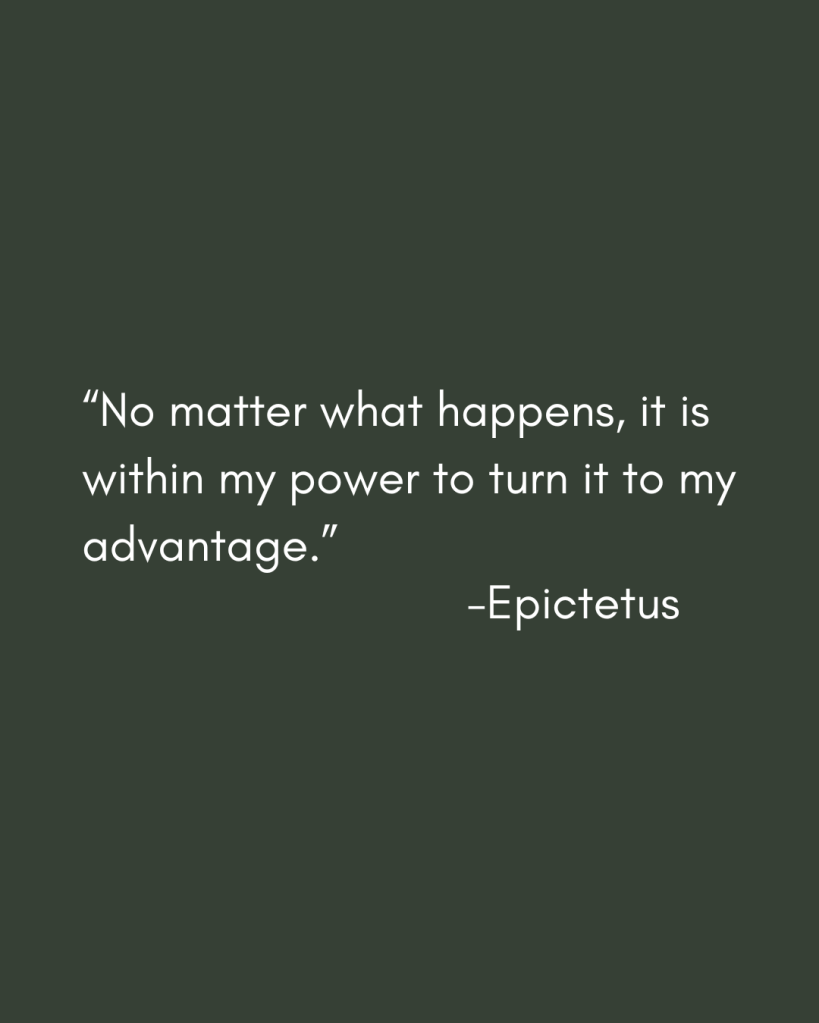
Experiencing overwhelm is a normal human condition. It often comes from trying to control things we can’t control, like people, outcomes, or timing. And sometimes that is in conjunction with neglecting to focus on the one thing we are in control of – our responses. There is a quote from one of the Stoics, Epictetus, that speaks to this. The quote says, “No matter what happens, it is within my power to turn it to my advantage.” This isn’t about pretending hard things are good, or pretending like this season is not hard at all. Instead, it is about choosing your angle. Shifting your mindset is always the key to dealing with a tough situation or season of life. Reframing your mindset helps you to see the good within the difficult situation. For example, with feeling overwhelmed – instead of crying and balling up in the fetal position, realize that the feeling of overwhelm is trying to tell you something. Maybe it is a signal that you need to set boundaries, acknowledging that you don’t have the bandwidth for everything that needs to get done. Are there things you can say “no” to? Or it could be signaling to you that you need to ask for help. Are there tasks you have on your to-do list that you could delegate to someone else?

There are some seasons that we just have more on our plates. I will often write about a topic that is relevant to me at the moment on these Thursday posts. I’m speaking to myself just as much as I am trying to encourage you! I have definitely felt the overwhelm creeping in as we get closer to our move. For those of you who don’t know, we currently live in Austin, Texas but one of our sons lives in Portland and we are planning to move to the PNW within the next 6 months. I feel pretty overwhelmed by everything that needs to get done before that move. But I recognize that part of feeling overwhelmed is my brain thinking I must do everything at once. I have tried tricks like making a list, but I am still feeling that pressure because all of the things that need to get done are not simple nor are they fun! But I just keep reminding myself to just keep working on a little bit every day. When I work with clients who feel overwhelmed in their spaces I remind them of that saying: how do you eat an elephant? One bite at a time.

Sometimes when we are in a crazy busy season it can be more overwhelming to write everything down. Instead I wanted to give you some specific things you can do to feel more grounded if you are in a season of overwhelm. I am going to implement these ideas as well. First, continuing any daily healthy habits you have in your routine. This can keep you grounded in general. Things like daily walking, exercising, drinking plenty of water, and/or spending time in prayer or meditation. All of these things help to reset our nervous systems. Something else you could do is write down specific micro actions you can take today or this week instead of writing out the entire to-do list. Like I mentioned, we can only eat an elephant one bite at a time. Taking those larger, less manageable tasks and breaking it down into micro tasks can make it feel less daunting. Lastly, you can name one thing that is within your control today. Being reminded of what you are in control of can go a long way to helping you reframe. Even in busy seasons of life, we can embrace that it is within our power to turn it to our advantage. If this resonated with you or you have been feeling overwhelmed lately, let me know what ideas I shared today will you implement to help you navigate this season of life!

Here is the YouTube video I shared in conjunction with this blog post!

FINDING COZY WITHIN MINIMALISM

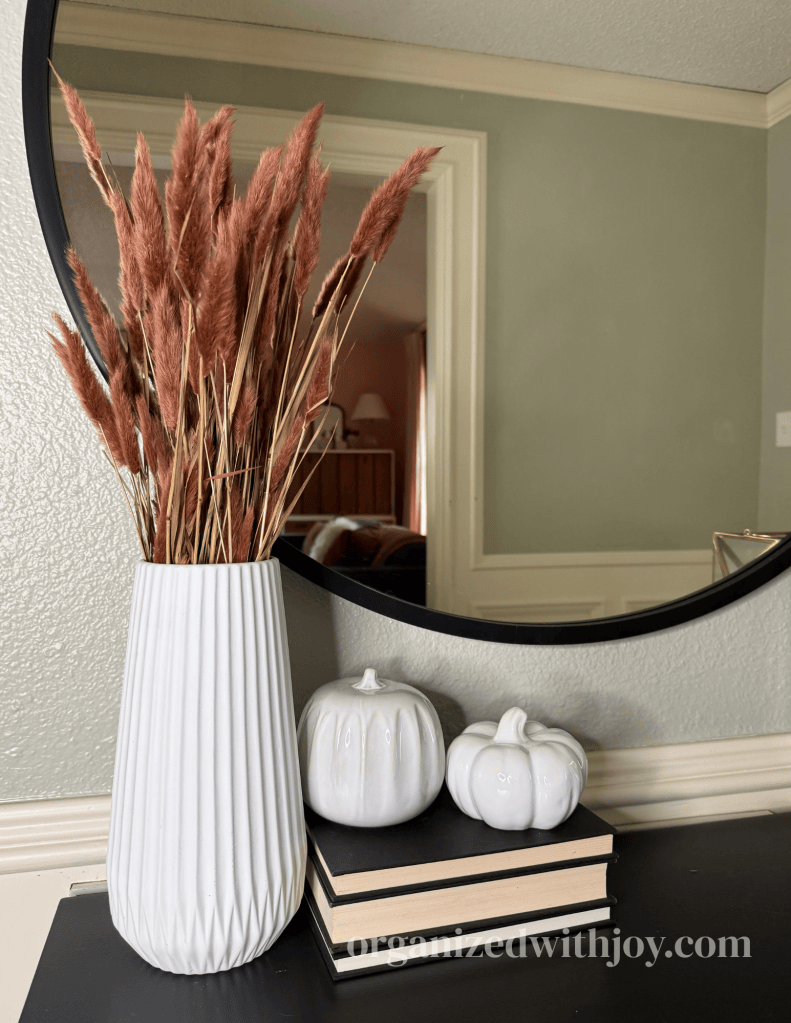
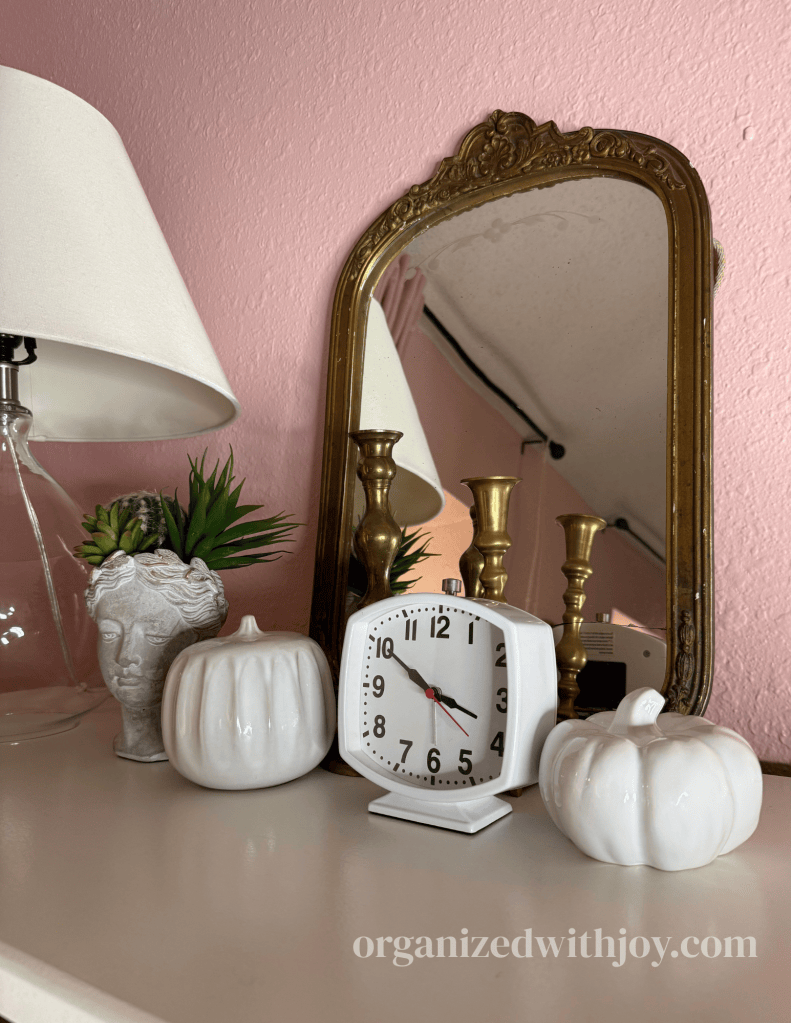
Fall is my favorite time of year. Perhaps it’s because I have lived in Austin for almost 25 years and fall signals the beginning of cooler weather – a much needed reprieve from the months of oppressive heat. But fall is also the time of year we can embrace the cozy vibes. Warm coffee, cozy blankets, fuzzy pillows, and fragrant smells of fall baking and fall candles.This is the time of year that can be so tempting to get caught up in the current of consumerism. It starts with the beginning of the school year – new clothes, new shoes, school supplies, then trickles into new fall decor, new candles, Starbucks new fall flavored drinks. Then we roll into the holidays – Halloween, Thanksgiving, and Christmas. With these come more spending. We all want our spaces to feel cozy! But today I want to talk about something I’ve wrestled with for years: how to create spaces that are minimal and cozy. Some of this spending is inevitable. But I do think we can create cozy homes with what we have.

When I first started pursuing minimalism, I thought, “I could never be a minimalist.” I love decorating our home and making it feel inviting — that didn’t seem to fit the minimalist mold or minimalist aesthetic. I have been pursuing minimalism for over a decade, and I’ve realized minimalism isn’t one-size-fits-all. There’s no single definition, no box to check. To me, it simply means living with the things I use and love. With that in mind, here are the ways I keep my home cozy and inviting while still leaning into minimalism.

Finding the balance is one of the most important things. Balancing minimal and cozy hasn’t come naturally — I love decorating, but I don’t want my spaces to feel cluttered either. For me, it’s been a process of trial and error: setting up decor, living with it, and deciding if it feels right. The longer I’ve pursued minimalism, the easier that balance has gotten. And over the years I have found I actually enjoy a more minimally decorated home. Each person needs to find the balance that works for them!

Rotate instead of accumulate is something that has helped me on my minimalism journey when it comes to decor.  I do have holiday pieces like my stash for fall and Christmas, but most of my decor could work year-round. I have found just rearranging it for a new look helps curb my decor shopping. Moving pieces to a different room or setup keeps things feeling fresh without adding to my collection of decor. I also lean toward decor that transitions well across seasons, so I’m not packing everything up every few months.

Cozy isn’t always about stuff.  One of the biggest shifts for me has been realizing that cozy doesn’t have to mean more things — it’s a feeling you can create. This is the idea behind hygge (pronounced “hoo-gah”), a cultural practice that originated in Denmark and is embraced across the Nordic countries. It’s centered on engaging the five senses: layering different textures with pillows and blankets, using ambient lighting, playing calming music, lighting a candle, running a diffuser, or having something baking in the oven. A home-cooked meal or a warm loaf of bread can make a space feel cozy all on its own. Cozy minimalism is also about the people in the room. Creating a space where friends and family feel welcome — prioritizing conversation, hugs, or curling up together under a blanket — often does more for that inviting feeling than any object could. If anything, too much stuff can get in the way of those moments.

Order creates calm in your home.  A cozy space is also an orderly one. Clutter in our physical space tends to create clutter in our minds, and that’s not exactly peaceful. A clean, tidy space naturally feels cozier — and that’s a lot easier to maintain with less to take care of in the first place. When I first started exploring minimalism, the sparse, stripped-down spaces I saw in blog posts and videos didn’t appeal to me at all. But I’ve learned there’s a real balance to strike — and that minimal and cozy can absolutely coexist. I’d love to hear from you in the comments! Are you working toward that same balance between minimal and cozy? Or how do you make your space feel cozy for fall?

Here is the YouTube video I shared in conjunction with this blog post.

WHEN EGO RUNS THE SHOW

Do you ever catch yourself needing to be right about something? Or needing to win an argument that didn’t really matter? Or maybe craving recognition for something you did? We all have these moments. This is our ego rearing its head. Our ego is not inherently a bad thing. It’s actually a survival mechanism built into us. The problem is when our ego starts running the whole show instead of being just one factor that drives our behavior.

I wanted to talk about this idea of the ego and how we can work to tame it so to speak. One of my core values is humility, but I often struggle with this living in the type of culture we live in now – with social media being so pervasive. First, let’s talk about what the ego is. A lot of people think ego is vanity or arrogance, but in reality it’s more of a mental construct of “self” that needs protecting, proving, and comparing. The job of our ego is to defend our image, seek validation, and avoid being wrong or feeling small. In our own heads, the ego convinces us that we are “the ego” side of us and so we tend to not evaluate its motives.

It is all too easy to allow our ego to quietly run our lives. The ego operates in several different aspects of our lives. It is present when we are having conversations, wanting to listen to respond rather than listen to understand. It is present in our decisions and can sway us to make decisions that make us look good or make it seem like we are doing the right thing or what others would approve of instead of what is actually the right thing to do. The ego operates in our relationships. It is that side of us that needs to be right in conversations and holds grudges to protect our pride. It also shows up in our work or achievement – causing us to chase status and recognition over meaning. And the ego is especially present when we are challenged as we react to criticism. It tends to cause us to have a defensive or emotional response rather than actually evaluating the criticism to see if there is something we need to work on or change.

It can be very difficult to pay attention to these ego responses and to push against them where necessary, actively seeking to live a life of humility. Humility is hard. Especially in our culture where so many people share their highlight reels and something so simple can get you “cancelled.” Humility requires putting the self down for a moment, while social media rewards the opposite. Social media platforms are actually engineered around self-preservation, curated highlight reels, likes as validation, and therefore comparison built into the scroll. There is a feedback loop at play, which is why it is so difficult to get perspective and really question the ego. It goes: you post something, you get validation, this reinforces your ego, which leads to the need for more validation, so you post again. Even “humble-bragging” or performative humility gets absorbed by the ego – which is why it can be so sneaky! It even hijacks virtue! And the reality is, we have all resorted to participating in this cultural noise: everyone is a brand, everyone has an opinion to share, everyone shows up as a “main character.” So if you don’t join this way of posting, where ego is driving, it can feel like you’re falling behind. The question I am often wrestling with as a content creator myself is how can I share in an authentic way that allows humility instead of my ego to lead? I feel like humility has a bad reputation. It needs a rebranding! Or at least a reframe. Humility is not self-deprecation or low self-worth. Instead it is an accurate self assessment! Having humility means being open-minded. Being willing to be wrong, to not know, or allowing someone else to be right. Humility is being curious and listening to others to understand not just to respond. Humility isn’t weakness, it’s being secure enough in the value you have to be okay if you aren’t right. Humility is quiet confidence over loud self-promotion which is anything but weak.

In order to live a life of humility, we must intentionally evaluate the motives of our ego. We must learn to practice self awareness and ask ourselves: “is this me or my ego protecting my image?” when we are challenged and tempted to just react defensively. We can look for opportunities to practice saying “I was wrong” or “I don’t know.” We can also pay attention to when we are mindlessly scrolling on social media, and particularly paying attention to when we are beginning to compare ourselves in the scroll. If we are having that reaction, maybe it’s time to stop scrolling. We can also pay attention to when we are seeking validation through posting on social media versus sharing to actually add value or make connections. Lastly, you can actively celebrate others accomplishments! Cheer others on, give compliments! I think one of the signs of a self-confident person is that they genuinely cheer others on!

The reality is the ego will never fully disappear. Like I said, the ego is there for a purpose – for our own self-preservation. The goal isn’t to eliminate the ego, but instead to be more aware of it and its motives. A humble life isn’t necessarily a smaller one, it just means that you aren’t performing for others or to seek validation. Instead you are living fully in your authenticity. Are there areas in your life today that you know your ego is driving? Are there any of these tips I shared that you could implement to help you become more self aware and allow humility to lead?

Here is the YouTube video I shared in conjunction with this blog post.


MINDFUL MODERATION

I was recently introduced to this Japanese practice Hara Hachi Bu, only eating until you are 80% full rather than 100%. Interestingly, Okinawa is located in one of the “Blue Zones” in the world, which is an area with usually higher longevity than other parts of the world. I find this a fascinating practice with regards to food for sure, but this philosophy of stopping before excess intrigues me. I find that this idea translates to all areas of life! It is the idea of mindful moderation.

The idea of stopping at 80% isn’t about deprivation. It could seem this way, but if you think about it in terms of food – often it takes a while for your brain to catch up to your stomach actually feeling full. If you stop at 80% it gives your brain time to catch up to feeling like you have had enough. Stopping at 80% really is less about deprivation and more about leaving margin in your life. In all areas of life, satisfaction does not equal saturation. We live in a time that pushes the idea of saturation. The other day my husband, son, and I were talking about how much entertainment is available to us these days. It is difficult to choose what to spend your free time on sometimes because of how saturated the entertainment world is now. In general, our culture glorifies the idea of “more,” “full,” or “maxing out.” If you are on social media, you are constantly being exposed to “more.” Just one more Reel, just one more Tik Tok, just one more minute of scrolling. And on social media we are exposed to so many lifestyles and things that it can make us crave more in our own lives.

Like I mentioned, this idea of 80% can be applied to all areas of life. In work or ambition, we can stop at “good enough is good enough for today.” Instead of grinding until we are depleted, we can work to 80%. I know I have experienced this with homemaking. I have had to learn the art of progress over perfection and allowing my work to be “good enough” sometimes instead of constantly pushing myself to do things even when I don’t have the energy or bandwidth that day. This can also be true with screen time or taking in information. It is all too easy to “doom scroll” – scrolling until you’re numb. It is especially difficult to put boundaries on this since we know from research that scrolling on social media is an addictive behavior. We must learn to set and stick to our boundaries with regards to social media, news, and other media intake.

Another area where mindful moderation is helpful is in our spending and consumption habits. If you have been around a while, you know I have done two no buy years. I have also done multiple no buy months. The reason I did this was to practice this idea of mindful moderation when it comes to bringing things into my home. Implementing this idea has helped me tremendously on my decluttering journey. As we slow the inflow of things coming into our homes, we begin to see the progress of our decluttering instead of just purchasing more as we declutter.

Even healthy things should be done in moderation. Exercise is a good thing, but training at 80% effort instead of training to exhaustion can help with remaining consistent and avoiding ultimate burnout or even injury. Socializing is another positive thing, but it is another area of life where 80% would be beneficial. You can leave gatherings while you are still enjoying them rather than staying until you feel drained. On social media, you can turn off notifications so you do not constantly feel the need to respond to every comment and DM. Giving yourself time away from people to recharge, especially if you are an introvert, is important.

The idea of 80% can also be translated to speaking and sharing opinions with people. Instead of dominating conversations with what you want to share, learn to leave room for listening. Actually listening to others’ ideas and opinions and not listening just to respond. Lastly, related to relationships is the area of emotional reaction. We all have reactions to certain situations and confrontations with people in our lives – our spouses, family members, friends, and co-workers. It is human nature and natural to have an emotional response to certain things, but if we apply this idea of 80% – responding at 80% intensity, this leaves room to de-escalate. 

The idea of mindful moderation works well because of the psychological lag in recognizing “enough.” For example, like I mentioned, our brains take a while to catch up to how our stomach is feeling with regards to food. But this is true in other areas as well, like dopamine or even fatigue. If we stop at 80% it gives the brain time to catch up to realizing that is enough. It is better to undershoot – in all areas of life, then to overshoot and risk burn out. Also, focusing on 80% is more sustainable. When we shoot for 80% instead of 100 it feels more do-able and therefore we are more likely to follow through consistently. Moderation is a long game strategy that will help you remain dedicated day in and day out.

Can you pick one area of life this week to consciously stop at 80%? Maybe it’s with food, or your phone, or work. Reflect on where you stopped and how you felt stopping there. Remember those people who implement the Hara Hachi Bu practice are known to have longevity, which is likely also linked to well being in their lives. Mindful moderation is less about restriction and more about restraint as a form of self respect. 

Here is the video I shared in conjunction with this blog post.

DEALING WITH NEGATIVE PEOPLE

Do you ever leave a conversation feeling completely drained – emotionally or mentally or both? I know your answer could be dependent on your personality type. If you are an introvert, being with people generally drains you. But I’m talking about being around those people who are negative and emotionally exhausting. This type of person can drain even the most people oriented extrovert! There are some people who struggle with viewing things from a negative light and often bringing others down with them. As someone who practices the Christian faith, I believe we are called to love all people. Maybe we are especially called to love those who are going through difficult things in life. But loving others, even those the closest to us, does not have to mean absorbing their emotional state. I think people can confuse true empathy – which is being present with someone in their pain and enmeshment – which is being pulled into their emotional state.

Empathy is a good thing. I have done a lot of research on empaths, and I really think this type of person describes me. Knowing that I am an empath has helped me tremendously as I have navigated what that means and how I can train my empathetic tendencies for good. When you don’t realize you are an empath, or you realize it and don’t work to train your heart and mind you can be susceptible to morphing your emotional state to match that of the person you have empathy for. Typically what this looks like is your energy shifts to that negative energy or you feel obligated to fix their mood. This heaviness can quickly cause your own mood to spiral. I have learned that I can have empathy for others without allowing their mood to dictate my own mood. I can protect my own peace, while being there for them in their time of need. 

You can hold space for someone without getting wrapped up in their emotional storm. I think of it like the waves of the ocean. Their mood is the waves that are ever changing – you can get caught up in that or you can be like the shore – strong, steady, unchanging, and present for them. Arguably, loving someone well looks more like being grounded for them, not matching their negative energy. I know this can be so difficult, especially if you do feel like you are an empath. You might get tired of hearing me say this, but I do feel like when you have healthy habits of your own it is much easier to deal with this sort of situation. It is easier to be more emotionally well regulated when you have proper sleep, hydration, nutrition, and exercise. I have to share with you, ever since I have changed my diet and have been counting my macros, eliminating alcohol, and being more intentional with getting my steps in I have noticed I am more clear minded and able to regulate my emotions better, even amidst perimenopause!

In addition to having your own healthy habits, there are other practical things you can do in the moment when dealing with a negative person. The first thing you can do is to have a mental phrase prepared ready to speak to yourself in the moment. You could say, “I can care about this without carrying it.” or “Their emotions are not my emotions. I can be empathetic while also staying grounded.” Something else you can do is to be hyper aware of your physical state when you encounter someone negative. Are your shoulders tensing up? Intentionally relax them. Is your breathing speeding up? Slow your breathing down. Is your jaw or fists clenching? Pay attention to these cues and unclench them. Lastly, you can have a script ready that enforces your boundary with someone when you have had enough and need to exit a draining conversation. That could be something like being direct and saying, hey can we pick up this conversation at a later time, I’m starting to feel emotionally overwhelmed. I want to be there for you in your time of need, but I want to make sure I’m fully emotionally present for you. Or it could be a redirection of the conversation. Being aware of your vulnerability towards absorbing their energy and then being prepared for what you can do in the moment can make all the difference. 

It may feel selfish to want to protect your peace and your positive mindset, but it is far from selfish. Like I mentioned earlier, loving people well means staying grounded FOR them. When you match their energy, you can’t be as level headed and present for them. Over time, consistently absorbing others’ energy leads to emotional burnout and that is good for no one! Not for you, or those around you. There is a bigger purpose at play and protecting your own peace actually helps those who need you. At the beginning of this message I asked you if there was someone who drained you. Who was that person you were thinking of at that moment? Can you love that person from a more grounded place? Dealing with negative people requires us to be aware of our tendencies towards enmeshment, and flipping that to true empathy and being present for them.

Here is the YouTube video I shared in conjunction with this blog post.

INCONVENIENCES

Picture this, you are on your commute to work and suddenly traffic stops. You hear sirens coming and up ahead you can see there has been an accident. What are you thinking? What are you feeling? Are you irritated that this will inconvenience you? That this will make you late to work, you might start your day feeling behind, your boss might yell at you for being late. Inconveniences in life can cause our blood pressure to rise and stress to settle in. But you could choose a different mindset at this moment. Yes, I said choose. We may have an immediate negative reaction to inconveniences, but we don’t have to stay there.

What if instead of getting irritated and stressed in this moment you thought about how lucky you are that you were not the one in the accident that morning? That person in the accident likely is much more inconvenienced. They may be badly injured, perhaps causing them to miss days or even months of work while they recover. Or worse, they may have lost their life. It is easy to get frustrated when we are inconvenienced, but it is just as easy to shift our mindset to a more positive outlook. I saw a post on Instagram that said, “That 30 minute workout you hate? Someone’s in a wheelchair dreaming of it. That meal prep you avoid? Someone’s scraping together money to afford their next meal. That rest day you call ‘annoying’? Someone’s body is shutting down. Taking care of your body isn’t a chore, it’s a privilege.” It’s all about mindset!

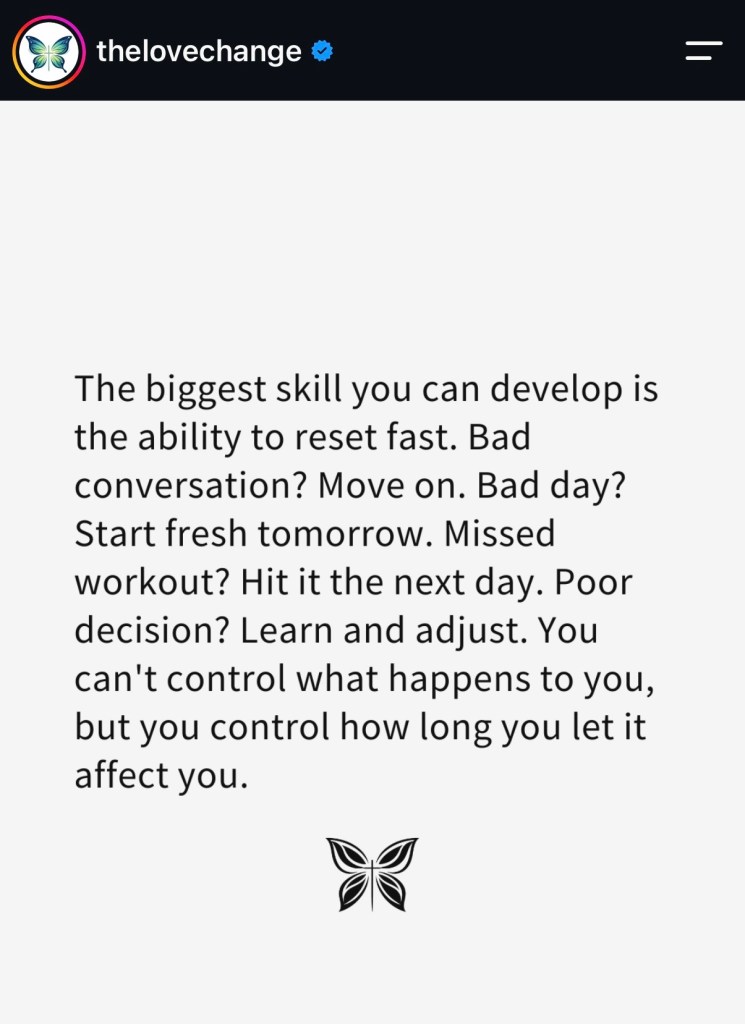
The traffic example I gave is a slight inconvenience, but I think even with bigger inconveniences we can have a more positive mindset and not let these things ruin our day or even week! Another post I saw the other day on Instagram said: “The biggest skill you can develop is the ability to reset fast. Bad conversation? Move on. Bad day? Start fresh tomorrow. Missed workout? Hit it the next day. Poor decision? Learn and adjust. You can’t control what happens to you, but you can control how long you let it affect you.” I wholeheartedly agree with this! It is natural to feel annoyed or frustrated at inconveniences or when things don’t go your way. But you do have the choice to dwell in that feeling or to choose to have a more positive outlook.

When life throws you a big inconvenience, it may take more than a moment to readjust and see the silver lining. I realize this is subjective. What is a big inconvenience to one person may not seem as big to another. But if it feels big to YOU, then it is big. There are things in life that are big curve balls. Things you did not expect or want to deal with. These things take time. Often with big inconveniences, we have to recalibrate. This often involves grieving. If nothing else you may be grieving the life you thought you would have or the person you thought you would be at this point in life.

When our kids were young, my husband and I would talk about how crazy it would be that we would be empty nesters at the age of 47. Here we are four years later and we cannot really call ourselves empty nesters yet. Currently two of our three adult children are living with us. Our oldest daughter is in a grad school program and living with us to save money as it is very expensive to live in Austin and she is paying for her grad school without debt. Our youngest son is still living with us as he just needs some extra time to grow and be ready to live on his own. This was unexpected. At first I really struggled with grieving what I thought my life would be at this age. But I was able to grieve that, and realize what a blessing it was to have extra years with two of our kids. It especially hit when our other son moved away, not just out of our house but out of the state! I appreciate the extra time I have with my two other kids! It has also been a mercy in a sense for me to ease out of being a stay at home mom. I’m still able to cook dinner for the family a few nights a week and help my kids with things.

My perspective now is that inconveniences are part of your path. When something happens that seems annoying, I like to think of it as protecting me and keeping me on the path I was meant to be on. Call it God or call it fate, or the universe… but I do think things happen the way they are supposed to happen for our higher good. Even when things seem bad in life, all circumstances can be used for good – to help us grow and become better versions of ourselves! 

Here is the YouTube video I shared in conjunction with this blog post.

LESSONS & OPPORTUNITIES

We are almost halfway through the year, and many of us are probably evaluating the first half of 2026 and what we have done. We may be pondering if we have accomplished any goals and/or if we are working our way towards those goals. Some of us may have given up on our goals long ago, but even if we gave them up we are likely still thinking about them. Perhaps even feeling a sense of guilt or shame that we have not stuck to our habits to achieve our goals. Today I wanted to remind you that when looking back, don’t have the mindset of guilt and shame if you are not working towards your goals. Instead have the mindset of the past being a lesson for you. This is how we learn and grow and do better in the future. Our past is just lessons, and our future is opportunity. When we have this mindset, it allows for a positive perspective which leads to growth.

It is easy to get discouraged when you fall off the wagon with your goals and discipline, but my mindset is that every day is a new day to start over! Many people tend to completely give up when they don’t follow through perfectly, but as I frequently say: focus on progress over perfection. Perfection really isn’t sustainable, so learning to push through after a failure is important. Your past failures don’t define you as a failure, your past failures teach you. Every stumble was just a course correction in disguise. Instead of focusing on the failure, and potentially labeling yourself as a failure, ask yourself what that season taught you. What did it teach you about your strength, your values, and your blind spots? When you use your failures as a point of reflection, it turns into a positive and will help you to grow. The goal isn’t to forget where you have been and how you have failed, but instead to evaluate it and extract the wisdom, then keep moving!

Just like past failures don’t have to define your overarching story of life, the future is not something to worry about or fear. The future is not a threat, but instead it is a blank canvas of opportunities and you hold the brush! You are in charge of every decision moving forward, and that is empowering! Every goal you have is a possibility waiting to happen. Don’t fear failure, don’t be overwhelmed by the big picture, instead focus daily on what small steps you can take today to move towards your goal. Stop focusing on what could go wrong and instead focus on what could go right! Having a positive mindset, acting as if things will go right will help you more than you know! When you think things will go right, your brain will be looking for evidence that things will go right! There will always be uncertainty and set backs, but keep a positive mindset always looking for the possibilities.

Right now, THIS MOMENT is where lessons become decisions and opportunities become reality. You can ignore the lesson and keep falling down the slippery slope. You can tell yourself that you failed, so why keep trying. OR you can make a different decision TODAY. One honest look at where you have been and one brave step towards where you’re going is all it takes! That is the whole formula! This Thursday ask yourself: what lesson am I still carrying that I haven’t used yet? And what opportunity am I standing in front of right now? You didn’t come this far to stay stuck. You came this far to grow! So grow!

This is the YouTube video I shared in conjunction with this blog post.

OVERRIDING YOUR NERVOUS SYSTEM

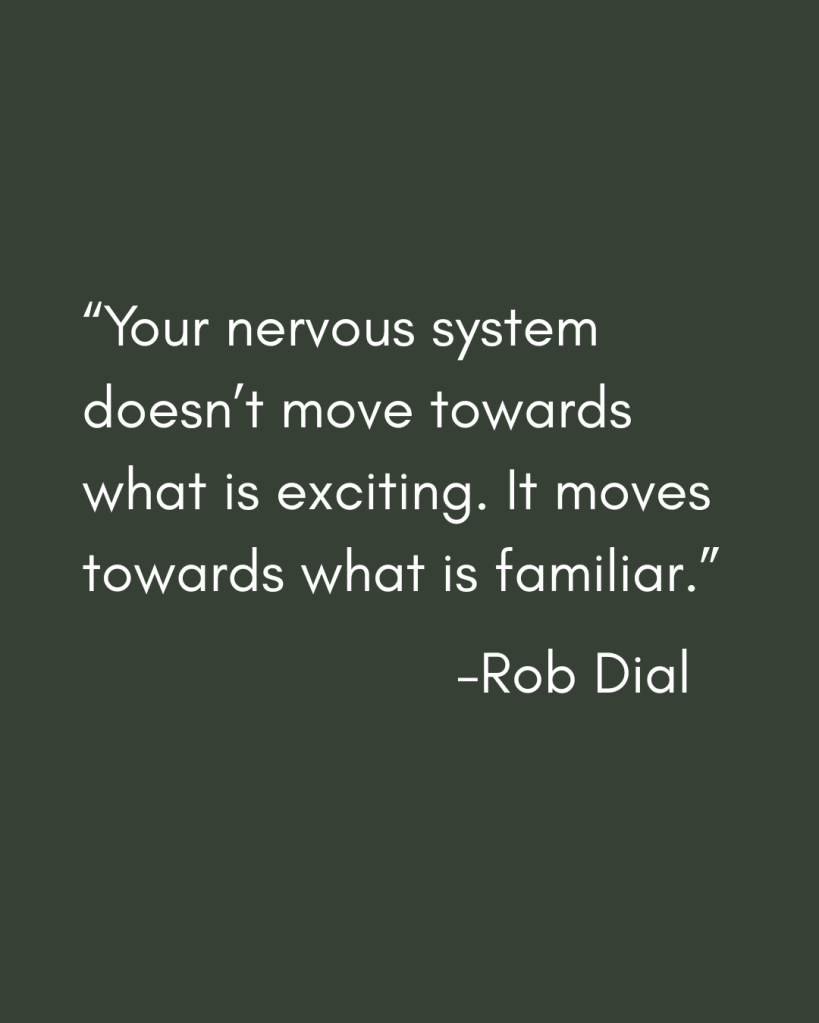
This week I heard a quote from Rob Dial, a motivational speaker on social media, “Your nervous system doesn’t move towards what is exciting. It moves towards what is familiar.” This quote really resonated with me. For much of my life I have struggled with anxiety and clinging to the familiar to ease my anxiety. It made me think about how many people think they are chasing goals, but the reality is they are chasing comfort or familiarity.

Our nervous systems are created to inherently prefer the familiar because predictability equals safety. The brain is designed to save energy and it is always looking to automate recurring experiences to conserve cognitive load. It is constantly searching for known patterns, even if they are uncomfortable or unhealthy, because the unknown is processed as an unpredictable threat. Familiar stimuli require less mental processing, which is easier for the brain, therefore it registers as positive and safe. The amygdala, part of the brain that detects threats, is wired to anticipate the future based on the past. If you survived a familiar environment or dynamic, your nervous system will naturally steer you back towards these same familiar patterns in order to guarantee survival, regardless of whether the experience was objectively healthy or not. Repeated behaviors and emotional states become encoded in the part of your brain called the basal ganglia, which controls voluntary motor control, procedural learning, and reward-based decision making. This wiring can become very ingrained and incredibly difficult to break and retrain.

Since the nervous system equates unfamiliarity with danger, attempting sudden or big changes can trigger the fight- flight response. You can break the loop by gradual exposure. When you introduce micro steps, it makes change more manageable and your brain is more easily able to process the new in your routine as safe. This can be something as simple as visualizing that scary thing you want to do, then take one small action towards this new thing, then keep taking small steps towards your ultimate goal. You can also practice somatic regulation. This is just consciously calming your body when you begin something unfamiliar. You can do things like box breathing or paying attention to your 5 senses to ground you. This is a signal to your nervous system that everything is okay and you are not in danger. You can also consciously remind your brain that the discomfort you feel is normal for someone trying something new, and is not actually dangerous. We must continue to expose ourselves to the unfamiliar over and over again to get used to that feeling of being in a situation that feels scary because it is unfamiliar. Over time this gets easier and you are able to do more and more exciting things! Ultimately, familiarity is built over time, it is not innate. 

Because our nervous system tricks us into wanting to stay comfortable, we must recognize that if we want change in life, it’s not always necessarily about more motivation or more discipline. What we really need to focus on is creating that familiarity in our lives. Once we have that mastered, we are actually able to move towards the exciting!

Here is the YouTube video I shared in conjunction with this blog post.