NO SPEND YEAR IN 2025?

Okay friends, for today’s Thoughtful Thursday post I decided I wanted to talk about some of my ideas moving into the new year. This will be the final Thoughtful Thursday of the year because I will not be posting the week of Christmas. My son will be in town and I want to just focus on enjoying time with family that week!

So, in case you didn’t know this, I just turned 50 last month and I feel like it has caused me to really evaluate life. Well, really I have been quite introspective over the last 5 years or so. I have been constantly evaluating how I spend my time, energy, and resources. And I have done a lot of challenging things to intentionally push myself outside of my comfort zone to try to become a better person. I recently watched a documentary on Netflix entitled Buy Now. It is all about consumerism in Westernized culture and how marketing has gotten so specific with the rise in popularity of social media. One thing I have shared in the past as a decluttering tip is to be mindful not just of the outflow but also the inflow. You can do a ton of decluttering and consistently make that a part of your everyday or every week routines, but if you continue to bring things into your home it will feel like you have not made progress.

As I was watching this documentary I was evaluating my own recent spending habits and decided that I would like to make some changes. If you have been following me on social media you might know that I did a lot of traveling in 2024. Because of those trips, I purchased more clothes this year than I have in many years. Back in 2019, I decided to do a no spend year as a way to really deal with my spending habits especially with regards to clothes and home decor. I feel like I learned so much that year. I chronicle this experience here on my blog by writing a monthly blog post during that no spend year, so you can go back and read those. But this year, as I really evaluate things, I think some of those old spending habits have crept back in. 

Watching this documentary made me realize that some of it has to do with marketing, particularly on social media apps. I was talking with a friend about it and she also mentioned how easy it is to purchase things now through links – whether that is on a social media app or through an influencer. She talked about how all the “pain points” are removed. Oftentimes our credit card information is saved on our phone, or through Instagram, Amazon, or Google pay. Our name and address are also saved. We no longer need to enter all that information in and with one click we can have what we want.

So, with all of this said, I am considering doing a no spend year again in 2025! I haven’t fully decided if I am going to do this. I have also thought about alternatively “fasting” from something each month of next year. I’m still pondering all these details. If I do a no spend year, it will again be focused on clothes, shoes, accessories, and home decor. I will need to purchase things for fixing up our home, because there is a long to do list for home maintenance! One reason I thought about implementing this no spend year is because I remember one of the huge benefits of cutting shopping out of my life is how much extra time I had! I know that sounds a bit silly. But I am so bad at making decisions – deciding which color and which size and measuring to determine which size, and reading reviews, then often having to return things that didn’t fit. It just wastes a lot of time!

One thing I know about myself is that I am really good at keeping up with everyday responsibilities, and keeping up with healthy habits and routines, but when it comes to extra things that need to get done, I keep putting those on the back burner. Like I mentioned, there are a lot of projects that need done around our house that just take time to research and make decisions and I want to focus on that throughout this next year. Also, I truly thought I was done decluttering, but I am still noticing some things around my house that I could let go of. I want to continue to focus on decluttering our home and watching to see the difference it makes to mostly stop the inflow!

Let me know what kind of plans you have for the new year! I don’t necessarily like the term New Year’s Resolutions, but if that’s what you call them – let me know what yours are! Let me know what goals you have for 2025 or what ideas you have brewing for the new year!

Here is the YouTube video I shared in conjunction with this blog post!

5 BENEFITS OF MINIMAL HOLIDAY DECOR

Okay friends, for today’s Thoughtful Thursday I wanted to share with you the 5 benefits of having minimal Christmas decor. I thought this was a great topic for this time of year as we all begin to get our holiday decor out! And before I get into that, just want to make a disclaimer and say I fully appreciate people who like to go maximalist for the holidays! If you enjoy having an abundance of decor for the Christmas season and it works for you then go for it! I just wanted to share the benefits of less!

The first benefit of minimal Christmas decor is that it saves you time! It takes less time to put up the decor and it also takes less time to take it down. Around the holidays is such a busy time of year with extra obligations and events to attend. There is shopping, wrapping, filling out Christmas cards, holiday parties, and end of the season children’s events to attend! Not to mention the extra baking and cooking this time of year! Having extra time is always a good thing, but especially around the holidays!

The second benefit is that you are able to fully enjoy the items you have to display. With a curated holiday collection of decor, you are able to appreciate each piece fully! You are able to focus on quality over quantity, and each piece becomes that much more special. For me, an extra side benefit of this is that you are more intentional about what you purchase for holiday decor, not overspending on decor during a season where there is more financial burden than the rest of the year.

The next benefit of minimal holiday decor is it prevents overstimulation. The holiday season can be a season of overstimulation! This season is a time where excess seems to be acceptable – eating, drinking, socializing, gifts, and of course decor! All of this excess can be very overstimulating. We all have a different bandwidth for how much we are able to handle before we feel overstimulated. I admit that I think I have a lower threshold than most. But with less to visually consume each day, the less you will be stimulated. This is honestly true for decor year round! Overstimulation can lead to stress as well, so this also can prevent additional stress in what can be an already stressful season.

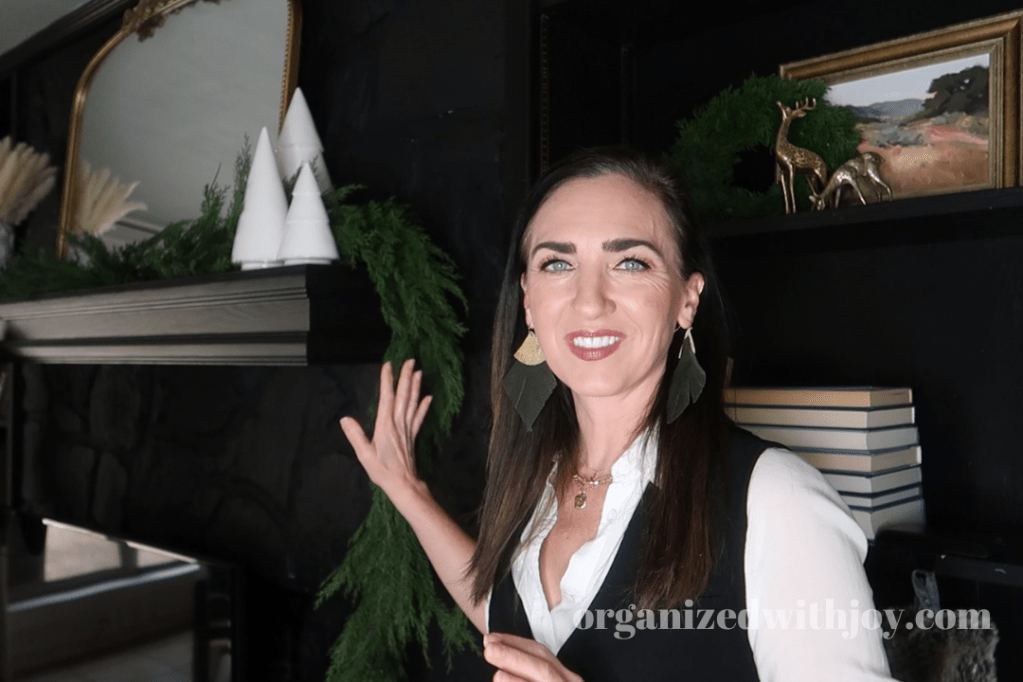
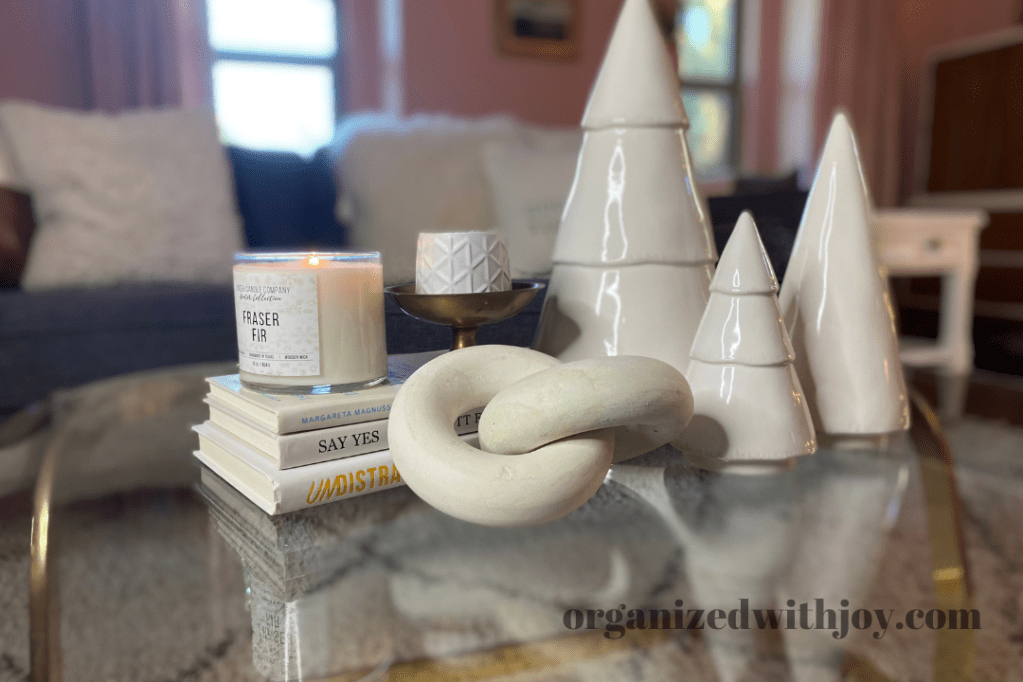
The fourth benefit is that minimal Christmas decor promotes creativity and personalization. With minimal decor, it affords you the opportunity to get creative. I like to arrange my holiday decor differently every year. This helps me to not be as tempted to purchase new decor each year. I like to find not only a different space to style my items around my home, but also styling them in a new way. I chose to style the white ceramic trees on my coffee table this year, which lead to me coming up with this whole white theme idea! Last year I styled these trees on my mantel {{see photo above.}} It also encourages personalization and uniqueness as you curate your collection intentionally and style it in a creative way. There is something to be said for being intentional with what you purchase and collecting unique pieces over time. 

Lastly, with minimal Christmas decor we are able to focus more on the holiday spirit – spending time with loved ones, enjoying holiday gatherings and traditions, or cooking and baking special holiday treats and meals. Focusing more on the essence of the season – family, friends, and memories, instead of getting lost in excessive decor will be more meaningful in the long run.

Here is the YouTube video I shared in conjunction with this blog post.

SLOWING DOWN

Okay friends, for today’s Thoughtful Thursday post I wanted to talk about how when we slow down, it creates a perspective shift in life. In today’s culture, productivity and busyness seem to be praised above all else. It seems like it is a badge of honor to answer the question how are you doing with the answer: I’ve been so busy! But I would like to argue that busyness doesn’t necessarily equal productivity. And slowing down can give us the space we need to evaluate our lives and if what we are doing with our time and energy truly aligns with our goals and values.

One of the main reasons people hesitate to slow down is because they equate it with getting behind. In our westernized culture, we have been taught that busyness leads to success and success reveals our worth, measured by our output. This relentless pace can lead to stress and eventually burnout because it doesn’t leave room for creativity, introspection, or genuine connection with family and friends. On the other hand, people often equate slowing down with doing nothing, or worse laziness. But the truth is slowing down allows us to live life with intention and presence. By slowing down we leave space to evaluate our lives, our surroundings, and our thoughts and feelings. This introspection gives us insight into what we really want out of life. In the hustle and bustle of life, we can begin to focus on the immediate which can cause us to lose sight of what really matters!

Oftentimes, creative ideas arise from moments of quiet and reflection, not during moments of intense stress and busyness. Have you even awoken in the middle of the night with a great idea? Our bodies are able to slow down enough for our minds to wander and think about new possibilities. Slowing down fosters a mental state that is open and receptive, allowing us to come up with those new and creative ideas.

Slowing down can help us enjoy everyday tasks more as we shift our perspective to being present in each moment. So often we feel hurried and rushed, like we are living life against the clock. With the modern pace of life time can feel like a scarce resource and something to be managed and optimized, however if we are able to slow down we can experience a sense of flow and harmony as we take care of our daily tasks. When we slow down these everyday mundane tasks can actually be enjoyable as we live with a deliberate mindset. We begin to notice the small moments that can bring joy and peace into our lives. We might begin to truly experience things with all 5 senses, being fully attuned to the moment – something that is difficult to do when we are moving quickly and doing things just to get them done.

This week I decided to start eating my lunch outside in quietness. No phone, no YouTube video to watch, no talking to people. I tend to eat lunch by myself anyway. I started this practice as a way to slow down. Eating in silence has already helped me to be more aware. I feel like I eat so slow and I’m not sure if I am eating more slowly as I sit quietly in nature to eat, or if time is passing by more slowing because I’m not multitasking. I plan to do this for 30 days to see the long term benefits!

Slowing down enhances our relationships. As we take the time to truly listen to others and engage with them we deepen our connections and develop greater empathy. Instead of hurrying through conversations or multitasking while we are talking, we create that space for genuine connection.

Slowing down is not about withdrawing from life or avoiding responsibilities. It’s about being more present and mindful in the way we approach life. It’s about enjoying each moment to the fullest. It’s about giving ourselves permission to have space to pause and reflect. We move from a mindset of scarcity and urgency to one of abundance and presence. This shift allows us to see the beauty in the mundane, and to connect more deeply with ourselves and others.

Here is the YouTube video I shared in conjunction with this blog post.

ASK WHAT, NOT WHY

Okay friends, for today’s Thoughtful Thursday post I wanted to talk about an idea I recently heard on a podcast. The host of the podcast was discussing with the interviewee about hardships in life and he suggested that instead of asking “why?” when we are going through trials we should ask “what?” Not why is this happening to me? But what should I do next? What could I learn from this? What is the purpose of this trial in my life?

I think it is human nature to ask “why me” when we are going through a difficult time in life. It’s human nature to want to understand why, to search for reasons. But the truth is we will likely never know why. Bad things happen to good people all of the time. We are wasting our energy, spinning our wheels, if we are just focused on trying to figure out why. If we shift our energy to answering “what” I think we will not only give purpose to our pain, but also we will find peace and contentment amidst the trial as we change our perspective. When we ask “what?” instead of “why?” We can focus on practical, actionable things which are more productive.

When we are going through something difficult in life, asking “why is this happening to me?” may lead to feelings of frustration or helplessness. Instead, asking “What can I do to improve this situation?” directs energy toward creating solutions and taking ownership. In this way, “what?” questions empower us by reinforcing the idea that, while we may not control external events, we can control our responses to them.

In personal growth and self reflection, asking “what?” questions can be transformative. When you ask questions like “why am I like this?,” “why do I keep doing x, y, or z?,” “why can’t I be more like this person or that person?” this keeps us caught in self doubt and insecurity. If we focus on what questions like “what can I learn from this?” or “what is in my control to change?” or “what small step can I take today towards becoming who I want to be?” encourages constructive thinking and leads us towards actionable goals.

“What?” questions can be helpful in relationships as well. In relationships “what?” questions tend to deepen understanding and empathy. “Why?” questions may feel accusatory and provoke defensiveness instead of mutual understanding. For example if you have a friend who is notoriously late and say, “Why are you always so late?” this can be perceived as an attack on their character instead of focusing on the issue at hand. If you say something like, “What usually causes you to be late?” it opens up the conversation to the actual issue at hand instead of perceived personal flaws.

Asking “what?” questions instead of “why?” questions helps us to feel more in control and there are actionable things we can do to change our circumstances or our perspective. When we focus on the “why” we stay in a defeatist mindset where we feel sorry for ourselves and just sulk about our circumstances which is not productive. Next time you catch yourself thinking a “why?” question, see if you can reframe to a “what?” question!

This is the YouTube video I shared in conjunction with this blog post.

CURBING EXPECTATIONS

Okay friends, this week’s Thoughtful Thursday will be brief because I always share the content of these posts over on my YouTube channel in conjunction with sharing some sort of homemaking motivation and this week I did a lot of chatting in this video! I was decluttering and cleaning out my closet, so if you want to check that out I always have my YouTube videos linked at the bottom of each Thoughtful Thursday post. Perhaps this will make up for the extremely long one I shared last week! For this week’s topic I wanted to talk about a quote I shared over on Instagram earlier this week. It is a quote from Buddha and it says, “Don’t blame people for disappointing you. Blame yourself for expecting too much from them.”

I thought it was appropriate to discuss this idea to share while I’m cleaning out my closet because for a long time I really struggled with placing expectations on my husband. There were a lot of expectations I had, but today I will talk about this expectation that he would have the same desire for a clutter free environment and therefore put forth effort to declutter. I personally decided to stop having this expectation of him. I can lead by example, and I can do things to make decluttering more manageable for him, but I understand that he doesn’t really want to spend his free time decluttering.

We need to allow people to set boundaries and what they are capable or willing to do, recognizing that they will not always do things the way we want them to or the way we would do them. I like quoting Mel Robbins who brings up this idea often on social media and her podcast: she says “Let them.” We are not in control of other people and how they live their lives so we need to just let them. Let them live their lives the way they want to or need to live their lives. With most people, perhaps not with our spouse, we only see a small portion of their lives. We don’t know what they are going through. We don’t know what their social or emotional bandwidth is. We don’t know how much margin they have in their lives. So, to have expectations of people is really just not fair. We must have a perspective shift and take accountability for our REACTION to someone disappointing us.

On the other hand, it is okay for YOU to set your own boundaries as well. You are allowed to live your life the way you want to. Setting boundaries is not unkind. We are only responsible for our own choices and if we are intentional with our time and boundaries we will be able to sleep well at night even if others don’t agree with or understand our choices. Like I mentioned, no one knows what you go through on a daily basis, or what your bandwidth is. Only you know and get to choose how to spend your time based on your bandwidth.

The key here is perspective. We can lead happy and peaceful lives if we keep perspective. We have a choice on how to react or respond to the behavior of others. If someone disappoints you I think it is perfectly fine and healthy to have a conversation with that person. It’s okay to let someone know, especially if they are close to you, that they have disappointed you. But the key is to have an open mind with their response, allowing them to have boundaries. This isn’t a simple thing to do, but I have found I am much happier and at peace when I hold my expectations loosely.

The YouTube video I shared in conjunction with this post.

PHYSICAL AND EMOTIONAL BAGGAGE

For those of you who don’t know, this year I have been taking a lot of trips. I wanted to focus on travel this year in part because there were events happening that required me to travel, so I just decided it would be my year of travel, and it felt appropriate because I’m turning 50 next month! With all this travel I have been thinking about baggage. Literal baggage, but the analogies of emotional baggage. So that is what I wanted to talk about for today’s Thoughtful Thursday.

Okay, perhaps I’m digging a little too deep to connect this analogy, but stick with me. This last trip I took I had to wait at the airport for quite a while before my flight left because my sister had to drop me off earlier than I expected when I ordered the tickets. And truly it was fine because I had a lot to catch up on from being away. But as I sat at the airport with my baggage under foot I was thinking about how difficult it was to do anything. If I wanted to go get coffee, I had to take it with me. If I needed to use the restroom, it came with me. I started thinking about how it was parallel to our emotional baggage in how it slows us down.

Physical baggage is tangible and measurable. Our bags are heavy or light depending on how much and what we pack. Emotional baggage is similar but it is all of our unresolved feelings, past traumas, regrets, and grudges we carry. Just as a heavy piece of luggage can cause back pain and fatigue, emotional baggage can lead to emotional pain and mental fatigue or if prolonged, lead to anxiety or depression. I didn’t do a great job packing my bags because I knew I would have plenty of time in the airport to do that. As I sat there unpacking and repacking everything more neatly I thought how often do I do this with my emotional baggage. I unpack everything – maybe with a friend or a therapist, or even just journaling. But do I ever decide there are things I need to let go of and no longer hold onto. Are there things that if I let go of them, my load would be lighter as I walked through life.

Are you an over-packer when you go on trips? I used to be an over-packer and wanted to account for everything and anything that could happen. But as the year went on and I went on more trips I started to learn what I really needed and my anxiety about not having what I MIGHT need started to calm down. I realized that it wasn’t worth carrying around ALL that extra stuff just in case. I got to the point where I preferred to take the risk of not having what I needed in order to have a lighter load. Are we holding onto things in life that are making our load too heavy? Both physical and emotional baggage can be an unnecessary burden we carry. When you are an over-packer you have unused items that become a physical burden, and when we hold onto emotional baggage we burden ourselves with these things that no longer serve a purpose. We can hold onto old grudges, past failures, or fears of rejection, which makes it difficult to experience life to the fullest in the present. Whether it’s physical or emotional baggage, letting go often involves unpacking everything, sorting through, deciding what is essential, and then letting go of the excess.

There is danger in ignoring the weight of our baggage both physical and emotional. When we carry a heavy bag for too long it can cause physical harm, and potentially long term damage if we don’t listen to our bodies. Similarly, when we carry emotional baggage for too long, the result can manifest in harmful ways such as anger, anxiety, or depression. This can affect our relationships, job performance, erode our self esteem, which can have long term effects on our lives. We must acknowledge and deal with the baggage because left unchecked it can end up controlling our lives, dictating how successful we are and our overall happiness in life.

The process of letting go, for both physical baggage or emotional baggage can transform any journey. Traveling light allows us to move freely, explore more easily, and feel less weighed down by possessions. In the same way, letting go of emotional baggage creates space for new experiences and personal growth. We can live more fully in the present and experience deeper connections with our loved ones. We can pursue goals more easily not being held back by our past. 

Here is the YouTube video I shared in conjunction with this blog post.

INTENTIONAL LIVING IN 2024

Hey friends, for today’s Thoughtful Thursday post I wanted to talk about the value of intentional living. {{Scroll to the bottom to find the link to my YouTube video I’m sharing in conjunction with this post. I’m sharing some footage I took while driving to Portland with my son and then while we were in Portland.}} It can be so easy to fill our schedules to the brim. We live in a culture characterized by distractions, demands (both in our physical world and online), and fast paced living. I’m realizing the value of living intentionally to give me that space to really enjoy and savor each moment. There was a time in my life, when my kids were younger, that I felt like I was rushing through moments as I had my eyes on the horizon towards the next thing. Now I’m learning the value of consciously choosing how to spend my time, energy, and resources so that they are in alignment with my values, goals, and priorities. We don’t have to live on autopilot, living in a passive way and allowing the distractions and demands to dictate what we do. Instead as we focus on living intentionally we can cultivate a greater sense of fulfillment and purpose in life.

What does it mean to live with intention? When I looked up the definition on the Merriam-Webster website the definition that resonated with me was: a determination to act in a certain way; resolve. I like that idea of resolve. When we resolve to do something it’s not always the easy path or what we really want to do, but rather it’s what we choose to do. But a surprising definition entry was: a process or manner of healing of incised wounds. Wow. This really struck me. I thought about how when we are busy we have no time to process things. We have no space to heal emotionally or sometimes even physically. When we live with intention it leaves the margin we need to heal. When we leave this margin we are able to reflect on and evaluate what matters most to us so that we can align our daily choices with those values and priorities. We don’t have to follow social expectations or family pressure, but instead can decide what are those inner values and make choices that align with our long term well-being, goals, and happiness.

This doesn’t necessarily mean a meticulously planned out day, week, or life. It’s not about adhering to some rigid routines you put in place, instead it’s about being proactive on how you spend your time and not allow your choices to be influenced by external pressures and circumstances and instead by your own thoughtful choices that come from a place of your authentic self. Life is unpredictable, and things don’t always go our way. Challenges and setbacks are inevitable. Living with intention doesn’t mean we are exempt from difficulties in life, but actually helps us to be more equipped to deal with struggles as we can adapt, pivot, and continue to make choices that align with our values and priorities. Already having these values and priorities on the forefront of our minds can act as a compass as we navigate through challenging or unexpected circumstances. When we have not evaluated values, goals, and priorities, it can be all too easy to be reactive, giving into frustration and potentially reacting impulsively in stressful or unexpected circumstances in life.

Another key element to living intentionally is letting go of perfectionism. Perfectionism is not only not necessary, but it’s also not attainable. Living with this desire for perfection is also unhealthy. We weren’t created for perfection. Living with intention allows us to focus on progress over perfection. When we fall into the trap of believing there is some idealized version of life, it often leads to stress, anxiety, and burnout. By letting go of perfection, we can focus on making consistent choices that lead us towards our goals, values, and priorities, and embracing that we will not always do things flawlessly. This mindset allows us to embrace that life isn’t perfect, but instead those failures can foster resilience and encourage growth.

Mindfulness is another important aspect of living with intention. By practicing mindfulness we can become more attuned to our thoughts and emotions. This deeper awareness allows for self reflection which can help us stay on our intended path. Being mindful also encourages us to live in the present. We must be aware of the many distractions around us so we don’t get caught up in the busyness of life and miss the opportunities to engage with the present.

There are lots of things I have learned through focusing on living intentionally, but I will just share the top three things with you. The first thing I have learned in slowing down and living with more intention, is the value of being in nature. Time in nature is never wasted. For me being surrounded by God’s beauty refuels my soul and gives me energy! There is a John Muir quote that I really love. He said “Life I am so moved by nature. I have been known to cry while driving into the mountains, staring at a waterfall, or walking through the forest.

The other thing I have learned is to really value cultivating relationships that are supportive and meaningful. This involves being present with loved ones, offering my full attention (like putting my phone away when we are together), and spending quality time with one another. It’s not always easy to prioritize relationships. It takes intention to be authentic and vulnerable, creating space to develop intimacy with one another. It also includes setting healthy boundaries, and really evaluating who you spend your time with. There may be people who don’t contribute positively to your life. You may find you need to step away from these draining or even toxic relationships. By surrounding yourself with people who uplift and inspire you, you create an environment that supports your intentional path.

Lastly, living with intention is more likely to provide us with opportunities to do things outside of our comfort zone. By its nature, intentional living promotes growth, expansion, and change. When we stop living on autopilot and living in the rut of societal expectations, we can do things that in the past we have felt uncomfortable doing. The more I do things outside of my comfort zone, the more I realize that this is where life is truly lived! Helen Keller said, “Life is either a daring adventure or nothing.” And I couldn’t agree more! When we just run on the treadmill of life we aren’t really living!

Well friends, I hope this post about living intentionally encouraged you today. I always love hearing from you in the comments, so please share your thoughts on my thoughts. I also wanted to share an update on my son: he is doing amazing in Portland! He is loving his job and making new friends. I’m so incredibly proud of him and so glad I was able to be there for him in this big life transition! Click on the link below if you want to check out my video sharing the process of moving him!

LIVING AS AN ULTRA MINIMALIST

Okay friends, for today’s Thoughtful Thursday post I wanted to debrief with you about living as an ultra minimalist for 3 weeks. I traveled with my son to Portland, Oregon to move him there as he was going to be starting his first job out of college. There were several things that I learned during this challenge.

First, I did learn that I have too many clothes. I have known this, but I have been struggling to hit the sweet spot. Even though I feel like I have too many clothes, I don’t think I could live with a capsule wardrobe. I found myself worrying too much about what I was going to wear for fear I would wear something I needed for some other occasion before I was able to wash it. At home I don’t usually think much about choosing an outfit because I love everything in my closet and I have plenty of clothes to last me a week as I do laundry once a week. I definitely did not have enough workout clothes while on this trip. I only brought 4 workout outfits with me and I workout at least 5 times a week, so I ended up having to do laundry more often than when I am at home. 

One thing I did learn about myself is that I definitely gravitate towards a more plain style. As you might be able to tell from the outfits I brought with me {{see photos below}}. I think focusing on weeding out the unique items from my wardrobe and sticking with simple will make it easier for me to pare down.

Something else I learned apart from the clothing living as an ultra minimalist is that I need far less than I own in general. While I was in Portland, I slept on my son’s sofa in his living room and did all my work either from the sofa or his kitchen table. I realized I truly don’t need an office and I am perfectly fine editing just on my laptop, I don’t really NEED the secondary monitor to edit. Is it nice to have? Yes, it is. But I don’t need it. You’re thinking, Joy, are you planning to declutter your office?? No! This is important as we think about our future and discuss downsizing. I think I could easily work just in a kitchen nook space and not need an entire office.

Another thing I learned while I was away was how nice it was to have such minimal things to take care of. When I got home I was a bit overwhelmed jumping back into taking care of a family of four and a 2600 square foot home. I know that I live with three adults, and they for the most part take care of themselves, but it was more so about how large our house is and how much stuff we own! It was so refreshing to have a smaller space to take care of while staying in my son’s 700 square foot apartment!

A side note that doesn’t necessarily have to do with minimalism is I learned how much I love living in an urban environment! It was so nice to walk places – to the grocery store, the post office, coffee shops, and restaurants. I think I was organically walking a lot more during that time.

While my son lives in an urban environment, he is not far from nature too!

While I don’t think I would enjoy living as an ultra minimalist full time, it was interesting to challenge myself and live out of a carry on suitcase and my computer bag for three weeks. I was thankful for the lessons that I learned during that time!

Here is the YouTube video I shared in conjunction with this post.

TIME OF CHANGE

Okay friends, a couple weeks ago I talked about feeling lost in this time of change in life as I am about to help my son move across the country! I wanted to circle back to this topic as I have been continuing to process my feelings around the life changes that are happening for me right now. Ironically, shortly after I posted that blog talking about feeling lost, I heard something on a podcast that really resonated with what I was feeling. This was a Mel Robbins podcast and the gentleman she was interviewing was talking about how normal it is to feel lost at the end of a decade of life. For those of you who don’t know, I am turning 50 this fall! Not that there is anything different necessarily about turning 47 versus turning 50, but we all tend to evaluate our lives and choices as we near the end of a decade, kind of like we would as we near the end of a year. He said it is perfectly normal to feel lost when you are in the final year of a decade. This really reassured me that everything I was feeling was normal and valid.

The first thing I wanted to share with you, and encourage you if you’re going through a period of transition in life, is that it is normal to feel unrest during a time of change. It is okay to feel sad. It is okay to mourn the life you once had as it changes into something different. It’s good to really feel your feelings and process them rather than pushing down your feelings.  

Which leads me to the next point I wanted to share. It’s so important during a time of change in life to have emotional awareness. I think it is human nature to not want to face negative feelings, and we have the tendency to lean on numbing tactics. It is so easy these days to distract ourselves from those negative feelings. We have so many distractions at our fingertips! With all the streaming services and social media apps available to us. It takes a lot of discipline and intention to process unresolved feelings. It’s important to find time to process through your feelings either journaling about them, talking through things with a friend, or perhaps seeing a professional – a therapist or counselor – to help you work through your feelings.

Next I wanted to talk about the importance of acceptance. Some life changes are unwelcome, and therefore it’s even more important for us to accept the change. You often hear in the grief process, acceptance is the final stage. As I mentioned, oftentimes with life changes comes the need to grieve the life we once had. Change is an inevitable part of life. Isn’t there some saying about that – the only thing consistent in life is change? Sometimes this change provides an opportunity to reinvent ourselves: pursuing new interests or hobbies, finding a new career path, or engaging in lifelong learning – either through a program or just self guided through YouTube or other online learning platforms.

It is important in a season of change to find things that bring fulfillment. For me entering a mid-life season is a prime time to rediscover and pursue passions that may have been sidelined by earlier responsibilities. This can involve revisiting old hobbies, exploring new interests, or setting new personal and professional goals. Career-wise, midlife may bring opportunities for a new beginning. You could embark on entirely different career path, or you may want to focus on achieving a better work-life balance or finding roles that align more closely with your values and passions.

During a time of transition, it’s important to cultivate strong, supportive relationships to help you navigate this time. Investing more in friendships during this time can help you to have that extra emotional support you need, and helps you to not feel so alone. Now is a great time to reevaluate your relationships and work on fostering deeper connections with those people who are encouraging and positive for you and stepping away from toxic relationships. Getting involved in new activities and hobbies might provide those connections for you!

Finally, I wanted to share about the importance of self compassion during this time. It’s important to acknowledge that everyone experiences challenges and setbacks. Being kind to yourself, forgiving past mistakes, and focusing on the present can help to keep your outlook positive. Also, as I mentioned seeking professional help, such as therapy or counseling, can also provide valuable support and guidance during this period.

I can’t believe one of our kids is going to be moving across the country very soon! But I am excited for him, and I’m excited for me as I see what this next phase of life holds for me. AND, I do still have two of our adult children living with us! Like I mentioned, I will be helping our son drive a U-Haul to Oregon, and so I will be gone for a good part of August. Because of this I will be taking a break from posting content in the month of August!

Here is the YouTube video I shared in conjunction with this post!

FEELING LOST

Okay friends, I think I have said this before but this was another one of those weeks that I was really struggling to know exactly what I wanted to share. I have several topic ideas simmering, but I feel like I just can’t flesh them out right now. And honestly, it may relate to what I have been feeling lately, and the topic I wanted to talk about today. For a lack of a better way to describe it I have been feeling lost lately. I’m in a weird life stage right now where I have adult children, but two of the three of them still live with us. We are honestly in a bit of a standstill in life right now, and maybe that is making me feel lost? We have talked about downsizing before, but without sharing a bunch of details about our situation, we have decided it is best to stay in the home we are currently in. It’s just not the right timing yet. Not to mention it financially makes sense to stay in our home because of the interest rates!

Everyone has a different “mid-life” experience. {{I don’t want to call it a mid-life crisis because I don’t like that term!}} Maybe I feel extra lost because I never really had a career that I developed since my focus was on raising my kids and taking care of our home. I did have a couple of part time jobs, and I also worked with non for profit organizations when my kids were younger, and then I ran my own business as a professional organizer for a few years. I’ve always kept busy but nothing consistent or cohesive, so now I’m in this phase of trying to figure out what I’m doing with my life and career.

In addition to feeling a little lost as far as my career, I think there are a lot of things that happen in this stage of life that people don’t talk about. Understandably so as it is difficult and painful things, and quite honestly hard to articulate the feelings around it. I am at the age where my kids are moving out or just getting older and moving towards leaving home and it’s hard to have a different family dynamic as they age. There are a lot of wonderful things about having adult children, but it does take getting used to parenting them in a different way as they turn into young adults. This is also the age where our parents begin to decline in health as they begin to age and you are really faced with the reality of their mortality. I did lose my biological father back in 2020, but I’m thankful that my mom and stepdad are still in fairly good health, and we have longevity on that side of the family as my grandfather turns 98 this month! But my husband’s parents are declining, so that reality has hit hard.

During this life phase it is easy to feel regret about everything you didn’t do with your life leading up to this point. It’s important to focus on the positive and remember all the things you did right. Also, I frequently remind myself – like I would a friend – that if I’m worried I didn’t do enough, then I probably was a good parent because I care enough to worry! 

I think for me personally, all of these feelings are coming up because one of our kids will be moving – not just out of the house, but across the country to the pacific northwest in less than a month! Big life changes like this cause us to evaluate our lives and decide if we want or need to make some changes. And honestly, this is also triggering my anxiety. If you have been around a while then you might have heard me talk about my struggles with anxiety. When I was in my mid 30’s I was actually diagnosed with generalized anxiety disorder. While I have learned a lot of ways to manage it on my own without medication, there are life circumstances that can trigger it. I think I have been decluttering more around my home lately as part of a coping mechanism. I have more to say on that topic, but I will save that for another Thoughtful Thursday!

Since I was really struggling to know what to share, I thought I would just share with you what has actually been on my mind lately. I hope that this resonated with someone or made someone feel not as alone today. If you are going through life transitions – whatever they might be – I am sending you a big hug today!

The YouTube video I made in conjunction with this blog post.