FOCUS ON YOUR HEART!

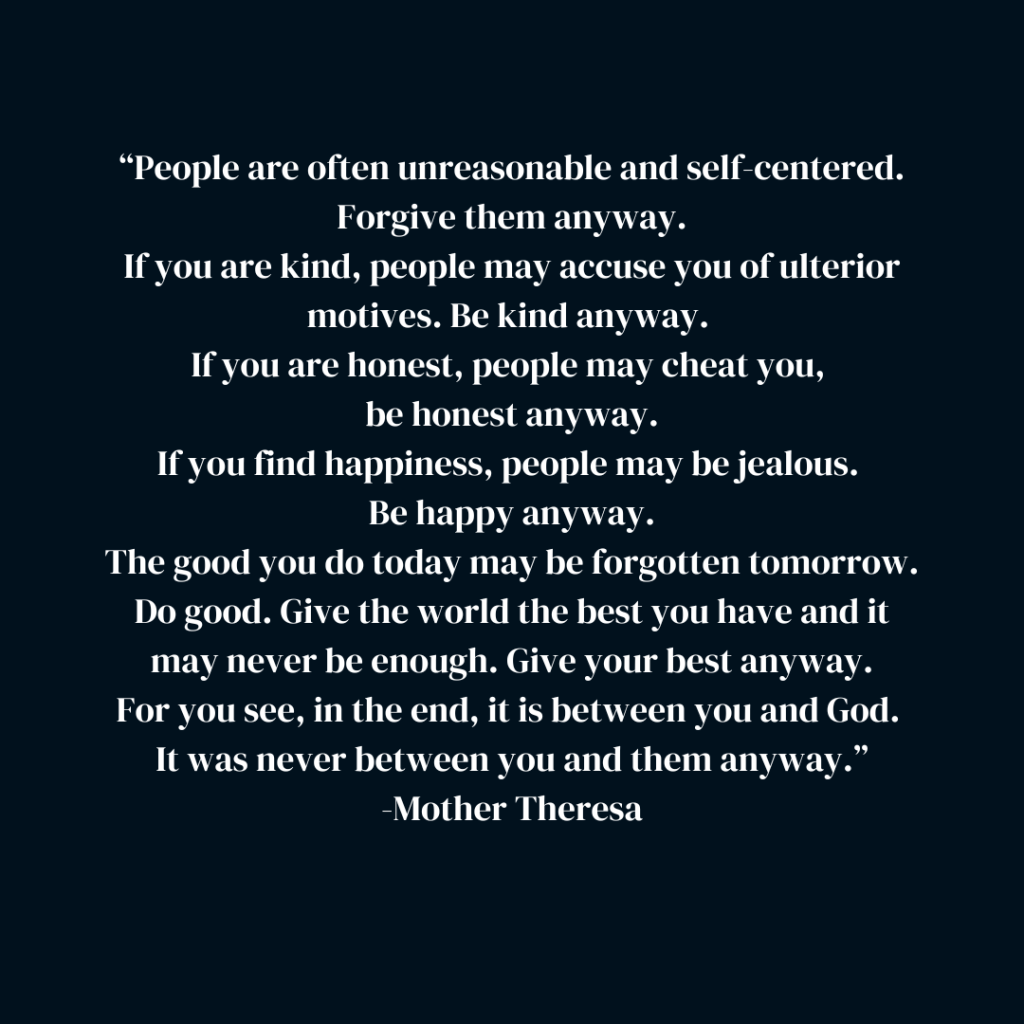
Okay friends, for today’s Thoughtful Thursday I wanted to share a quote that my friend Jo shared with me. Jo also has a YouTube channel, Minimal Zebra! This quote is from Mother Theresa and it says, 

“People are often unreasonable and self-centered. Forgive them anyway. If you are kind, people may accuse you of ulterior motives. Be kind anyway. If you are honest, people may cheat you, be honest anyway. If you find happiness, people may be jealous. Be happy anyway. The good you do today may be forgotten tomorrow. Do good. Give the world the best you have and it may never be enough. Give your best anyway. For you see, in the end, it is between you and God. It was never between you and them anyway.”

It can be challenging to deal with people who are unreasonable and self-centered. Oftentimes this behavior is a result of internal struggles the person is going through. When we recognize that people who are unreasonable and self-centered are likely going through or have gone through really difficult things, it can make it easier to have compassion on them and forgive them.

One thing I have learned from having a presence on social media, well and really just in life in general, is that people may misunderstand you. This is something that is really difficult for me as a people pleaser. But I am learning to realize that all that really matters is what is in your heart. People will interpret your actions and words however they want, but they don’t know what is in your heart. All we can do is focus on being the best we can be – a kind, caring, compassionate, and loving person. Also recognizing that we will make mistakes and we won’t always be perfectly kind, caring, compassionate or loving. But all we can do is our best. I’m learning to focus on the internal more than the external, because behavior, if even seemingly good on the outside, doesn’t always reveal true heart motives.

People often misunderstand you when they don’t know you well. Either acquaintances in your real life, or people seeing your content online. They don’t know what your life is really like. They don’t know what you endure day in and day out, especially if you are going through things that you don’t share openly about on social media. You know your heart and your motives, so if those are right you have nothing to worry about!

Ultimately we are only responsible for ourselves. Our behavior, our motives, our thoughts. We can’t control what others do, say, or think. In my opinion, it is better to live in such a way that we do the best we can do each day. “Give the world the best we have” as Mother Theresa says. It might not be “enough” by the world’s standards, but when you know you gave it your all, then you can sleep well at night. When you live with integrity, you have nothing to be ashamed of and nothing to hide. And when you do make a mistake and don’t live in such a way that you are proud of, then you make a different choice tomorrow!

As someone who is a people pleaser, or like I like to call myself a recovering people pleaser,  it can be easy to get wrapped up in trying to convince people you are a good person. I’m realizing this is a complete waste of energy. We must put our energy into BEING a good person and let the chips fall where they may so to speak. As Mother Theresa so wisely pointed out: “it is between you and God. It was never between you and them anyway.”

It is not always easy to do, but focusing on your own life, your own happiness, and your own goals without worrying about others’ opinion of you is the healthiest way to live!

This is the YouTube video I shared in conjunction with this blog post.

7 TIME WASTERS

Okay friends, for today’s Thoughtful Thursday post I wanted to share with you ways that we can waste our time. Especially if you are a homemaker, it can be easy to fall into these habits of wasting time. I hope by sharing these 7 time wasters with you, I can encourage you to be more efficient in your day, giving you more margin to do the things you love!

The first time waster is inefficiency in chores, responsibilities, or activities. I have found it really helpful to batch activities for efficiency. Running errands is a perfect example. It makes more sense to run all of your errands at once while you are already out and about then to do them throughout the week. This is especially true if you don’t live close to stores. Another example is checking your email or other notifications on your phone. Set aside times during the day when you will check email and other notifications to respond to emails or social media comments at the same time. It can be a big time waster to continually open your phone to respond to things like this throughout the day. Included in this is even batching your rest time! I personally have found it really helpful to have one day a week where I do not do any work!

The second time waster I wanted to share with you is the amount of time we spend choosing our clothes for the day. Now, if you’ve been around for a while, you will not hear me tell you to become a minimalist and wear black t-shirts everyday! That is not my style at all. I love having lots of options and being able to creatively put together outfits. However, I did want to suggest having a uniform. I do like to wear a uniform. In the summer I wear shorts with a t-shirt or button up, and in the winter I wear jeans with a t-shirt, button up and layer with cardigans and sweaters. I will say, more recently I am rotating in some dresses and skirts as I have been trying to wear everything in my closet. I am really enjoying adding these pieces into the rotation! And of course there are some days where I just stay in my workout clothes all day! Having a uniform cuts down on the time it takes to make that daily decision, and it prevents decision fatigue. 

The next time waster is trying to remember everything that needs to get done. I absolutely love lists! Having daily to-do lists helps me to get these things that need to get done out of my brain and onto paper. You could use digital to do lists if that is your preference, I just love writing things down with pen and paper! In addition to daily to-do lists, I would also suggest keeping a running master to-list – everything that needs to get done at some point but you’re not necessarily going to do it today. You can reference this master to-do list as you are making your daily or weekly to-do lists to incorporate these tasks throughout your week. Again, just getting these tasks down on paper relieves your brain from having to remember them!
Similar to that, we waste time trying to remember all the appointments and where everyone needs to go. I would recommend keeping a calendar – either a physical calendar, a digital one, or like me you could use both. When my kids were younger, I liked to color code my calendars with a color for each person so it was easy to know who had activities or appointments for each day. You could also color code the activities. Perhaps errands could be one color, chores another, and desk work another color.

The fifth time waster I wanted to share with you is trying to figure out when to do what needs to get done. This would be more so for chores or tasks that need to get done each day or each week. I like to have a regular schedule of when I get my basic chores and errands done so I don’t need to waste time thinking about when I will get each task done. Each week I have set aside time to get these chores done. I find that it works best to do two to three chores each day of the week and then you don’t need to worry about it for the remainder of the week. For example, every Monday I do our laundry; every Tuesday I give our kitchen a deeper clean; every Wednesday I pick up our groceries. By having the same schedule each week, I don’t have to waste time thinking about when these tasks will fit into my schedule for the week. 

Along those same lines, we may waste time by not having a regular sleep schedule. When our sleep schedule is unpredictable, we won’t know how much time we will have each day to accomplish our to-do lists. Studies have shown that it is far more healthy to stick to a regular bedtime and wake up time. Yes, even on the weekends! When we have a regular sleep routine, not only is it a healthier way to live, but it also allows us to be more efficient in our work. We are also less likely to feel tired when we keep a regular sleep schedule and so we are able to get our work done!

The last time waster is an obvious one, and I know it’s a tough one as I myself struggle with this… we waste time on mindless entertainment – either scrolling social media, or watching Netflix or YouTube. I understand that these things are a part of our lives, but I wanted to encourage you to unplug from time to time. Ideally we would come up with appropriate boundaries for ourselves on how much and how often we engage in this entertainment. I think we could all stand to cut back on our social media usage and tv watching, ME INCLUDED! I used to not open any of the social media apps on my phone on Sundays as a part of my rest day, but slowly it crept back in. Not to scroll, just to keep up with chats, DMs, and notifications. However I really think it would do me good personally to get back to the habit of not looking at social media at all for that one day a week.

The video I posted on my YouTube channel in conjunction with this blog post.

10 MINDSETS THAT WILL CHANGE THE WAY YOU DECLUTTER

Hey friends, today for my Thoughtful Thursday post I wanted to share with you some thoughts about decluttering. I know I have talked about decluttering quite a bit on my social media platforms. I have shown the process of decluttering, what I’m decluttering, and why I am decluttering items. But today I wanted to share with you mindsets that will change the way you declutter. Hopefully by sharing these mindsets it will give you a new perspective as you move forward in your decluttering journey. Today I am sharing 10 mindset shifts to help you declutter better!

The first thing I wanted to share with you is to have a positive perspective versus negative. Oftentimes when we approach decluttering we can feel like it is a negative thing: it’s difficult, time consuming, and maybe even tiring both physically and emotionally. When we have this mindset shift that decluttering is a positive thing, moving us towards our life goals, helping us deal with anxiety or other mental health issues, and making our external environment one we love to live in, we will be excited to start the process of decluttering.

Along those lines, another mindset shift around decluttering is to focus on what you are working towards. What is the end result you want? When you create a vision for your life and have that picture in your mind it can spur you on to take the necessary steps to achieve that life you are working towards.

The third mindset shift I wanted to share is to focus on what stays instead of what goes. Sometimes it can be helpful to choose the items you love and know you use regularly and set those aside first. Then you can evaluate what is left. I have done this with clothing for instance where I choose my top favorites, then evaluate if I really need to keep what is leftover. When we focus on what is staying it can help us to appreciate what we have and have an abundance mindset versus a mindset of lack.

Another mindset shift that is similar to that is to think of decluttering as curating. You are curating your collections – anything from clothes to kitchen items. When we think of curation, we may think of a museum. Museum curators are intentional and thoughtful about what they bring in. So much like this curating, it is an intentional process of only surrounding yourself with the things you love and use and removing everything else so it’s easier to enjoy the items you own.

The fifth mindset I wanted to share with you is to focus on the inflow as well as the outflow. Sometimes we don’t realize how important it is to change our spending habits as we work towards decluttering our homes. If we don’t change the inflow, then we will quickly come back to square one and the decluttering progress we made will have made little difference. Sometimes we must be ruthless with ourselves and implement a spending freeze or a no buy period in order to change our habits.

Another mindset shift is realizing you do not equal your stuff. Your value is not in the clothes you wear, the car you drive, or the stuff you own. Finding our value in something more important like in our faith, in our ethics, or in the way we live our lives makes more sense. If we find our value in our stuff, this is a very unpredictable thing to put our value in as we could lose our stuff or lose our jobs and not be able to continue to buy more items.

Something else I wanted to remind you of is having the mindset that the money is long gone. You cannot get your money back after you have purchased and then used an item. Some people find it difficult to declutter because of the money they spent on an item. If an item is sitting in the back of a drawer or cabinet going unused for years, it does not help us financially to hold onto it. Let go of the guilt you may have for spending money on items and then make better decisions moving forward in the future.

Speaking of guilt, let go of all of the guilt around getting rid of items. Whether it is guilt over spending money on the item, or maybe it was a gift given to you and you feel bad getting rid of it, or perhaps it’s something you inherited. If the item is no longer serving you, let go of the guilt and let go of the item.

The ninth mindset change I wanted to share that is adjacent to the feelings of guilt is that memories are not stored in things. You can have memories of a certain time in life, or of a person without holding onto items. Sometimes it can help to take a photo of something if you are struggling to let go because you have memories attached to the item. I do recognize that sometimes tangible things can spark our memory of a time or person, but ultimately the item itself does not hold the memory. The memory is in your mind!

Lastly, I wanted to share that decluttering doesn’t have to be a sprint. In spite of what Marie Kondo told us, we do not have to declutter our whole house in one day! I understand that different decluttering processes work for different people, but sometimes this mindset that we have to declutter all at once or set aside a big chunk of time to get decluttering done prevents us from getting started in the first place. If we have the mindset that we can do a little at a time it will feel more manageable. Oftentimes once you get started the ball starts rolling and you want to continue on, but you can have the mindset that it can be a slow and steady process!

DEBUNKING THE BUSYNESS CULTURE

Okay friends, for today’s Thoughtful Thursday post I wanted to talk about the culture of busyness. I have often talked about living intentionally, and part of that is living at a slower pace – spending time on the things I love and the things that are important to me, and cutting out the things that just keep me busy.

In today’s fast-paced world, many people are proud of how busy they are. They may believe this busyness is a sign of importance or productivity. Today I wanted to challenge this glorification of busyness and the idea that constant activity is synonymous with success and/or fulfillment. I wanted to debunk this idea that busyness is always positive by sharing the detrimental effects it can have on our mental well-being, relationships, and overall quality of life.

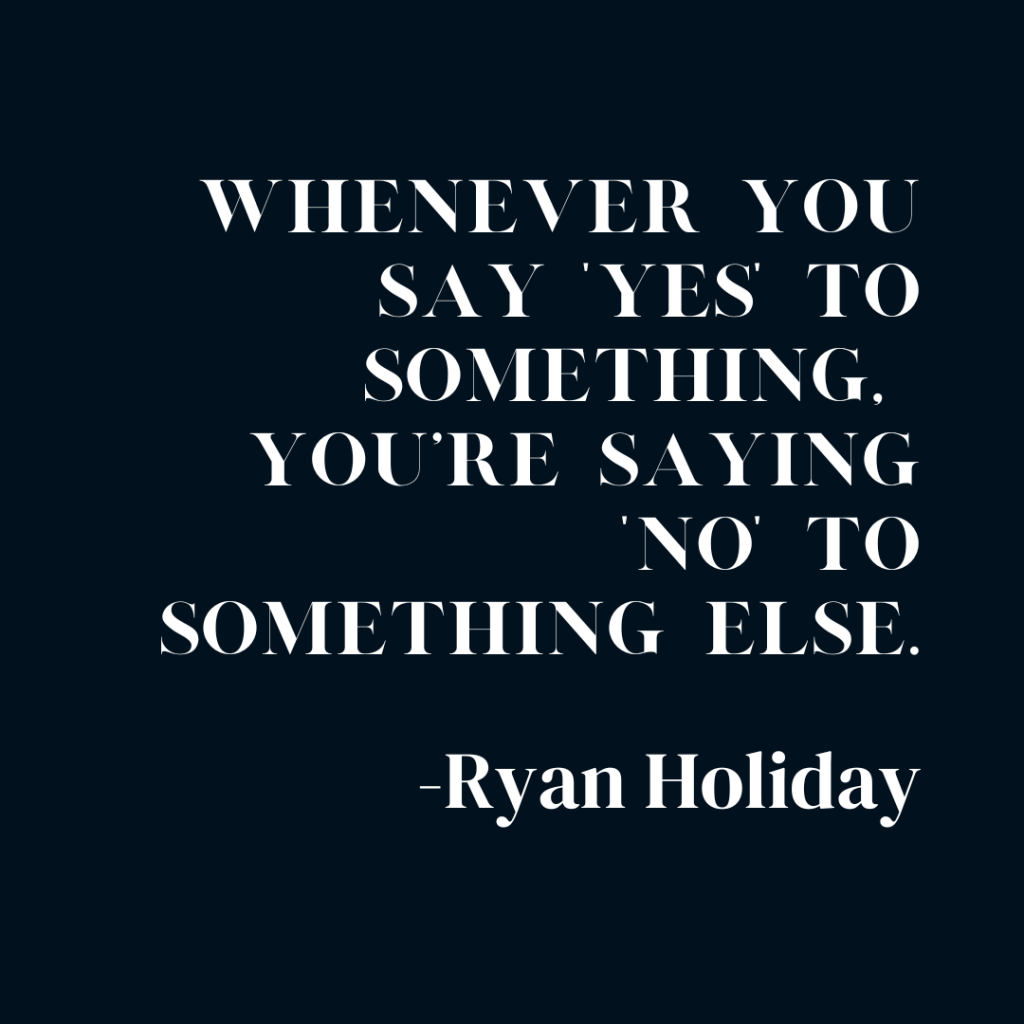
Ryan Holiday, an author and content creator has said this: “Whenever you say ‘yes’ to something, you’re saying ‘no’ to something else.” We all make decisions on how to spend our time. And we all have a finite amount of time. If we say yes to lots of things, then we may be forfeiting time to rest and rejuvenate. 

One of the primary things I wanted to talk about is this assumption that being busy equates to productivity. The reality is, busyness often leads to inefficiency and burnout. When we have a lot on our plates, our ability to focus on and prioritize tasks diminishes. This affects our productivity and our quality of work. Being busy is different from being productive, and I think people often don’t realize this.

Something else I wanted to address is the effect constant busyness has on our mental well being. The constant pursuit of busyness can over time take a toll on our mental health. Having nonstop obligations leave little room for rest, relaxation, and self-care. All things that I think can be undervalued. This can lead to stress and anxiety which causes emotional exhaustion. Rest and relaxation are not a negative thing, these are not things to be viewed as being lazy, but instead as part of a healthy lifestyle. Scheduling in times of rest prevents you from being lazy by making a plan in your schedule for rest AND for work. When we give our brains, bodies, and emotions time to rest and rejuvenate, we are more likely to be productive when we are working. If you think about athletes training, they schedule in time to allow their bodies to rest for their muscles to recover. Our brains are no different, and need time to recover as well.

Our relationships can also take a toll when we are constantly busy and have a packed schedule. In the pursuit of busyness, we can sometimes sacrifice quality time with friends and family. When we are busy all of the time, it can be difficult to be present in the moment as we do interact with others, we may be thinking of all the other things that we must get done. Deep and meaningful relationships require time and attention. When we leave little margin in our lives to develop these kinds of relationships, we are left feeling alone and/or disconnected. We must schedule our time in a way that we can be fully present in everything we do, including time with people fostering these deeper connections.

Contrary to popular belief, a truly fulfilling life cannot be measured by the number of tasks we accomplish each day. Busyness can cause us to not live in the moment, and therefore we may miss life’s little pleasures as we are rushing from one task to another or one activity to another. Again, as we keep a schedule that allows for margin we are more likely to truly live in the moment, enjoy the little things, and therefore experience more gratitude in life. If we have a balanced life of productivity and the ability to live in the moment our quality of life will go up!

To counteract this culture of busyness, we must embrace simplicity and mindfulness. Simplifying our schedules, and learning what to say yes to and what to say no to can create the space we need for this type of presence in each task and activity in life. As we are more mindful of how we spend our time, we begin to become self aware of our priorities and moving forward we can begin to choose our time doing the things that align with our values and goals in life.

I did want to say that I recognize that there will always be busier seasons in life. I remember when my kids were all school aged we felt busy and on the go constantly. This was just a season. Also, we chose to combat the extreme busyness by limiting the number of activities our kids could participate in each season. We wanted to teach them the value in not overcommitting and to be fully committed to the things they wanted to invest their time in. We not only embrace these ideas for ourselves but to teach our children the value of rest and self-care. 

Lastly, I just wanted to encourage you to challenge our culture’s narrow view of success, which often revolves around busyness and external achievements. True success should be viewed more holistically, accounting for mental well being, healthy relationships, and personal fulfillment. When we adopt this mindset, we will be able to escape this culture of busyness and replace it with something far more meaningful.

This is the YouTube video I posted in conjunction with this blog post.

DO ORDINARY THINGS IN AN EXTRAORDINARY WAY

Hey friends, for today’s Thoughtful Thursday post I wanted to talk about a quote I posted over in my Instagram feed this week. The quote says, “The true call of a Christian is not to do extraordinary things, but to do ordinary things in an extraordinary way.” This quote is from Dean Stanley, an Anglican priest from the 1800’s. Although he speaks in terms of a Christian having this life ethic, I think this could apply to anyone. Do ordinary things in an extraordinary way.

I think it is easy to feel like what we are doing with our lives doesn’t matter. We can feel like these little mundane day to day tasks aren’t making a difference and we wonder if there is something grand we should be doing with our lives. This quote reminds us that we can do an extraordinary job right where our feet are planted. Sometimes we get so caught up in dreaming about what we should be doing that we don’t look at the opportunities right in front of us! 

Living an extraordinary life does not always include performing grand acts as defined by our culture. Living an extraordinary life happens when we are fully present in ordinary moments in life, being able to fully appreciate the moment for what it is. I talk often on my social media about living intentionally. Part of living intentionally is recognizing the importance of the mundane. These everyday ordinary moments make up the whole of our lives. When we approach these moments with mindfulness and enthusiasm, we then can uncover this extraordinary meaning in the mundane. Whether it’s taking care of children, preparing a meal, cleaning the bathroom, or engaging in conversations, we can find these experiences extraordinary when we infuse these moments with passion, creativity, and attention to detail.

In order to do ordinary things in an extraordinary way, we must approach each task, regardless of what it is, with a commitment to excellence and attention to detail. So many of our daily tasks can become mundane. When tasks become part of everyday routines or habits we can begin to do them on autopilot instead of living in the moment. These simple everyday tasks like exercising, making our beds, or answering emails can be done with precision and care and have a remarkable impact on the people around us as well as our internal thoughts. It is through this attention to detail that we begin to develop a reputation for excellence as we demonstrate that we go above and beyond in everything we do. 

When ordinary actions are carried out in an extraordinary way, the ripple effect it has on others can be profound. Especially if you are a mother with little eyes on you – they will absorb this work ethic. I can tell you, now having young adult children, that what you do is far more important than what you say. By infusing our daily interactions with kindness, empathy, and genuine interest, we have the power to positively influence those around us. Ordinary conversations can become extraordinary when we are present in the conversation – actively listening, offering support, and providing encouragement. Not only does this provide more meaningful connections, but it could also inspire that person to pursue their own extraordinary path.

In addition to these external benefits of doing ordinary things in an extraordinary way, there are also internal benefits. As we challenge ourselves to approach everyday, routine tasks with a growth mind-set and a commitment to self-improvement, we will begin to change the internal as well. This can push us to become more creative or expand our potential. We speak to ourselves more than anyone else speaks to us. We must be aware of the things we are saying to ourselves and redirect this belief that the ordinary is unimportant. We can choose to create a life of purpose and meaning through making the ordinary truly extraordinary.

As a homemaker, I have always pursued the work I do here in my home with excellence. I’m thankful to my parents who taught us high work ethic and to value putting in our full effort in anything that we did. I have not always done this perfectly and I know there have been days or even seasons in my life as a homemaker that I was just trying to make it through each day.

I wanted to share a story with you to remind you that while I fully believe in doing ordinary things in extraordinary ways, I acknowledge that this isn’t always easy. The year our daughter, who is our oldest child, graduated from high school was the same year our middle son graduated middle school and our youngest graduated elementary school. I’m not sure how the cosmos aligned to create this kind of upheaval of change in our lives, but this is nevertheless how it played out for us. That spring was tough for sure, and I think maybe in hindsight we should have invested stock in Kleenex before hitting this phase of life. But nothing would prepare me for what happened the following fall when the new routines set in, with all three of our kids in a new season of life.

That year was really rough for me mentally, which is probably not surprising. I wasn’t officially diagnosed with depression, but my behavior pointed to a depressive season of life. I felt lost, which made me not want to pursue things I used to love doing. In the fall of the following year, a local boutique owner reached out to me to see if I would like to work for her. I was a regular in her boutique and we had developed a friendship through my visits. I worked for her for a year and a half, and so appreciated that time which pulled me out of my funk and gave me new purpose and inspiration in life again. I actually quit working for her to start up my own business as a professional organizer!

We may go through days or even seasons in life that it is difficult to be present and to pursue our work with excellence, however we must keep pressing forward reminding ourselves that we can be extraordinary wherever our feet are planted!

The YouTube video I posted in conjunction with this blog post.

DEALING WITH ANXIETY, OCD, & PERFECTIONISM

Hey friends, for today’s Thoughtful Thursday I wanted to talk about something that has recently been on my mind. I have been thinking about mental health and balancing mental health challenges with my everyday life. For those of you who don’t know, I have shared in the past that I was diagnosed with generalized anxiety disorder around 15 years ago. Dealing with anxiety in my day to day life is now just the norm for me.

One thing that I haven’t really talked much about is my obsessive compulsive tendencies. I have not been officially diagnosed with OCD, but from what I know about this disorder it is often closely linked with anxiety disorders. Many people who have anxiety tend to have obsessive compulsive behavior to quiet the anxiety. We believe, although incorrectly, that if we could just do this one thing or control this one thing THEN we won’t feel anxious. The problem is there seems to be that one more thing that we believe will quiet our anxiety and it never really ends.

Now while I have not spoken much openly about these struggles, it may be obvious even to those uneducated about OCD. I am sure some people have thought to themselves “Joy goes a little overboard when it comes to cleaning, organizing, or decluttering.” Go ahead – raise your hand if you thought this! My response to that is I KNOW! I know I go overboard at times and that is one way I handle my anxiety.

Like I mentioned, I have been thinking about this more recently, and wondering if I need to find ways to better manage that anxiety. On the one hand, it has served me well in the sense that it has caused me to be highly motivated and disciplined in managing our household. However, it does get to the point where I have to evaluate how I spend my time. As someone who likes to live an intentional life, I am always evaluating what I do with my time and energy. 

I think something else that goes hand in hand with OCD is perfectionism. It’s easy to get caught up in the details and perfecting something when your anxiety is driving you and that manifests in obsessive compulsive behavior.

One of the things that I have been thinking about to practically help me navigate the OCD thoughts is to be realistic with myself about any given project or task. This can be very difficult for me as I was raised with a high work ethic. I was taught to do everything with excellence. And again, this is a great quality – but not when it interferes with relationships and other more important things. I’m learning to sometimes say “good enough is good enough.” I’m learning to evaluate when there are things that require A+ work versus the times when C+ work will suffice. This has been hard for me, but like I said – I’m learning.

Something else I do when I start to feel that anxiety rising because I feel like a project, task, situation, or circumstance feels out of control – I stop and ask myself: will this matter to me 5 years from now? How about 1 year from now? Or a month from now? Often I find that things that really upset me will not matter in the grand scheme of life. This helps me to let it go more easily.

Lastly, I like to make lists when I feel overwhelmed with life. Sometimes I can get out of control trying to do everything at once, or pushing myself too hard. If I make a list of things that need to get done, then I can more appropriately delegate tasks to different days. Once it’s on paper it can put my mind at ease. With that said, this doesn’t always work for me. Especially if it’s a big, ongoing project, I sometimes just want to keep working until it gets done.

I just want to encourage you today, no matter what struggle you may be going through, to give yourself grace. All you can do is work on things a little at a time, and try to be better today than you were yesterday. Self awareness is a great start because that’s where you can begin to make changes!

Here is the YouTube video I posted in conjunction with this blog post.

WHY DECLUTTERING ISN’T ENOUGH

Well, it has been quite a while since I have posted here on my blog! I have been focusing on my other social media platforms – YouTube, Instagram, and Tik Tok. I have been thinking about how I would like to share more often here on my blog. On my YouTube channel every Thursday I share in a video series called Thoughtful Thursday where I share cleaning, organizing, and/or decluttering motivation and in the voiceover I share my thoughts on a topic. This week my topic was pertinent to my website, so I decided to go ahead and share the information that I shared in that video. But it got me to thinking that I would love to start sharing my Thoughtful Thursday thoughts here on my blog as well, even if it isn’t specific to cleaning, organizing, or decluttering. So, you can look forward to seeing my thoughts each Thursday!

So, for this week’s Thoughtful Thursday I wanted to share with you why decluttering isn’t enough to create a clutter free home. Over the weekend I was thinking about how much time, energy, and effort it takes to keep up with our stuff – caring for, cleaning, and organizing it. I came across a quote from Peter Walsh, a professional organizer and author, probably best known for the TLC show Clean Sweep. I shared this quote over on my Instagram feed earlier this week: “What I know for sure is that when you declutter – whether it’s your home, your head, or your heart – it is astounding what will flow into that space that will enrich you, your life, and your family.”

This quote has inspired me to continue decluttering my home, even though in some ways it seems like I have nothing left to declutter! When we declutter, we make space for other things that will enrich our lives. I also loved his point that it’s not just our physical stuff that takes up space – but also mental and emotional clutter can prevent us from experiencing other beautiful things in life. We must be self aware, realizing what we spend our time and brain space thinking about and telling ourselves. I talk a lot about the importance of self talk over on my YouTube channel, as well as on my Tik Tok page. It is meaningful what you say to yourself. Also, if there are unresolved emotional issues in life, I encourage you to not ignore them but deal with those issues. Whether that’s reconciling in relationships, healing from past hurts or trauma, or just dealing with day to day emotions. This may require seeking professional help, and I can tell you from experience that this is so worth it. When we make time to deal with our emotional “clutter,” if you will, it frees up space in our lives for something else!

I did want to camp out on the physical clutter aspect today. I think one thing many of us don’t realize is that decluttering is usually not enough to keep a clutter free home. First of all, decluttering is an ongoing process. As long as items are still coming into our homes, we will have a need to assess what we are using and loving. Over time, as we go through different stages of life – for ourselves and especially our children – we will need to evaluate what we are still using.

In addition to this, I think one of the biggest reasons people feel like their homes are still cluttered despite decluttering, is because of the inflow. Things come into our homes organically – if nothing else junk mail, and kids’ papers. But we may also be contributing to this through our shopping habits. Think about how easy it is for something to come into your home. Especially if you do online shopping. You can shop from the comfort of your sofa, or even your bed. Within a few clicks you are done and the item is on its way directly to your front door. Whereas if you want to go through the decluttering process you must set aside time to evaluate your items, make decisions, sort the items, bag or package up the item for donation, drive to a donation center, or go through the steps it takes to sell an item online – taking a photo, writing a description, etc. It is actually much more difficult to get rid of items than to acquire them. This is something to keep in mind while shopping.

I have shared about my no spend year back in 2019, and this really opened my eyes to my spending habits. I am so thankful for that experience as it has helped me to be far more intentional about what comes into my home. Related to this, in order to keep the inflow in check, I do not purchase new things for each season – like new decor or new clothes. I like to curate my collection of decor and wardrobe intentionally and purchase items that speak to me. I may add some new items for a particular season, but I don’t shop for each new season.

In addition to this, is how easily we accumulate things because of free items or sales. I have learned that it is okay to say no to free items if it is not something I will love or use. It took time to learn, but now I am much more particular about what is allowed in my home.  I have also learned not to get sucked into a good deal. Just because something is on sale or seemingly a good deal, doesn’t mean I need it or it will be useful to me.

Something else that will make an impact in your decluttering process is accepting that it’s okay to have open spaces in your home. Now, I recognize that this may not resonate with everyone – I know some people are maximalists and like every nook and cranny to have something in it, well maybe this blog post is not for you anyway! Once you get to the point where you have open spaces, then you may be seeing the difference in your home on your decluttering journey. Sometimes we feel the need to fill the space back up, and obviously this is going to be counterproductive if you are getting rid of items just to fill the space back up again.

If you are on a decluttering journey, I hope these ideas were helpful to you. It’s really not enough to just declutter our spaces. We must change our spending habits as well in order to truly make an impact. I know for me, I just got tired of the cycle of stuff going out, stuff coming in. Slowly but surely I am seeing more open spaces in my home. It has helped greatly with my anxiety levels, not feeling overwhelmed with stuff in my space and just not having to take care of as much stuff as I once did. I am still working on it! I am thankful for the space I have now for other things to flow into my life, as Peter Walsh says.

Here is the YouTube video I made in conjunction with this post!

7 Tips to Avoid Decluttering Burn Out

Have you decided it’s time to get serious about decluttering your home? Are you tired of the piles, not being able to find what you need, and just the stress of clutter? Today I wanted to share with you 7 things you can do to avoid decluttering burn out. Sometimes when we decide we are fed up with the clutter and want to do something to change it, we can quickly get burnt out! 

Often people try to do too much, too fast, causing this decluttering burn out. In light of that, my first suggestion is to do a little at a time. I know at first it can be easy to pull everything out of a space konMari style and want to tackle everything all at once, but I suggest you resist the urge to do this. It is better to do a little at a time so you don’t get easily overwhelmed. I would start very small – maybe a single drawer or cabinet. Usually starting small like this gives us motivation to choose another small space, and then another, until we have gone through every space in our homes! Another idea adjacent to this is to set a timer. It can feel less overwhelming to work on projects like decluttering when we know there is an endpoint.

My next tip is to have a decluttering plan. For anything in life, when we have a plan set in place it makes everything go more smoothly. When we have a plan, we also have that feeling of there being an endpoint. {{Although I will say, as long as items are still coming into your home – even as gifts, freebies, or things your kids bring in, decluttering is a constant process. You just eventually get to the point where it’s not as overwhelming.}} What I like to do is choose one room in my home per week to deep clean and declutter throughout that week. Going through spaces in this way breaks it down into more manageable tasks.

My third tip is to make a game out of it! Making a game out of any task that isn’t fun can make it fun! I like to play the Minimalism Game, however this may be overwhelming to some people. With this game, you choose one item to get rid of on day one, two items on day two, three items on day three and so on throughout a month. So you end up donating things for 30 days, equaling over 400 items! Another game you could play is have every family member take a trash bag or box and see who can find the most items to donate. I am sure there are so many great decluttering games out there which you could Google for more ideas!

My next tip is to take breaks. If you feel a burn out coming on, take a few weeks or months where you aren’t focusing on decluttering. Sometimes we just need to take a break from it to recharge and feel ready to go through things again.

Another thing you can do to avoid decluttering burn out is to not start with sentimental items. These items can be very difficult to declutter and slow your process down. By starting with a space with items that you don’t have sentimental attachment to, you get the momentum you need to be successful at decluttering.

My sixth tip is to celebrate your successes. Celebrating along the way can also help with the momentum. When you acknowledge the progress you have made it can inspire you to keep working at it. An idea that I have seen is to take before and after photos. Sometimes we forget how far we have come! Having those photos can remind you of how much progress you have made!

My last tip is to invite a friend or a professional to help you! Sometimes you just need someone there to help you talk through why you should keep or get rid of items. Having another pair of eyes and someone else’s input can be really helpful. Also, this can also make this process less painful and more fun!

Well, I hope this post was helpful to you and that you are inspired to start decluttering your spaces today!

Digital Organization

Today I wanted to talk about digital organization. I have had this topic idea to share for quite some time, but have hesitated to share honestly because I feel like this is a space that I am the worst at keeping organized and decluttered. Much of our lives are now digital, so there is definitely a need to keep things organized and minimized. I will share with you what I would ideally do to keep this space under control, but I’m confessing that this is a struggle for me!

So first let’s talk about photos. This is one area that is so difficult to stay on top of! I’m pretty sure that currently as I write this I have over 5,000 photos on my phone! This is definitely something I need to deal with and learn to better stay on top of. A long time ago when digital cameras were first available, I was really good about removing the photos off of my camera, and putting them both on my computer and on a hard drive. As my kids got older and my schedule became chaotic, I found it difficult to keep up with this and eventually lost about a year and half worth of our family photos. Thankfully I was able to recover some of them as back then I used a website similar to Shutterfly to share photos with my extended family. This is definitely something I would suggest – to use an app that automatically backs up your phone’s photos. I personally use Google photos for this purpose. You can also use the Cloud, although I believe they cap the amount of data you are allowed to have stored there unless you pay an additional fee. 

I recently learned about a thumb drive that can connect directly to your iPhone in order to dump photos onto it to clear off your phone, and that is what I plan to use to save my photos in another location.

If you have time to organize your photos, I like to organize mine chronologically and will create folders for each month, putting the year first, then the month to keep it all chronological. That way it is easy to find the photo you are looking for. However, Google photos has a search mechanism which works wonderfully for finding a photo of a specific person, location, or thing.

Next let’s talk about computer file organization. First, I like to use external hard drives to keep minimal files on my computer as this helps it to run better. Creating folders with like files helps to keep things organized. Everyone will have different types of files, so you will have to determine what makes sense for your specific files. Perhaps having separate external hard drives for different types of files would be wise. Maybe you have personal files and work files.

Evaluate which programs or apps you have on your computer and determine if there are any that are unnecessary and uninstall those. In general, it’s good to have a regular habit of decluttering files and photos you no longer need.

Next I wanted to address email. I would suggest having a daily habit of deleting emails. Staying on top of emails will prevent that overwhelming feeling of having thousands of emails in your inbox. In addition to that, unsubscribe to emails from companies that you no longer need the information or are no longer helpful. I also suggest streamlining your email. Sometimes it is necessary to have more than one email address, but evaluate how many is really reasonable to have. It is far easier to keep up with just a couple email inboxes than several! 

The next thing I wanted to address is passwords! Keeping track of all of the passwords you have for all of the websites you use can be an overwhelming task. Every website seems to have different specifications on what the password can be. I think it is important to find a password storage tool that is easy and safe. I use NordPass to store all of my passwords, making it easy to access at any time, and I don’t have to worry about remembering all of these different passwords! Every site has different specifications for your password, and honestly it’s more safe if you use different passwords for different sites.

I of course also wanted to address your phone! The digital clutter we have on our phones can be overwhelming. As I mentioned with your computer, it’s a good practice to make time to declutter your phone regularly. Evaluate which apps on your phone that you actually use and delete any that you are not. Categorizing your apps into folders will keep your home screen looking less cluttered, and it will make finding them easy. You can categorize them into folders based on type (like social media, photography, finances, ect.) I like to do it according to color – Home Edit style, because I find this more visually pleasing. This may seem inefficient, but your brain quickly learns where to find each app.

Adjacent to our phones is social media. First, evaluate which social media apps you really want to spend your time on, and delete any that aren’t serving you! You can also declutter the people you follow on each social media platform, only keeping around the people who are helpful. If there are people who make you feel sad or upset about your life, or just create more mental health issues, I would suggest hitting the unfollow button!

Using a digital calendar can be really helpful for reminders and to access your calendar from anywhere. I like to use both physical and digital calendars. Keep your calendar up to date by setting aside time each week or each month to update all of your appointments and commitments. If you need to also keep track of other family member’s schedules, I  like to use a different color for each member of the family.

Lastly, I wanted to share that using sites like Google Docs and Google Sheets can help to keep things organized as well. There are functions within these sites/apps that allow you to create folders in order to keep things organized. You can then access these files easily on your phone through the apps. It also makes it easy to share files with others. I like to keep recipes in a folder in my Google Docs to access while I’m cooking!

Well, I hope this post gave you some inspiration or helpful information for you to get your digital space decluttered and organized today!

12 Tips For Packing To Move

In today’s post I wanted to share with you some tips for moving! I thought summer is the perfect time to share these tips as a lot of people move during the summer months. I have been married for 26 years, and we have three adult children now. Over the course of our marriage we have lived in 4 states, 6 different apartments and 2 homes, so I have experience with packing to move! I hope these tips are helpful for you for a future move, or if a move is not in your near future you can pass this along to a friend or family member that might benefit from these tips!

{{1}} The first tip is to pack all non essential items well in advance. I always liked to pack non essential items even a couple months in advance to get this out of the way. When we begin the packing process, we don’t realize just how many belongings we own. At first it seems like it won’t take long at all to get everything packed, but the deeper into the packing process you get, you realize that you have A LOT of stuff and it is time consuming. Some examples of non essential items are home decor, throw pillow and blankets, picture frames, books, and holiday related items. 

{{2}} My next tip is to color code labels to match the rooms they belong in. This tip is especially helpful if you have movers moving your belongings, but even if friends or family members help they will know which room each box goes to very quickly. You can even have a color sign in each room to indicate which boxes go in which rooms. 

{{3}} Another tip is to use towels and blankets to pack fragile items. Using towels and blankets to pack fragile items will be efficient since you’re packing both items, but protecting the fragile items. Obviously you will want to take special care to wrap really fragile and special items with bubble wrap or newspaper.

{{4}} Speaking of newspapers, save newspapers to wrap breakables. If you don’t get newspaper you can buy non printed newspaper from moving stores. Using the non printed newspaper is nice for things like dishes and drinking glasses so they don’t get dirty from the printing.

{{5}} Another great tip is to ask local grocery stores or big box stores for boxes. Instead of purchasing new moving boxes, you can go to local grocery stores or places like Target or Walmart to ask if they have extra boxes you could take. They often have leftover boxes from unloading inventory and are happy to give them to you. Sometimes these boxes aren’t quite as sturdy as the moving boxes, so you will want to be careful with what you pack in them. 

{{6}} My next tip is to declutter, donate, and sell anything not worth moving. It is best to use the opportunity while you are packing things to move to declutter and donate or sell anything you are no longer loving or using. Depending on how much you have, this can be an overwhelming task and too time consuming to do in conjunction with packing to move, but it is wise to just leave behind anything that is no longer serving you.

{{7}} Next, have paper goods on hand for the last few days leading up to the move and the first few days in the new place. It is nice to have paper plates and bowls, and plastic cups and cutlery the last few days before a move so you don’t have to worry about doing dishes. In addition to that, then you can get your kitchen packed and ready to go! And it is nice on the other end, moving into a new place knowing you have something to eat on when you arrive without having to unpack.

{{8}} Something else that really helped me was to have a box or bin filled with all moving essentials – packing tape, sharpies, labels, scissors, AND know where it is (have a designated location for it). Often during a move everything is a bit chaotic. It’s easy to misplace things or not know where things are because everything is getting upheaved. If you have a designated bin for all of the moving essentials, and you know where it is located (maybe in a central location in the home), then it’s easier to keep track of those things and know where they are when you need them.

{{9}} The next tip some people may not think about, and that is to carefully label the last boxes. We often are just throwing a bunch of stuff together towards the end. Indicating in detail what is in the box will make it easier to know what is in it. In addition to that, write “last box” on them clearly so you know that it is a box you will also want to unpack first!

{{10}} Another tip I have is to enlist help. You can teach your children to pack! Most kids are excited to help with the packing process. You can allow them to pack their own things and give them ownership. Maybe a friend or family member can come over and help you pack or unpack as well. Working with friends and family is always so much more fun than working on your own!

{{11}} My next tip is to unpack essentials first. Maybe this is an obvious tip, but it can be overwhelming arriving at your new place and feeling like you don’t know where to start. Starting with bedding, bathroom essentials, and kitchen essentials is a great place to start. You will also have those last few boxes that you labeled “last box” which you will likely need right away as well. If you’re anything like me, the coffee will be the first off the truck!

{{12}} My final tip is to take breaks! Packing for a move, and moving in general is really exhausting, both physically and emotionally. Be sure to listen to your body and take breaks when you can. 

Well, I hope this gave you some tips that will be helpful for your next move! If you’re interested, you can check out the YouTube video I made in conjunction with this post!