ELIMINATING BAD HABITS FOR GOOD

Okay friends, for today’s Thoughtful Thursday I wanted to share something that I have been processing this week with friends. I recently watched a video which unpacked the idea of why we struggle to eliminate our bad habits. He suggested that we indulge in these bad habits as a coping mechanism. We all have psychological needs that need to be met. When these needs are not being met, we tend to turn to the quick comfort. And unfortunately the way our society is now, there is no shortage of quick dopamine hits!

If you have been around a while, you may know that I am doing a no buy year in 2025. I debrief on how each month is going on the last Thursday of the month, so you can hear all about May next week! Spoiler alert: it’s juicy! You will want to check out that post! But in addition to that I have also been doing another challenge each month. In April I did a minimalist closet challenge which actually bled into the first part of May because I was so busy with travel at the end of April and then the beginning of May. And because I was busy with these trips I ended up not coming up with a challenge for May! But I started thinking about these challenges and even my no buy year. For several of my challenges so far this year I have been eliminating bad habits from my life – no alcohol, no sugar, no shopping. As I evaluated these challenges and the idea behind it, I realized it’s not actually dealing with the deeper issue of these unmet needs. Just removing a bad habit for a month (or even a year in the case of my no buy year) does not deal with the deeper issue. It is just a momentary act of discipline. We can’t just remove bad habits from our lives, we need to replace them with something else. We need to replace them with healthy ways of meeting those psychological needs. 

This is certainly not easy or a quick fix. It takes a lot of self reflection, determining what are those unmet needs. Then we must think of healthy habits that can replace the unhealthy habits to meet those needs. It’s also about acknowledging that these quick comfort habits release dopamine in the short term, but often leave us wanting. Incorporating habits that have long form dopamine will be more beneficial in the long run. It’s not easy to think about the long term when you are just trying to deal with the moment and finding comfort or peace in the moment. But we must parent ourselves in the moment and say, “No. This is not what you need now.”

When we try to implement different habits or different routines in life we must think about what is the source of our self discipline? Is it self love or self hatred? If we make changes in life through the perspective of doing it for self love, it is more likely to be sustainable in the long run. In every decision in life we should ask ourselves: Is this good for me? Is this good for my family, my friends, or other people in my life? – then we are more likely to stick to our healthy habits. When we do things out of punishing ourselves, it will perpetuate shame and we will constantly be at battle with ourselves.

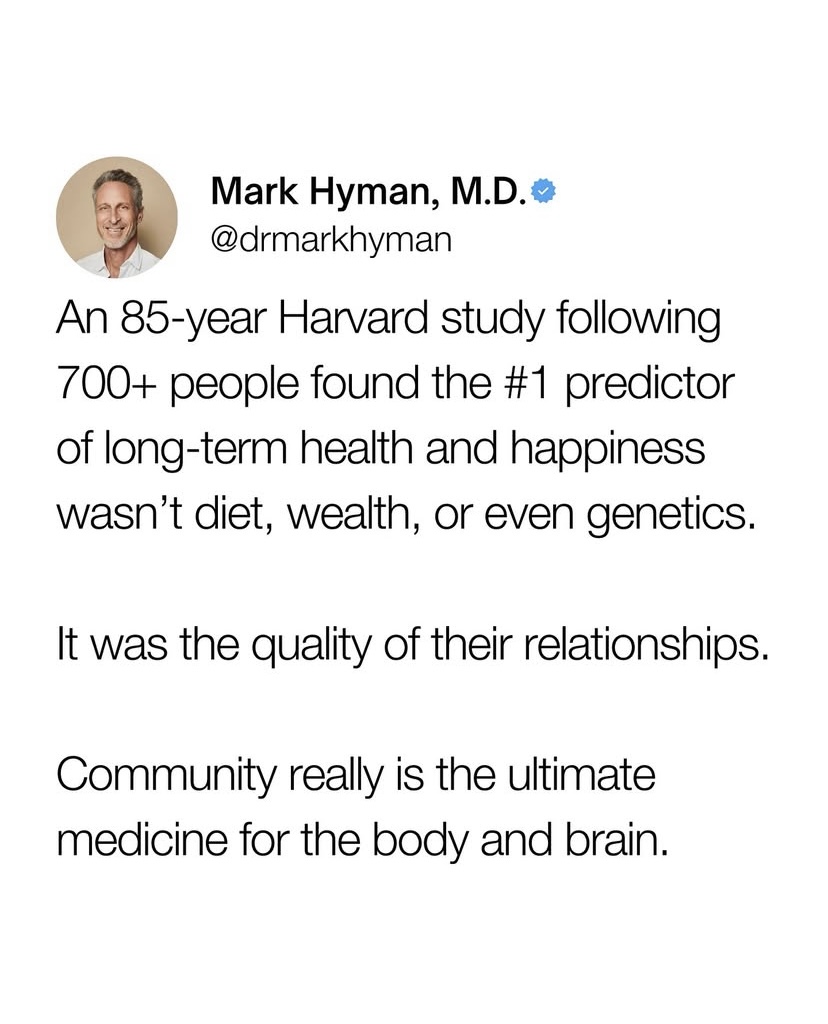
Something else I wanted to talk about with regards to this topic is the importance of relationships. The primary way we get our needs met is through relationships. Dr. Mark Hyman, whom I follow on Instagram, has shared data on the importance of relationships in our lives. In one post he stated: “Loneliness is as harmful as smoking 15 cigarettes a day – it raises cortisol, weakens immunity, and accelerates aging at the cellular level. But science proves that meaningful relationships lower stress, boost oxytocin, and even activate genes that protect against disease. Connection is truly medicine.” This is evidence that it is so important to foster healthy relationships! I also think it is important to evaluate if you have toxic people in your life and either cut those relationships off, or I know with some people you can’t completely cut them out of your life but you can control how often you interact. If you have problems in close relationships like your spouse, parents, or children, I think it is so important to actively work on repairing those relationships and getting professionals involved if necessary, doing your part to turn the relationship in a healthy direction.

That is all I have for today’s post. I would love to hear your thoughts on this idea of digging deeper and evaluating your needs and meeting them in a healthy way. If you’re still here with me and this resonates with you, type the phrase self love down in the comments. We need to make decisions based on self love, and I think this will truly guide us towards handling things in a healthy way.

Here is the YouTube video I shared in conjunction with this post.

MAINTENANCE OVER COMPLETION MINDSET

Okay friends, for today’s Thoughtful Thursday post I wanted to talk about an idea that I recently heard about. That is the idea of having a maintenance mindset over a completion mindset. So often we have this mindset that things will be better when something is completed. Or we will feel at peace once something is completed. Once we have achieved that goal we are striving for we will feel accomplished. But the truth is there is always something more. When we live in this completion mindset, we will probably never feel at peace. Instead, we should shift our mindset to one of a maintenance mindset where we constantly have routines or habits that we perform as part of our everyday lives.

I really liked this idea. I think this explains intentional living so well. Mindset shifts are so powerful, and this idea of having a maintenance mindset in life over a completion mindset is such a small but meaningful mindset shift. In many areas of life, especially in work, education, and fitness we are taught to chase milestones: complete the project, graduate with honors, and reach the finish line. This “completion mindset” focuses on finishing tasks and achieving goals. While it can drive short-term motivation and give a sense of accomplishment, it often creates a cycle of burnout, disappointment, and stagnation after the goal is achieved. In contrast, adopting a “maintenance mindset” — the perspective that success is about continual care, improvement, and sustainable habits — leads to deeper growth, resilience, and long-term fulfillment.

The completion mindset focuses on completing something, and then setting it aside. For example, we often think of fitness goals in terms of completing something: losing a certain number of pounds, finishing a race, or completing a workout program. Once the goal is met, many people revert back to old habits or lifestyles, leading to lost progress or frustration. This is because the underlying assumption is that we only need to exert the effort until the task is complete.

On the other hand, if you have a maintenance mindset, it’s not necessarily about achieving this specific goal, instead it is about the process itself. The emphasis is on continual growth, and finding satisfaction in the day to day routine of the process. Fitness for instance shouldn’t be just about completing a goal, but a lifestyle of sustaining daily healthy habits. Learning is not just about retaining information to pass a test, but about cultivating curiosity for a lifetime. Relationships are not about finding “the one” or finding the perfect friend or perfect friend group, it’s about continuously nurturing the connections you have, working through problems, building trust and understanding.

The completion mindset may actually set us up for persistent dissatisfaction in life. After the thrill of meeting a certain goal has been accomplished, there can be a dopamine crash. Without knowing your next steps or coming up with an ongoing system to cultivate continual growth, you may begin to feel directionless. In addition to this, when we have a completion mindset, each task can feel daunting and overwhelming, which with a maintenance mindset it is a consistent journey with manageable steps.

A maintenance mindset is rooted in stewardship rather than conquest. It asks, “How can I care for this so it thrives over time?” rather than, “How can I conquer this challenge and move on?” It sees value in consistency, patience, and gradual improvement. It understands that good things, once achieved, still require attention and energy. I’m realizing that living this way is not an easy road, but focusing on continual growth in life will have long term benefits!

Lastly, I wanted to highlight the idea that when we have a completion mindset, we are focusing on chasing outer change to find peace. That is the biggest problem I find with this completion mindset. This peace we are striving for continues to evade us as we keep placing new goals or achievements on ourselves. When we live in this maintenance mindset, we can live in peace as we know in the forefront of our minds that what we are working on and towards is just a continual process.

Here is the YouTube video I shared in conjunction with this blog post!

DEALING WITH BAGGAGE

So for today’s Thoughtful Thursday post I wanted to talk about baggage. I thought this was an appropriate topic since I recently returned from a trip. As I was walking through the airport with my carry-on rolling bag, my computer bag, and my purse, I was thinking about what a great analogy it was to mental and emotional baggage that we carry around with us. I saw this gentleman on one of my flights and all he had was his phone and a reader tablet. I thought to myself how nice that must be to have so little to manage while traveling. That’s when I got to thinking about how this mimics mental and emotional baggage. How much easier, or lighter, it must feel to walk through life with little baggage.

I actually talked about this idea last fall while preparing to go on a trip. I can link that post here. But I wanted to flesh out a couple of different ideas regarding this analogy of physical and mental/emotional baggage. One thing that struck me on this trip was how much easier it was for me to maneuver my bags through the airport and on the plane (lifting them into the overhead compartment.) I realized my muscles have gotten stronger since last fall with the consistent weight lifting I have been doing. I realized when we deal with difficult circumstances in life and process our feelings around them, “carrying” this baggage gets easier. It doesn’t feel as cumbersome when our emotional muscles are stronger.

The other thing that struck me on this trip is the importance of help or having a community around you when you are dealing with heavy or difficult circumstances. Yes, even strangers have helped me in the past with lifting my bag into the overhead compartment, but my son came with me on this trip and I realized it was nice for one of us to sit in the airport with the bags while the other one went to the restroom, or went to get food or a coffee. It was nice to have someone take the load for a while. It reminded me of the importance of friends and family in life to help us with our mental and emotional load.

The other thing I thought about regarding baggage, is how maybe everything I brought was not necessary. To be fair, I did use everything other than one workout t-shirt, but for the sake of this analogy, I think it’s good to evaluate what mental and emotional baggage we are carrying around and what we could declutter. Y’all know I’m all about decluttering and living with less as I pursue becoming a minimalist. And I can assure you that it takes time! Especially if it’s baggage you’ve been carrying around for a long time and it has accumulated. I have been decluttering and working on minimizing our possessions for many years now! And if you regularly watch my YouTube channel you know that is ongoing! AND, not only do I have to deal with past stuff that has accumulated (like our past emotional baggage) but also deal with the day to day maintenance. We constantly have to deal with things coming into and going out of our homes. Mental and emotional baggage is the same way. We daily have to deal with relational interactions and continual self discovery and growth. It is a constant process.

Recognizing our mental and emotional baggage as something that needs to be “gone through” and processed is the start. Acknowledgment is always the biggest step we can take. And then being aware that it will be a process and not an overnight fix or change!

Here is the YouTube video I shared in conjunction with this blog post.

WHEN THINGS DON’T GO AS PLANNED

Okay friends, for today’s Thoughtful Thursday post I thought I would talk about when things don’t go as planned. I decided to share on this topic as it was on the forefront of my mind the other day when lots of things did not go as planned that day. My new workout routine took longer than expected, I was not able to accomplish the task that I have been trying to get off my to do list for weeks, and then a stomach ache derailed my afternoon!

I used to be the type of person who really did not like it when plans changed or things didn’t go as I expected them to go. I’m not sure when it was that I finally learned that if I hold my expectations loosely, life is a lot more enjoyable. It reduced stress and anxiety, and just made me a happier person in general. It wasn’t easy for me to get to that place since my personality is someone who likes structure, consistency, and routines. But honestly, raising 3 kids and two dogs, and having a husband who arguably has an opposite personality, has trained me to be flexible. Weirdly, as a kid I was very much a go with the flow laid back type. I think it was maybe in high school that I really started to become someone who liked the structure more.

One thing I did want to share with regards to things not going as planned, is how it affects relationships. Holding our expectations loosely will help in our relationships. If we cling to our expectations, it can cause strife and frustration in our relationships, which can ultimately lead to resentment. When we are open to things going differently than planned, we have a much more laid back approach to life and those curve balls don’t affect us as much. We are willing to pivot and move forward with the new plans or the new path.

A trick that I use for myself is to look for the silver linings in the plans changing. Instead of focusing on all the reasons it sucks that things didn’t go as planned, focus on the reasons it was good that plans changed. It’s never fun to not feel good like when I got a stomach ache the other day, but I did think to myself that maybe my body needed more rest. I was grateful that my life is flexible enough right now to take an afternoon nap and let my body heal. Shifting our focus to the positive is always helpful!

When things don’t go as planned it can also provide us an opportunity to reevaluate the plans in the first place! This could be a great opportunity to evaluate how you are spending your time and do an audit. Are there things you are doing that have a low impact in the long run? Could you devote more time to more high impact activities? Meaning, are there things that you could focus on to better achieve your goals or that line up better with your values and true priorities? Of course there are everyday life things that need to get done, but this could be a good time to evaluate what’s important!

Ultimately I think it would benefit us to view when things don’t go as planned as a positive thing. Maybe this is just me, but when you are running late or you get stuck behind a slow car, or stopped by a train, or anything that slows you down towards your goal for that moment – do you ever think that you are being protected from something? Maybe this is just my morbid way of thinking, but instead of getting annoyed I think to myself maybe I was protected from getting into an accident! We have a choice every day to view things from a positive lens, or a negative one. I know for some people it doesn’t come as naturally to view things positively. I fully recognize that I have always been a glass half full sort of person, so perhaps it is easier for me. But I do think we all have the choice on how we will view every situation we encounter. And I think it is always better to view things from a positive mindset.

Here is the Day in the Life YouTube video I shared in conjunction with this blog post.


SLOWING DOWN

Okay friends, for today’s Thoughtful Thursday post I wanted to talk about how when we slow down, it creates a perspective shift in life. In today’s culture, productivity and busyness seem to be praised above all else. It seems like it is a badge of honor to answer the question how are you doing with the answer: I’ve been so busy! But I would like to argue that busyness doesn’t necessarily equal productivity. And slowing down can give us the space we need to evaluate our lives and if what we are doing with our time and energy truly aligns with our goals and values.

One of the main reasons people hesitate to slow down is because they equate it with getting behind. In our westernized culture, we have been taught that busyness leads to success and success reveals our worth, measured by our output. This relentless pace can lead to stress and eventually burnout because it doesn’t leave room for creativity, introspection, or genuine connection with family and friends. On the other hand, people often equate slowing down with doing nothing, or worse laziness. But the truth is slowing down allows us to live life with intention and presence. By slowing down we leave space to evaluate our lives, our surroundings, and our thoughts and feelings. This introspection gives us insight into what we really want out of life. In the hustle and bustle of life, we can begin to focus on the immediate which can cause us to lose sight of what really matters!

Oftentimes, creative ideas arise from moments of quiet and reflection, not during moments of intense stress and busyness. Have you even awoken in the middle of the night with a great idea? Our bodies are able to slow down enough for our minds to wander and think about new possibilities. Slowing down fosters a mental state that is open and receptive, allowing us to come up with those new and creative ideas.

Slowing down can help us enjoy everyday tasks more as we shift our perspective to being present in each moment. So often we feel hurried and rushed, like we are living life against the clock. With the modern pace of life time can feel like a scarce resource and something to be managed and optimized, however if we are able to slow down we can experience a sense of flow and harmony as we take care of our daily tasks. When we slow down these everyday mundane tasks can actually be enjoyable as we live with a deliberate mindset. We begin to notice the small moments that can bring joy and peace into our lives. We might begin to truly experience things with all 5 senses, being fully attuned to the moment – something that is difficult to do when we are moving quickly and doing things just to get them done.

This week I decided to start eating my lunch outside in quietness. No phone, no YouTube video to watch, no talking to people. I tend to eat lunch by myself anyway. I started this practice as a way to slow down. Eating in silence has already helped me to be more aware. I feel like I eat so slow and I’m not sure if I am eating more slowly as I sit quietly in nature to eat, or if time is passing by more slowing because I’m not multitasking. I plan to do this for 30 days to see the long term benefits!

Slowing down enhances our relationships. As we take the time to truly listen to others and engage with them we deepen our connections and develop greater empathy. Instead of hurrying through conversations or multitasking while we are talking, we create that space for genuine connection.

Slowing down is not about withdrawing from life or avoiding responsibilities. It’s about being more present and mindful in the way we approach life. It’s about enjoying each moment to the fullest. It’s about giving ourselves permission to have space to pause and reflect. We move from a mindset of scarcity and urgency to one of abundance and presence. This shift allows us to see the beauty in the mundane, and to connect more deeply with ourselves and others.

Here is the YouTube video I shared in conjunction with this blog post.

ASK WHAT, NOT WHY

Okay friends, for today’s Thoughtful Thursday post I wanted to talk about an idea I recently heard on a podcast. The host of the podcast was discussing with the interviewee about hardships in life and he suggested that instead of asking “why?” when we are going through trials we should ask “what?” Not why is this happening to me? But what should I do next? What could I learn from this? What is the purpose of this trial in my life?

I think it is human nature to ask “why me” when we are going through a difficult time in life. It’s human nature to want to understand why, to search for reasons. But the truth is we will likely never know why. Bad things happen to good people all of the time. We are wasting our energy, spinning our wheels, if we are just focused on trying to figure out why. If we shift our energy to answering “what” I think we will not only give purpose to our pain, but also we will find peace and contentment amidst the trial as we change our perspective. When we ask “what?” instead of “why?” We can focus on practical, actionable things which are more productive.

When we are going through something difficult in life, asking “why is this happening to me?” may lead to feelings of frustration or helplessness. Instead, asking “What can I do to improve this situation?” directs energy toward creating solutions and taking ownership. In this way, “what?” questions empower us by reinforcing the idea that, while we may not control external events, we can control our responses to them.

In personal growth and self reflection, asking “what?” questions can be transformative. When you ask questions like “why am I like this?,” “why do I keep doing x, y, or z?,” “why can’t I be more like this person or that person?” this keeps us caught in self doubt and insecurity. If we focus on what questions like “what can I learn from this?” or “what is in my control to change?” or “what small step can I take today towards becoming who I want to be?” encourages constructive thinking and leads us towards actionable goals.

“What?” questions can be helpful in relationships as well. In relationships “what?” questions tend to deepen understanding and empathy. “Why?” questions may feel accusatory and provoke defensiveness instead of mutual understanding. For example if you have a friend who is notoriously late and say, “Why are you always so late?” this can be perceived as an attack on their character instead of focusing on the issue at hand. If you say something like, “What usually causes you to be late?” it opens up the conversation to the actual issue at hand instead of perceived personal flaws.

Asking “what?” questions instead of “why?” questions helps us to feel more in control and there are actionable things we can do to change our circumstances or our perspective. When we focus on the “why” we stay in a defeatist mindset where we feel sorry for ourselves and just sulk about our circumstances which is not productive. Next time you catch yourself thinking a “why?” question, see if you can reframe to a “what?” question!

This is the YouTube video I shared in conjunction with this blog post.

PHYSICAL AND EMOTIONAL BAGGAGE

For those of you who don’t know, this year I have been taking a lot of trips. I wanted to focus on travel this year in part because there were events happening that required me to travel, so I just decided it would be my year of travel, and it felt appropriate because I’m turning 50 next month! With all this travel I have been thinking about baggage. Literal baggage, but the analogies of emotional baggage. So that is what I wanted to talk about for today’s Thoughtful Thursday.

Okay, perhaps I’m digging a little too deep to connect this analogy, but stick with me. This last trip I took I had to wait at the airport for quite a while before my flight left because my sister had to drop me off earlier than I expected when I ordered the tickets. And truly it was fine because I had a lot to catch up on from being away. But as I sat at the airport with my baggage under foot I was thinking about how difficult it was to do anything. If I wanted to go get coffee, I had to take it with me. If I needed to use the restroom, it came with me. I started thinking about how it was parallel to our emotional baggage in how it slows us down.

Physical baggage is tangible and measurable. Our bags are heavy or light depending on how much and what we pack. Emotional baggage is similar but it is all of our unresolved feelings, past traumas, regrets, and grudges we carry. Just as a heavy piece of luggage can cause back pain and fatigue, emotional baggage can lead to emotional pain and mental fatigue or if prolonged, lead to anxiety or depression. I didn’t do a great job packing my bags because I knew I would have plenty of time in the airport to do that. As I sat there unpacking and repacking everything more neatly I thought how often do I do this with my emotional baggage. I unpack everything – maybe with a friend or a therapist, or even just journaling. But do I ever decide there are things I need to let go of and no longer hold onto. Are there things that if I let go of them, my load would be lighter as I walked through life.

Are you an over-packer when you go on trips? I used to be an over-packer and wanted to account for everything and anything that could happen. But as the year went on and I went on more trips I started to learn what I really needed and my anxiety about not having what I MIGHT need started to calm down. I realized that it wasn’t worth carrying around ALL that extra stuff just in case. I got to the point where I preferred to take the risk of not having what I needed in order to have a lighter load. Are we holding onto things in life that are making our load too heavy? Both physical and emotional baggage can be an unnecessary burden we carry. When you are an over-packer you have unused items that become a physical burden, and when we hold onto emotional baggage we burden ourselves with these things that no longer serve a purpose. We can hold onto old grudges, past failures, or fears of rejection, which makes it difficult to experience life to the fullest in the present. Whether it’s physical or emotional baggage, letting go often involves unpacking everything, sorting through, deciding what is essential, and then letting go of the excess.

There is danger in ignoring the weight of our baggage both physical and emotional. When we carry a heavy bag for too long it can cause physical harm, and potentially long term damage if we don’t listen to our bodies. Similarly, when we carry emotional baggage for too long, the result can manifest in harmful ways such as anger, anxiety, or depression. This can affect our relationships, job performance, erode our self esteem, which can have long term effects on our lives. We must acknowledge and deal with the baggage because left unchecked it can end up controlling our lives, dictating how successful we are and our overall happiness in life.

The process of letting go, for both physical baggage or emotional baggage can transform any journey. Traveling light allows us to move freely, explore more easily, and feel less weighed down by possessions. In the same way, letting go of emotional baggage creates space for new experiences and personal growth. We can live more fully in the present and experience deeper connections with our loved ones. We can pursue goals more easily not being held back by our past. 

Here is the YouTube video I shared in conjunction with this blog post.

FINDING HOPE AMIDST SUFFERING

Okay friends, for today’s Thoughtful Thursday I wanted to talk about something that might be a bit heavy. I wanted to talk about finding hope amidst suffering. Suffering is a universal human experience that comes in many forms – like personal loss, health challenges, difficult relationships, or even societal inequalities. When we are going through suffering it can be hard to cling to hope for the future or hope for change, but it’s not impossible. Having hope amidst suffering really is a choice. We cannot expect to just feel hope, but we must actively pursue it. 

Suffering is obviously a personal thing, but it also connects us all as it is a universal human experience. Regardless of the source of suffering, it often causes us to question our belief system, leaving us with more questions than answers. In situations of extreme suffering, we can feel powerless over our circumstances causing us to feel hopeless. We wonder if change is a possibility. However, suffering can help strip away some of our beliefs that we are in control, reminding us of our vulnerability as humans. In this space of vulnerability, hope can emerge—not as a denial of suffering, but as a response to it. The act of seeking hope becomes a way of embracing our suffering and vulnerability: saying that while suffering is real, it is not the end.

Hope truly is a choice we must make. Choosing hope does not minimize our suffering, it merely helps us to cope and move forward. If we are intentional about pursuing hope, it can have a profound impact on our spirit—it enables us to endure even when external circumstances seem unbearable. Hope can come in many forms. For some, it is rooted in spiritual beliefs where they find comfort in a higher power and meaning beyond the suffering for suffering sake. For others, hope can be found in the connections they have with family or friends, receiving comfort and empathy during a difficult time in life. Recognizing the growth and or resilience you have gained through the suffering can be another source of hope, acknowledging that the suffering was not in vain.

One of the most effective ways to find hope in suffering is to shift your perspective. While it is natural to focus on the pain of the present, stepping back to view suffering as part of a bigger picture can be empowering. This shift often involves recognizing that suffering, while painful, is temporary and that the future holds the potential for healing and renewal. Sometimes suffering helps us to view the world through a different lens: appreciating the little joys in life, being more empathetic towards others, or it may be a catalyst to find a greater purpose in life. Finding hope amidst suffering doesn’t have to mean we are denying the pain of the challenge we are enduring, it just helps us to embrace the complexity of life. It helps us to see things in a different light and allow these challenges to make us better, stronger, and more resilient than before.

Something that can also bring hope or provide comfort is recognizing most of us who have endured suffering can attest that it does eventually end. We may have to face some other type of suffering in the future, but our current suffering will let up! We don’t have to allow our current suffering to define us. That is where hope can shift things. This suffering, even if it is longer than we want, is only one chapter and not the whole story of our lives.

Here is the YouTube video I shared in conjunction with this post.

IT’S OKAY

Okay friends, for today’s Thoughtful Thursday post I just wanted to share a bit of encouragement with you. As I have spoken about before, there is a lot that I have gone through over the past 5 years or so. One of the primary ways that I have dealt with challenging circumstances has been to focus on the positive. I have incorporated positive affirmations into my weekly routines and that has helped tremendously with my mindset and outlook on life.

BUT, I wanted to encourage you that it’s okay if you can’t always be positive. There are some days that we will struggle with keeping a positive mindset, and that’s OKAY! As I have frequently said – progress over perfection. We can do all of the right things to keep a positive mindset and to be healthy. We can listen to positive affirmations, follow through on healthy habits like exercise, eating healthy, and getting good sleep. But there are just some days that no matter what we do we just feel down, sad, disappointed, or even hopeless.

For me I am well aware that hormones play a role in how I am feeling, and acknowledging that and giving myself grace on those days has been helpful. Don’t beat yourself up when you are not feeling as positive as you would like. On these days you might benefit from spending more time than you ordinarily would on self care. Go get your nails done, take a bubble bath, or make your favorite dessert. I have also found it helpful to talk to friends and honestly to just vent when I’m feeling this way. If you are a friend receiving this sort of vent session – I think often we just want validation and to be comforted more than to have our problems solved. Oftentimes the problems are not something that has a simple formula to solve anyway.

I know I have shared before about the Marco Polo app, but I just have to tell you about it again because it has been on days like these that I appreciate that app so much! With this app you send a video message to a friend (or a group of friends) and you are basically just talking like a monologue and then your friends watch the video back when they have the opportunity. The thing I love about this is that you can just get things off your chest without any interruptions and it is surprisingly therapeutic!

I have also found that sometimes when I’m feeling down that it is okay to sit with those feelings. To feel those feelings. Cry if you need to. It can help to talk to friends, but it can also help to journal when you’re feeling this way. Sometimes we just need to feel the negative feelings and process them. Sometimes we don’t need to hear platitudes, instead we just want to feel the feelings!

If you are feeling down, sad, discouraged, or even hopeless right now, I just want you to know that you are not alone. If you feel comfortable sharing in the comments any difficulties you are going through right now, I would love to pray for you! And I hope you will have some better days ahead!

LEAVING SPACE FOR PROCESSING EMOTIONS

Okay friends, for today’s Thoughtful Thursday post I wanted to talk about something that has been on my mind. There were several things that caused me to think about if  I am really leaving space in my life to process unresolved feelings, or am I still filling my life with other things as a distraction from processing and dealing with those feelings?

The first thing that spurred me on to think about if I am really dealing with my feelings is doing the Surrender Dip. If you missed it, last week I shared in my post (and in a DITL YouTube video) that I found this group on Instagram of people who get together once a week to jump in Barton Springs pool (which is a cold, spring fed pool in Austin) as a way to start the day off with positive energy! I decided to go again this week! The act of jumping in a cold pool has been a tangible way to let go of negative energy. But in addition to that it also just wakes you up. I don’t really know how to describe it. It shocks your nervous system in a good way. Also, this group provides a community of people who all are working to better themselves, which has led to some really deep and meaningful conversations. Some of these conversations have gotten me to really think about those areas of my life where I have some unresolved feelings.

The other thing that really got me to thinking about this idea of if I am really processing my feelings was a random YouTube video that I saw on my home page. As many of you know I am fascinated by minimalism, and trying to pursue a minimalist life in my own way. So this video where a YouTuber was sharing her extreme minimalist apartment tour with no furniture caught my eye. While I don’t think I could ever live as an extreme minimalist, I do find that lifestyle interesting and perhaps even a little bit enviable. As she walked us through every nook and cranny of her home – literally showing us everything she owned – I thought to myself how nice it would be to have so little to manage. Some of those feelings come from someone who has been a homemaker for many, many years and who is quite frankly tired of managing stuff!

Here is the YouTube video I watched if you’re interesting in check it out!

BUT, as I thought more about this idea of living with so little and having to manage so little I started thinking about what in the world I would do with all that extra time I would have. This made me realize that I do, to a certain extent, use my stuff or more specifically managing my stuff or working to keep me distracted. While I definitely have more margin in my life now than when my kids were younger, I find that I still am able to fill my time with work. I’m not exactly sure what to do with this information at this point. Do I look at my stuff with a more critical eye and declutter more? Do I lower my expectations of how often I clean and organize my stuff? Or are there other things in my life that I could cut back on in order to create that space that I need to process unresolved feelings?

It’s actually scary to think about opening that can of worms – allowing myself to really evaluate my feelings in certain areas that I have repressed over the years. But the first step is always awareness. I am aware that there are feelings that I have been masking or ignoring because it feels too hard. I was just talking to a friend this morning, and I realized that I have so much more self work to do! While I have grown a lot over the last five years of my life, I still have a lot more growth that needs to happen!

I don’t know what you are dealing with today. I don’t know what difficult thing you might be going through, but I hope this encouraged you today. Make space in your life to feel and process unresolved emotions! It is well worth it!

Here is the YouTube video I made in conjunction with this blog post.