PHYSICAL AND EMOTIONAL BAGGAGE

For those of you who don’t know, this year I have been taking a lot of trips. I wanted to focus on travel this year in part because there were events happening that required me to travel, so I just decided it would be my year of travel, and it felt appropriate because I’m turning 50 next month! With all this travel I have been thinking about baggage. Literal baggage, but the analogies of emotional baggage. So that is what I wanted to talk about for today’s Thoughtful Thursday.
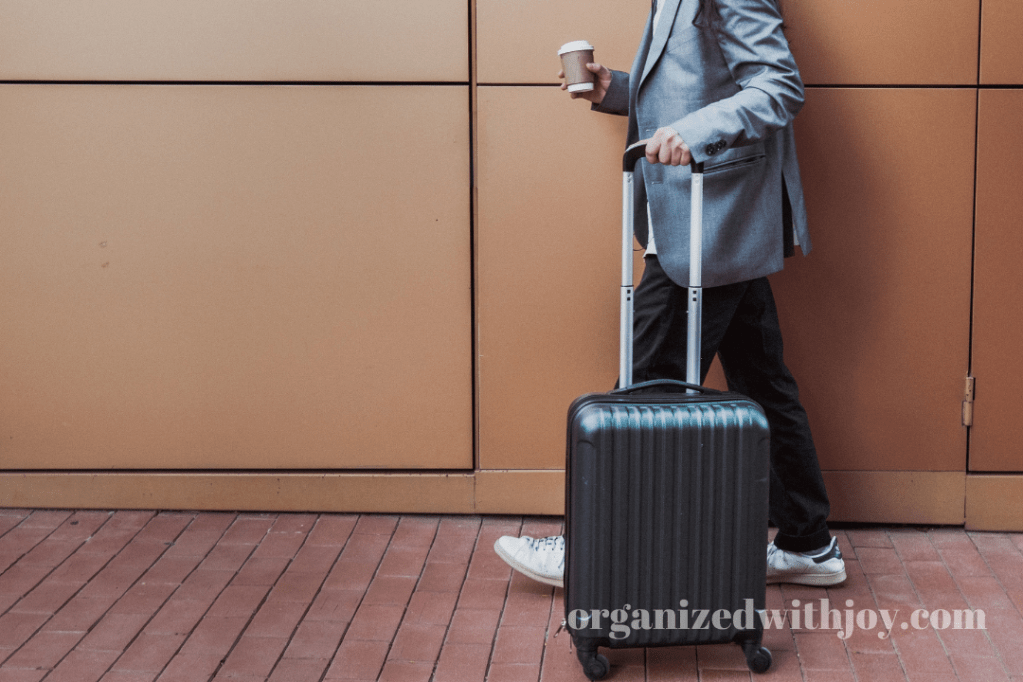
Okay, perhaps I’m digging a little too deep to connect this analogy, but stick with me. This last trip I took I had to wait at the airport for quite a while before my flight left because my sister had to drop me off earlier than I expected when I ordered the tickets. And truly it was fine because I had a lot to catch up on from being away. But as I sat at the airport with my baggage under foot I was thinking about how difficult it was to do anything. If I wanted to go get coffee, I had to take it with me. If I needed to use the restroom, it came with me. I started thinking about how it was parallel to our emotional baggage in how it slows us down.
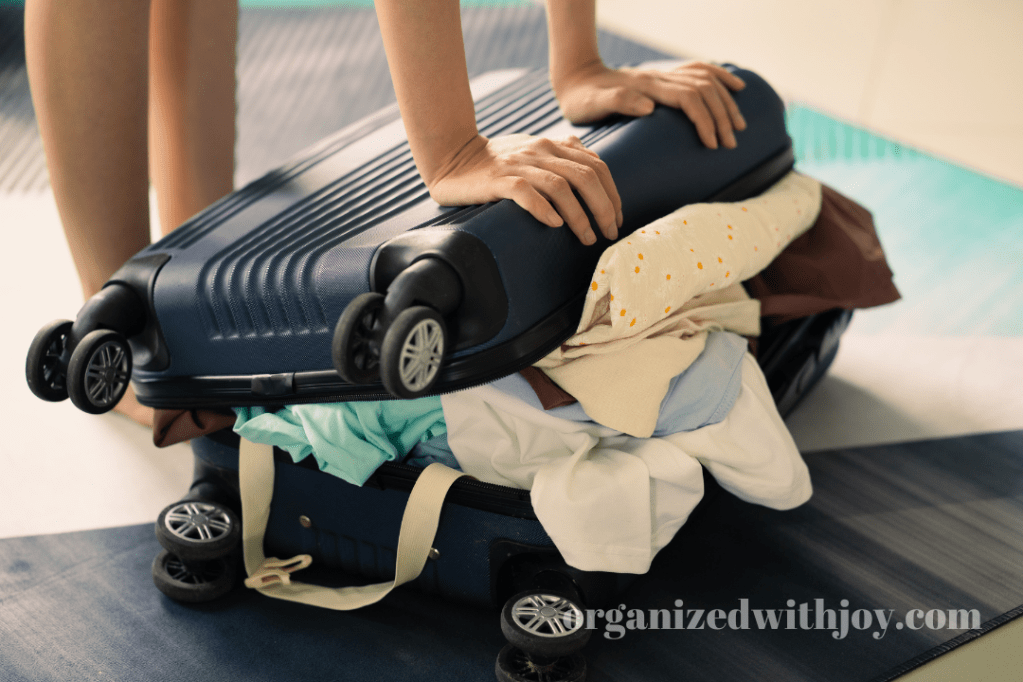
Physical baggage is tangible and measurable. Our bags are heavy or light depending on how much and what we pack. Emotional baggage is similar but it is all of our unresolved feelings, past traumas, regrets, and grudges we carry. Just as a heavy piece of luggage can cause back pain and fatigue, emotional baggage can lead to emotional pain and mental fatigue or if prolonged, lead to anxiety or depression. I didn’t do a great job packing my bags because I knew I would have plenty of time in the airport to do that. As I sat there unpacking and repacking everything more neatly I thought how often do I do this with my emotional baggage. I unpack everything – maybe with a friend or a therapist, or even just journaling. But do I ever decide there are things I need to let go of and no longer hold onto. Are there things that if I let go of them, my load would be lighter as I walked through life.

Are you an over-packer when you go on trips? I used to be an over-packer and wanted to account for everything and anything that could happen. But as the year went on and I went on more trips I started to learn what I really needed and my anxiety about not having what I MIGHT need started to calm down. I realized that it wasn’t worth carrying around ALL that extra stuff just in case. I got to the point where I preferred to take the risk of not having what I needed in order to have a lighter load. Are we holding onto things in life that are making our load too heavy? Both physical and emotional baggage can be an unnecessary burden we carry. When you are an over-packer you have unused items that become a physical burden, and when we hold onto emotional baggage we burden ourselves with these things that no longer serve a purpose. We can hold onto old grudges, past failures, or fears of rejection, which makes it difficult to experience life to the fullest in the present. Whether it’s physical or emotional baggage, letting go often involves unpacking everything, sorting through, deciding what is essential, and then letting go of the excess.
There is danger in ignoring the weight of our baggage both physical and emotional. When we carry a heavy bag for too long it can cause physical harm, and potentially long term damage if we don’t listen to our bodies. Similarly, when we carry emotional baggage for too long, the result can manifest in harmful ways such as anger, anxiety, or depression. This can affect our relationships, job performance, erode our self esteem, which can have long term effects on our lives. We must acknowledge and deal with the baggage because left unchecked it can end up controlling our lives, dictating how successful we are and our overall happiness in life.

The process of letting go, for both physical baggage or emotional baggage can transform any journey. Traveling light allows us to move freely, explore more easily, and feel less weighed down by possessions. In the same way, letting go of emotional baggage creates space for new experiences and personal growth. We can live more fully in the present and experience deeper connections with our loved ones. We can pursue goals more easily not being held back by our past. 

Here is the YouTube video I shared in conjunction with this blog post.

DO YOU WANT OPTIONS OR FREEDOM

Okay friends, for today’s Thoughtful Thursday I wanted to talk about something that I have been thinking about with regards to minimalism. I have talked frequently about my quest to simplify my life. I’m sure many of you who have been around for a while know that I have spent several years decluttering our home. I’m finally getting to a point where I have reached maintenance mode.

One big lesson I have learned from this process is the idea that we have a choice between options or freedom. What I mean by this, is we can have a lot of options in any given personal possessions category, or we can have freedom from those items. Take clothing as an example. We can have a closet full of clothes, which offers us lots of options, but it comes at the expense of freedom – of time, choosing what to wear can be more difficult with more options, and it also takes more time to maintain a larger wardrobe.

You might have heard people talking about how paralyzing making decisions can be these days because of our options. The internet offers us so many options – from different types of jeans to purchase, to job opportunities, to dating partners. Having endless options can be overwhelming and take up a lot of mental capacity to sift through all of the information presented to us to make a decision on any given thing.

I have been thinking about how as we pursue minimalism, we must decide which categories are important for us personally to have options and which it’s important to have freedom. This will be different for each person since we all have different interests and passions. Maybe you don’t cook or bake much, so you can have far less kitchen and pantry inventory on hand – giving you more freedom to spend time on other things. There are some people who find that freedom is more important than options in most categories of possessions. But we must each decide what works best for us and for our families.

For me, I used to have lots of extra decor on hand. I loved decorating for each season and rotating out different decor, but as I age I’m realizing I would rather own a smaller collection of items I truly really love and rotate them less frequently. I choose the freedom of not switching out decor often and having that time to pursue other things.

Everything we own will cost us. It will of course cost us the initial monetary price, but then it will cost us time and energy to clean, maintain, organize, and store these items. It will also cost us the mental energy of one day perhaps deciding to declutter that item. 

I was especially thinking about this as I put away my Christmas decor this year. I realized it really was quite simple to put everything away because of how much I have pared down my holiday decor. And I have several transitional pieces that can stay up through the winter.

Stuff can own us, or we can own the stuff. I have learned that it is a balance trying to decide what’s important enough to have options and where I want freedom instead. The longer I pursue minimalism and simple living, the more I become drawn to freedom over options! Each of us must decide what works best for us, our lifestyles, and our families!

The YouTube video I shared in conjunction with this blog post.

SIMPLIFYING YOUR HOLIDAYS

In today’s post I wanted to share with you EIGHT WAYS you can simplify your holiday season this year. Over the past several years I have been pursuing minimalism, and it has not just been about decluttering and living with less physical items, it has also been about living a more intentional life. It’s been about eliminating anything that no longer serves me so I can live at a slower pace. One of the things I evaluated was how I spent my time, money, and energy around the holiday season. There are several things that I have intentionally chosen to do in order to simplify my holidays.

The first thing I wanted to share with you is to MINIMIZE YOUR HOLIDAY DECOR. I am all for people doing whatever works for them! If you have the time, energy, and bandwidth to deck the halls all out for the holidays, then you do you! But my guess is you’re reading this blog post for a reason. You long for things to be more simple during the holiday season. Having a more simplified holiday decor collection will definitely help with this. I am now down to two large bins for my Christmas decor, and I feel like this is a good amount. Something else I do is choose holiday decor that could be cross-over into winter. Having decor that is not Christmas specific will cut down on the amount of time it takes you to put everything out.

The second thing I would suggest is EVALUATE HOW MANY GIFT EXCHANGES TO BE INVOLVED IN. I recognize for some people this is really meaningful and important. Just evaluate if there are gift exchanges or people on your holiday gift list that could be eliminated. We stepped away from extended family gift exchanges because we don’t get to spend the holidays with them in person. It didn’t really make sense to purchase something they told you they wanted, wrap it up, then stand in line at the post office to mail it. It felt like at that point we were really just exchanging money. 

Third, I would suggest DO AS MUCH ONLINE SHOPPING AS YOU CAN. It takes the stress out of shopping to sit in the comfort of your home instead of hustling and bustling around with everyone else.

Another suggestion I have is to EVALUATE YOUR HOLIDAY GATHERING COMMITMENTS. Are there any holiday parties that you could say no to? All of the extra commitments around the holidays can get overwhelming, so intentionally choosing which parties to go to is wise.

The fifth thing you can do is, DON’T COOK ALL OF THE HOLIDAY FOOD YOURSELF. Does your local grocery store or a nearby restaurant have pre-made holiday foods you could purchase? Sometimes it’s helpful to at least purchase a few pre-made dishes, especially if you are hosting a holiday meal.

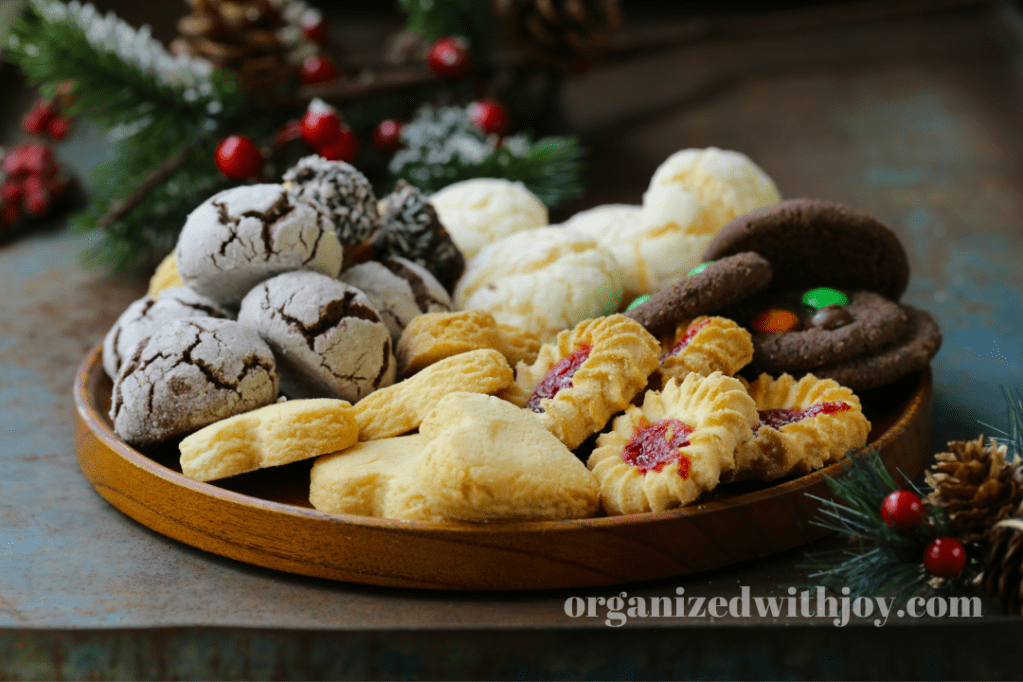
The sixth thing you can do is KEEP HOLIDAY BAKING SIMPLE. Instead of making a dozen different types of cookies, maybe choose your 4 or 5 favorite cookies. Perhaps buy pre-made sugar cut cookies to decorate. Or pre-made icing to decorate your cookies.

Next, the seventh thing you can do to simplify your holidays is consider NOT SENDING OUT HOLIDAY CARDS. This is a tough one. At least it was for me. I have been married 26 years and we always sent out a family photo Christmas card up until last year. I started writing Christmas letters about everything that was going on with our family that year as well once our kids got to be school aged. It was fun, but also a lot of work and expensive to send out after purchasing the cards, the paper for the letter, and the stamps. So, last year I finally decided to just remove this from my holiday to-do list.

My eigth and final idea is to KEEP YOUR TRADITIONS SIMPLE. If you have traditions that are time consuming or a lot of work it can be overwhelming. By keeping your traditions simple you are more likely to have follow through, and it will remove some of the stress in your holiday season.

Well, I hope these ideas were helpful for you to simplify your holiday season this year! Wishing you and your family a Merry Christmas, Happy Hanukkah, Happy New Year, and whatever holiday you celebrate!

Here is the YouTube video I made in conjunction with this blog post.

HOLIDAY GIFT GUIDE 2022, GIFTS FOR YOUNG ADULTS

In today’s post I wanted to share with you a holiday gift guide for young adults. My three children are now young adults, so I thought I would share some ideas with you! I have six categories of types of items to share with you.

The first category is the PRACTICAL GIFTS. Let’s be real, most young adults are poor. When kids are little they don’t want things like socks for Christmas, but young adults get excited to get practical gifts that they did not have to purchase themselves. Practical items could be kitchen items like maybe some specialty kitchen gadget like an instant pot, rice cooker, or fancy blender. Or you could get something as simple as a Yeti type cup – water bottle, coffee mug, or wine cup. Another practical item would be coasters. I only thought of this because this is something I purchased for my college age son this year. He doesn’t have coasters for his apartment, so I thought purchasing some fun coasters was a great gift idea for him. For my daughter, I like to find higher end makeup or skin care products which I know she loves and might not spend the money on herself. Lastly, if the young adult on your gift list enjoys coffee you could get them coffee items like a French press, pour over coffee pot, or maybe an Aeropress which makes espressos. You could add some specialty coffee or syrups along with it.

The next category of items would be SUBSCRIPTION SERVICES. Many young adults these days got used to using their parents’ subscription to Netflix, Hulu, or other streaming services so a year subscription might be appreciated. Or maybe they will continue to use their parents’ accounts! You could also get them extra streaming services instead like Disney +, HBO Go, Peacock, or YouTube premium. Other streaming services they might enjoy getting as a gift are Spotify Premium, Audible, or Skillshare. Another type of subscription service that would be great for young adults is the meal kit services. Many times young adults are still learning how to cook and honing their kitchen skills. These meal kit services will help them with meal ideas and teach them some cooking skills.

The third category of gifts would be EXPERIENCES. Again, many young adults don’t have a lot of extra expendable income, so some sort of experience would be much appreciated. Perhaps they love to travel and you could get them a plane ticket voucher, or even more fun plan some sort of trip that you could take together! Another idea is gift cards or passes to fun things to do with friends like Top Golf, one of those ax throwing venues, escape rooms, or if you have an extra adventurous young adult perhaps something like skydiving or bungee jumping.

The fourth category would be SEASON PASSES to venues you know they would like to frequent. Perhaps a gym, rock climbing gym, or yoga studio. Our son is on the rock climbing team at his university and always appreciates getting a year membership to a local rock climbing gym as a gift. A local amusement park is another great idea for young adults. Or perhaps passes to a favorite sporting event. Lastly, you could get season passes to a local museum you think they might enjoy.

The fifth category is probably the easiest route and that would be GIFT CARDS. Most people in general appreciate gift cards, particularly if you know of coffee shops, fast food restaurants, or clothing stores they like. 

The sixth and final category is FUN ITEMS! These are items that they would likely not purchase for themselves, but would really enjoy having. Maybe put together a gift basket of fun food or snacks. You could even make this themed – like maybe a movie night theme, hot sauce basket, or just a variety of snacks you know they enjoy. Another idea along the same lines is fun or specialty drinks. If age appropriate you could even get alcohol and perhaps assemble items for a specific drink, like items for a margarita or for a Moscow Mule. Another fun idea would be plants. I believe plants are still really popular right now among young adults! You could get them a fun board game that is geared towards adults. Also, you could get them a nice Charcuterie board with some non-perishable items that could go onto the board. I know Charcuterie boards have been pretty popular and I think they continue to be! Lastly, this is mostly for women but receiving jewelry is always fun as well. I have shared the company Ana Luisa on my YouTube channel before and highly recommend their jewelry company! I have partnered with them for YouTube content, but purchased items from their website even before partnering with them! They are a great sustainable jewelry company with beautiful and simple pieces which fit almost any woman’s style.

Some of these items could work well for teenages too! Young adults and teens can be difficult to purchase gifts for so I hope this gave you some diverse ideas about things you could get for the young adult on your gift list!

10 Questions to Ask Yourself When Decluttering Sentimental or Holiday Items

Today I wanted to talk about decluttering sentimental items, and in particular holiday decor. Decluttering sentimental items can be such a difficult thing! Holiday decor can have an added layer of difficulty because of the sweet and fond memories wrapped up in the items. I always encourage people to start with an easier category when beginning their decluttering journey because momentum is the key. It’s a whole lot easier to declutter items that don’t have a sentimental attachment. Starting there will give us the confidence in our decision making process as we gain momentum with decluttering. If you are in a place where you are ready to tackle decluttering sentimental items, but you are struggling, I have ten questions you can ask yourself as you make these decisions.

The first question you can ask yourself is: Am I going to use it again? If you didn’t put it out this year, how likely are you to put it out next year? Oftentimes if we do not display something from our Christmas bins one year, we are not very likely to display it the next year. And even less like the next year, or the next. I know it can be difficult to be realistic with ourselves when it comes to sentimental items, but really evaluate if you are going to display items in the future. 

If you’re not going to display the items, the second question you can ask is: are these items worth just storing away in a closet, attic, or basement? I am all about displaying or discarding. For me, when things are out of sight, they are out of mind. Be honest with yourself if the items are important enough to just have stored away in a box somewhere.

The third question to ask is: Am I believing in my  fantasy self? This term refers to having items in your home that you think you will one day use because of who you wish you would be. You have a desire to follow through on ideas you have, but the reality is you probably won’t. Maybe you’re keeping old Christmas cards to use for a future craft project, or you have some other craft materials to make things that you will actually never make, or maybe you have a lot of holiday decor with the idea that you will put it all out but the reality is you don’t have the time or bandwidth during the holiday season to do so. Again, being realistic with yourself is the key. Ask yourself how much you really need to have on hand. How much will you actually use?

The fourth question you can ask yourself is: is this meaningful to my children or family members? Think about if your children or family members would want these items when you are gone. I know this is a bit morbid to think about, but it is a good way to help make these decisions. If you missed my previous blog post (or YouTube video) regarding Swedish Death Cleaning, you should check it out for a more in depth explanation, but this mindset has helped me when making decisions especially regarding sentimental items. The basic idea of Swedish Death Cleaning is recognizing that one day when you pass away your children or other family members will have the responsibility of deciding what happens with the belongings you left behind. It is already an emotional time dealing with the loss of a loved one, but there is the added burden of going through their stuff. Therefore this question of will your family members find these items meaningful is valuable.

An adjacent question you can ask yourself with regards to your children or other family members is: can I pass anything along to my children or family members now? While you are still living it is a great time to ask your family members what items are important to them. You may find that what is important to you may not be important to them, or vice versa. It may be easier to let go of sentimental items if you know they are going to be cherished by family.

The sixth question you can ask yourself is: will this matter to me one year from now? Five years from now, or ten years from now? Thinking about sentimental items in terms of the future can help you to make those decisions. You may want to hold onto items for now and that’s okay. It can take time to let things go. In a recent video on my YouTube channel where I was going through my Christmas decor to declutter, a friend asked me if I was emotional going through my kids’ childhood items (my three children are now young adults). I honestly was not emotional. It took time, but I am starting to get to a place where I am accepting this life stage. It takes time to transition for sure, but when you’re ready to let go, you’re ready.

The seventh question you can ask yourself is: is this item something I could take a photo of to have the memory? Sometimes it’s enough to have a photo of the special item, and this takes up far less physical space since photos are now digital. This is an especially great technique for larger sentimental items.

Another question you can ask yourself is: how much Christmas clutter am I okay with having displayed in my home? Everyone has a threshold of how much stuff they can have around them. Studies have shown that clutter can contribute to feelings of anxiety and overwhelm. For some people that threshold is higher, but really evaluate your threshold. If you like a lot of holiday decor and you have the time and energy to put it all up, then by all means keep it all! But if the reality is you have way more than you feel comfortable displaying then it’s time to evaluate what you can part with. 

The ninth question you can ask yourself is: do I have the space to store what I want to keep? Physical boundaries can be a great way to limit what you keep. It can be helpful to give yourself boundaries by having a certain number of bins for your holiday decor and only keeping what fits in the bins.

The tenth and final question you can ask yourself is: Am I keeping items because of guilt? Sometimes we keep sentimental items or holiday items because they were gifts given to us. It can be very difficult to let go of items given to us, however it doesn’t seem sustainable to keep every gift ever given to you. I am sure the person who gave you the gift would not want you to keep the item simply out of guilt and might rather you pass it along to someone who can use and enjoy it!

Well, I hope these ten questions were helpful to you to process through making decisions when it comes to decluttering sentimental and holiday items. This time of year as we get out our holiday decor and set it up is a great time to think through these questions! Happy decluttering, and happy holidays!

Here is the YouTube video I created in conjunction with this blog post if you would like to check that out.

7 Tips to Avoid Decluttering Burn Out

Have you decided it’s time to get serious about decluttering your home? Are you tired of the piles, not being able to find what you need, and just the stress of clutter? Today I wanted to share with you 7 things you can do to avoid decluttering burn out. Sometimes when we decide we are fed up with the clutter and want to do something to change it, we can quickly get burnt out! 

Often people try to do too much, too fast, causing this decluttering burn out. In light of that, my first suggestion is to do a little at a time. I know at first it can be easy to pull everything out of a space konMari style and want to tackle everything all at once, but I suggest you resist the urge to do this. It is better to do a little at a time so you don’t get easily overwhelmed. I would start very small – maybe a single drawer or cabinet. Usually starting small like this gives us motivation to choose another small space, and then another, until we have gone through every space in our homes! Another idea adjacent to this is to set a timer. It can feel less overwhelming to work on projects like decluttering when we know there is an endpoint.

My next tip is to have a decluttering plan. For anything in life, when we have a plan set in place it makes everything go more smoothly. When we have a plan, we also have that feeling of there being an endpoint. {{Although I will say, as long as items are still coming into your home – even as gifts, freebies, or things your kids bring in, decluttering is a constant process. You just eventually get to the point where it’s not as overwhelming.}} What I like to do is choose one room in my home per week to deep clean and declutter throughout that week. Going through spaces in this way breaks it down into more manageable tasks.

My third tip is to make a game out of it! Making a game out of any task that isn’t fun can make it fun! I like to play the Minimalism Game, however this may be overwhelming to some people. With this game, you choose one item to get rid of on day one, two items on day two, three items on day three and so on throughout a month. So you end up donating things for 30 days, equaling over 400 items! Another game you could play is have every family member take a trash bag or box and see who can find the most items to donate. I am sure there are so many great decluttering games out there which you could Google for more ideas!

My next tip is to take breaks. If you feel a burn out coming on, take a few weeks or months where you aren’t focusing on decluttering. Sometimes we just need to take a break from it to recharge and feel ready to go through things again.

Another thing you can do to avoid decluttering burn out is to not start with sentimental items. These items can be very difficult to declutter and slow your process down. By starting with a space with items that you don’t have sentimental attachment to, you get the momentum you need to be successful at decluttering.

My sixth tip is to celebrate your successes. Celebrating along the way can also help with the momentum. When you acknowledge the progress you have made it can inspire you to keep working at it. An idea that I have seen is to take before and after photos. Sometimes we forget how far we have come! Having those photos can remind you of how much progress you have made!

My last tip is to invite a friend or a professional to help you! Sometimes you just need someone there to help you talk through why you should keep or get rid of items. Having another pair of eyes and someone else’s input can be really helpful. Also, this can also make this process less painful and more fun!

Well, I hope this post was helpful to you and that you are inspired to start decluttering your spaces today!

The Real Secret of Tidy People

I think I have figured out the real secret to being a tidy person. I have a whole blog post sharing how to keep your house tidy. These habits are easier to develop if we adopt this secret of being a tidy person. In my other blog post I share several habits you can cultivate to become a tidier person. Dealing with things immediately instead of setting them down to deal with later, having a cleaning routine that makes sense so you can stick to it, enlisting the help of other family members, and having a place for everything are all great habits that can help you to stay on top of clutter accumulating. But the real secret is the final tip I shared in that post – DON’T OWN A LOT OF STUFF!

The real secret of being a tidy person is that they don’t have extra inventory in their homes. They don’t keep things just in case. They don’t want to manage a lot of inventory. I think I came to this conclusion as my kids got older. Now that all of our children are adults, even though currently they are all living with us, I realize that there is a lot less stuff I need to manage. When they were younger there were toys, school papers, and sports equipment. Now that they are older they manage their own things.

In addition to that, over the past 7-8 years I have been pursuing minimalism. It is definitely a slow process for me decluttering my home and learning new spending habits, but less inventory in my home equals less to put away, clean, and organize.

I have a friend who openly admits she is not tidy. I would consider her a maximalist. She loves ALL the things! And I think that is totally fine! We are all different, and that’s what makes the world a beautiful place! I can go over to her house and appreciate all of the things she has surrounded herself with, but I personally could not live this way. If you’re someone who loves all the things, that is okay. But just know that the more you own, the more difficult it will be to be a tidy person. It comes down to what you value and what you can handle.

I am very affected by my external environment. My guess is you are too since you are reading this blog post and wanting to learn the secret to being tidy. Clutter and extra stuff around me definitely affects my anxiety and my mood. When my external environment is chaotic, I feel a bit chaotic in my mind as well. Everything we own takes up our energy and time. The less we own, the less we have to manage, the easier it is to keep a tidy home.

The more I simplify our home, the more I really see the benefits of living with less! Easily being able to tidy your home is one of those many benefits. I hope this post was helpful for you today!

Digital Organization

Today I wanted to talk about digital organization. I have had this topic idea to share for quite some time, but have hesitated to share honestly because I feel like this is a space that I am the worst at keeping organized and decluttered. Much of our lives are now digital, so there is definitely a need to keep things organized and minimized. I will share with you what I would ideally do to keep this space under control, but I’m confessing that this is a struggle for me!

So first let’s talk about photos. This is one area that is so difficult to stay on top of! I’m pretty sure that currently as I write this I have over 5,000 photos on my phone! This is definitely something I need to deal with and learn to better stay on top of. A long time ago when digital cameras were first available, I was really good about removing the photos off of my camera, and putting them both on my computer and on a hard drive. As my kids got older and my schedule became chaotic, I found it difficult to keep up with this and eventually lost about a year and half worth of our family photos. Thankfully I was able to recover some of them as back then I used a website similar to Shutterfly to share photos with my extended family. This is definitely something I would suggest – to use an app that automatically backs up your phone’s photos. I personally use Google photos for this purpose. You can also use the Cloud, although I believe they cap the amount of data you are allowed to have stored there unless you pay an additional fee. 

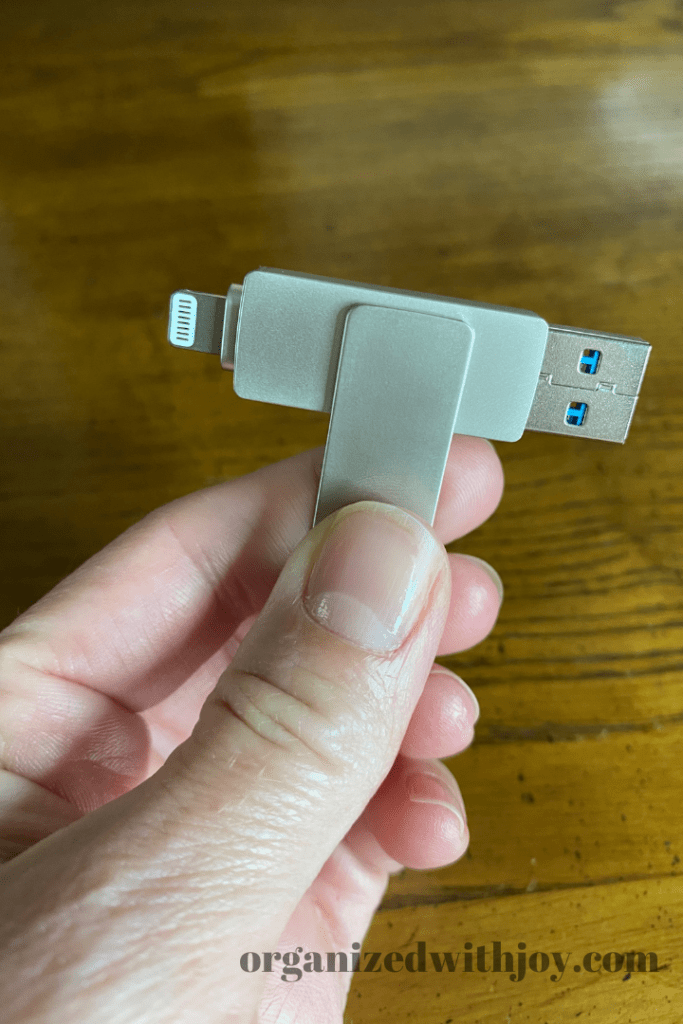
I recently learned about a thumb drive that can connect directly to your iPhone in order to dump photos onto it to clear off your phone, and that is what I plan to use to save my photos in another location.

If you have time to organize your photos, I like to organize mine chronologically and will create folders for each month, putting the year first, then the month to keep it all chronological. That way it is easy to find the photo you are looking for. However, Google photos has a search mechanism which works wonderfully for finding a photo of a specific person, location, or thing.

Next let’s talk about computer file organization. First, I like to use external hard drives to keep minimal files on my computer as this helps it to run better. Creating folders with like files helps to keep things organized. Everyone will have different types of files, so you will have to determine what makes sense for your specific files. Perhaps having separate external hard drives for different types of files would be wise. Maybe you have personal files and work files.

Evaluate which programs or apps you have on your computer and determine if there are any that are unnecessary and uninstall those. In general, it’s good to have a regular habit of decluttering files and photos you no longer need.

Next I wanted to address email. I would suggest having a daily habit of deleting emails. Staying on top of emails will prevent that overwhelming feeling of having thousands of emails in your inbox. In addition to that, unsubscribe to emails from companies that you no longer need the information or are no longer helpful. I also suggest streamlining your email. Sometimes it is necessary to have more than one email address, but evaluate how many is really reasonable to have. It is far easier to keep up with just a couple email inboxes than several! 

The next thing I wanted to address is passwords! Keeping track of all of the passwords you have for all of the websites you use can be an overwhelming task. Every website seems to have different specifications on what the password can be. I think it is important to find a password storage tool that is easy and safe. I use NordPass to store all of my passwords, making it easy to access at any time, and I don’t have to worry about remembering all of these different passwords! Every site has different specifications for your password, and honestly it’s more safe if you use different passwords for different sites.

I of course also wanted to address your phone! The digital clutter we have on our phones can be overwhelming. As I mentioned with your computer, it’s a good practice to make time to declutter your phone regularly. Evaluate which apps on your phone that you actually use and delete any that you are not. Categorizing your apps into folders will keep your home screen looking less cluttered, and it will make finding them easy. You can categorize them into folders based on type (like social media, photography, finances, ect.) I like to do it according to color – Home Edit style, because I find this more visually pleasing. This may seem inefficient, but your brain quickly learns where to find each app.

Adjacent to our phones is social media. First, evaluate which social media apps you really want to spend your time on, and delete any that aren’t serving you! You can also declutter the people you follow on each social media platform, only keeping around the people who are helpful. If there are people who make you feel sad or upset about your life, or just create more mental health issues, I would suggest hitting the unfollow button!

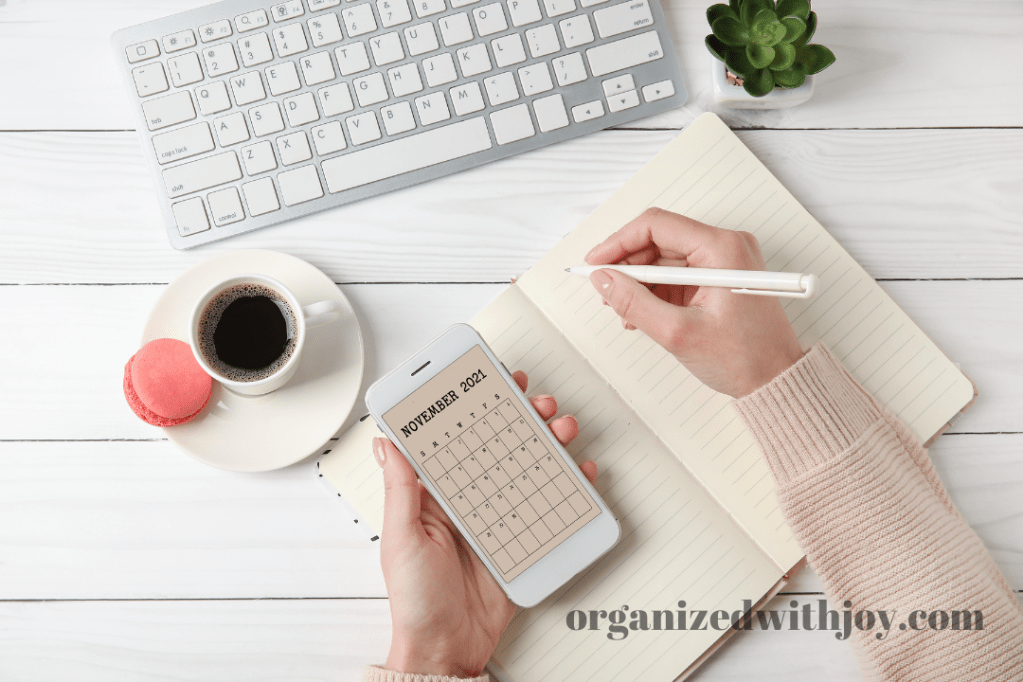
Using a digital calendar can be really helpful for reminders and to access your calendar from anywhere. I like to use both physical and digital calendars. Keep your calendar up to date by setting aside time each week or each month to update all of your appointments and commitments. If you need to also keep track of other family member’s schedules, I  like to use a different color for each member of the family.

Lastly, I wanted to share that using sites like Google Docs and Google Sheets can help to keep things organized as well. There are functions within these sites/apps that allow you to create folders in order to keep things organized. You can then access these files easily on your phone through the apps. It also makes it easy to share files with others. I like to keep recipes in a folder in my Google Docs to access while I’m cooking!

Well, I hope this post gave you some inspiration or helpful information for you to get your digital space decluttered and organized today!

12 Tips For Packing To Move

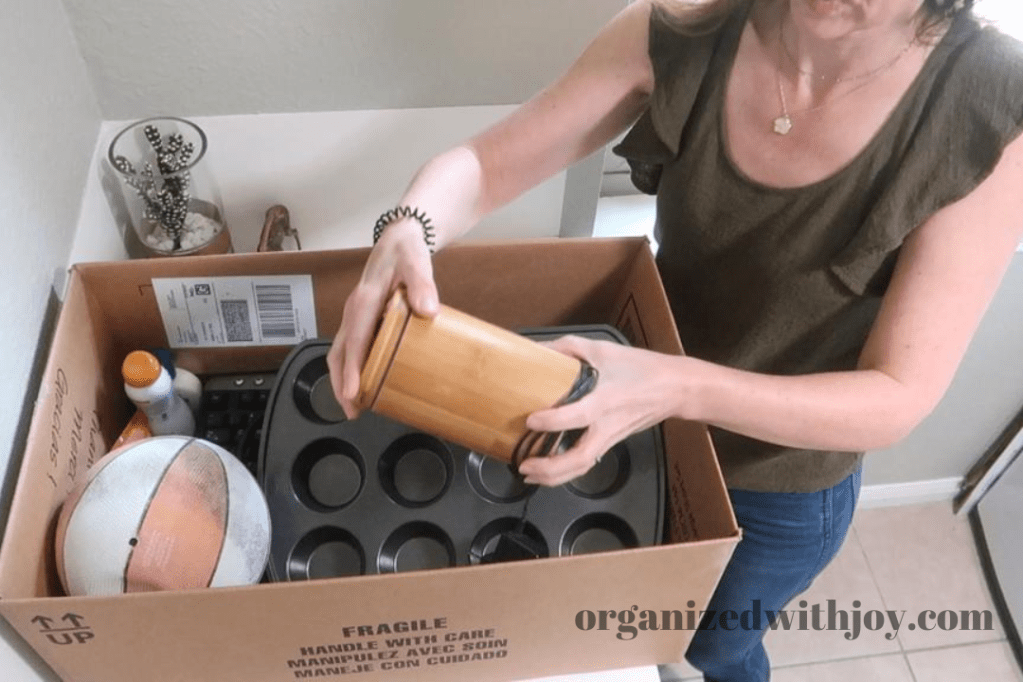
In today’s post I wanted to share with you some tips for moving! I thought summer is the perfect time to share these tips as a lot of people move during the summer months. I have been married for 26 years, and we have three adult children now. Over the course of our marriage we have lived in 4 states, 6 different apartments and 2 homes, so I have experience with packing to move! I hope these tips are helpful for you for a future move, or if a move is not in your near future you can pass this along to a friend or family member that might benefit from these tips!

{{1}} The first tip is to pack all non essential items well in advance. I always liked to pack non essential items even a couple months in advance to get this out of the way. When we begin the packing process, we don’t realize just how many belongings we own. At first it seems like it won’t take long at all to get everything packed, but the deeper into the packing process you get, you realize that you have A LOT of stuff and it is time consuming. Some examples of non essential items are home decor, throw pillow and blankets, picture frames, books, and holiday related items. 

{{2}} My next tip is to color code labels to match the rooms they belong in. This tip is especially helpful if you have movers moving your belongings, but even if friends or family members help they will know which room each box goes to very quickly. You can even have a color sign in each room to indicate which boxes go in which rooms. 

{{3}} Another tip is to use towels and blankets to pack fragile items. Using towels and blankets to pack fragile items will be efficient since you’re packing both items, but protecting the fragile items. Obviously you will want to take special care to wrap really fragile and special items with bubble wrap or newspaper.

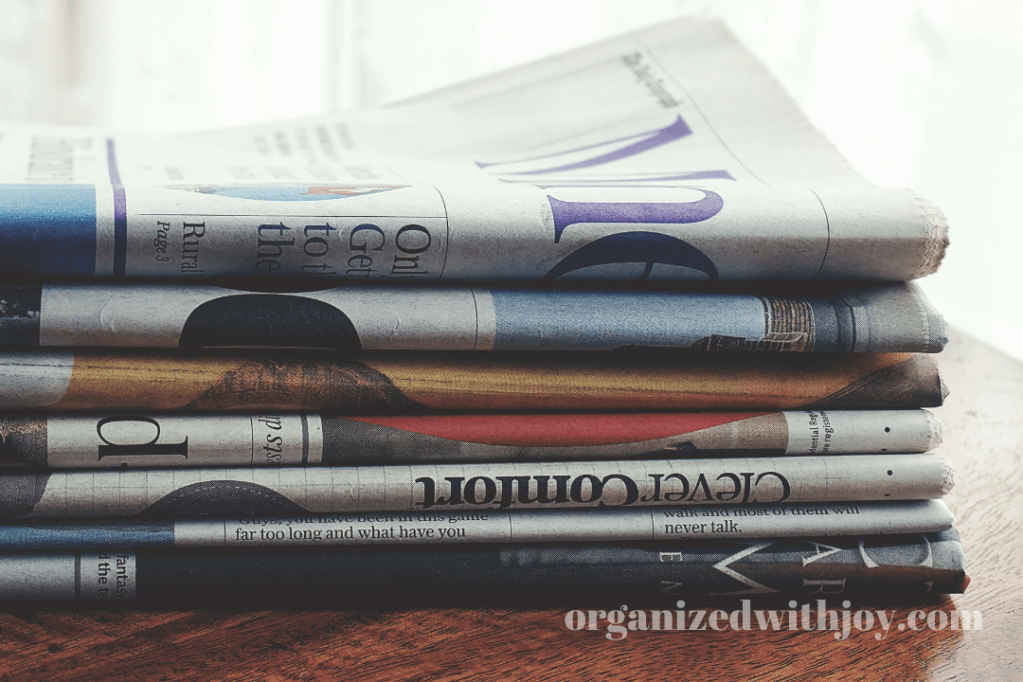
{{4}} Speaking of newspapers, save newspapers to wrap breakables. If you don’t get newspaper you can buy non printed newspaper from moving stores. Using the non printed newspaper is nice for things like dishes and drinking glasses so they don’t get dirty from the printing.

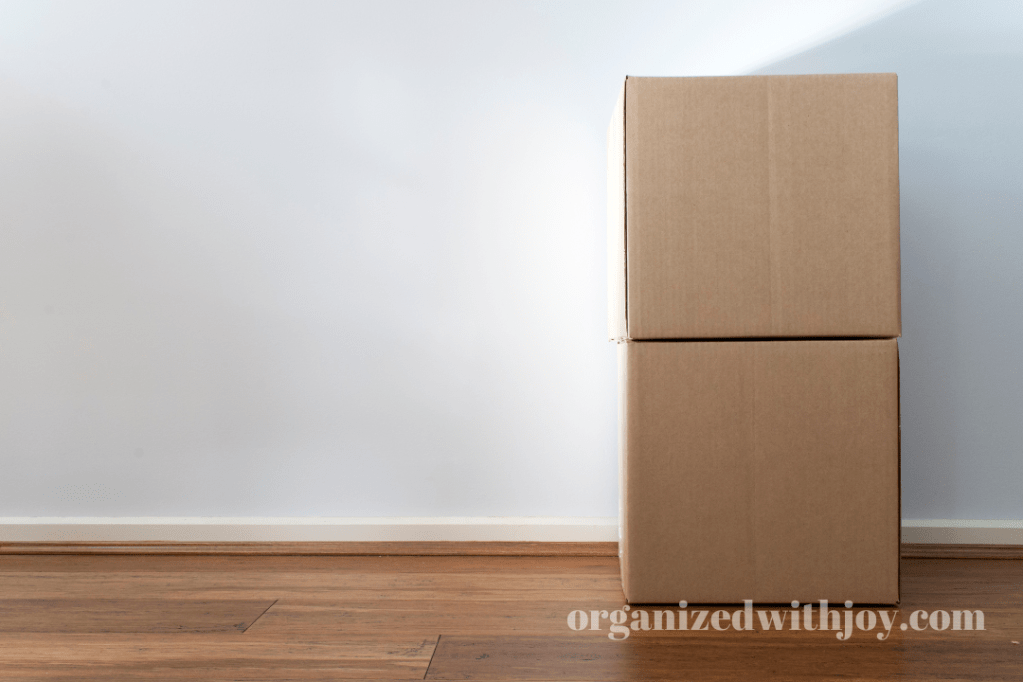
{{5}} Another great tip is to ask local grocery stores or big box stores for boxes. Instead of purchasing new moving boxes, you can go to local grocery stores or places like Target or Walmart to ask if they have extra boxes you could take. They often have leftover boxes from unloading inventory and are happy to give them to you. Sometimes these boxes aren’t quite as sturdy as the moving boxes, so you will want to be careful with what you pack in them. 

{{6}} My next tip is to declutter, donate, and sell anything not worth moving. It is best to use the opportunity while you are packing things to move to declutter and donate or sell anything you are no longer loving or using. Depending on how much you have, this can be an overwhelming task and too time consuming to do in conjunction with packing to move, but it is wise to just leave behind anything that is no longer serving you.

{{7}} Next, have paper goods on hand for the last few days leading up to the move and the first few days in the new place. It is nice to have paper plates and bowls, and plastic cups and cutlery the last few days before a move so you don’t have to worry about doing dishes. In addition to that, then you can get your kitchen packed and ready to go! And it is nice on the other end, moving into a new place knowing you have something to eat on when you arrive without having to unpack.

{{8}} Something else that really helped me was to have a box or bin filled with all moving essentials – packing tape, sharpies, labels, scissors, AND know where it is (have a designated location for it). Often during a move everything is a bit chaotic. It’s easy to misplace things or not know where things are because everything is getting upheaved. If you have a designated bin for all of the moving essentials, and you know where it is located (maybe in a central location in the home), then it’s easier to keep track of those things and know where they are when you need them.

{{9}} The next tip some people may not think about, and that is to carefully label the last boxes. We often are just throwing a bunch of stuff together towards the end. Indicating in detail what is in the box will make it easier to know what is in it. In addition to that, write “last box” on them clearly so you know that it is a box you will also want to unpack first!

{{10}} Another tip I have is to enlist help. You can teach your children to pack! Most kids are excited to help with the packing process. You can allow them to pack their own things and give them ownership. Maybe a friend or family member can come over and help you pack or unpack as well. Working with friends and family is always so much more fun than working on your own!

{{11}} My next tip is to unpack essentials first. Maybe this is an obvious tip, but it can be overwhelming arriving at your new place and feeling like you don’t know where to start. Starting with bedding, bathroom essentials, and kitchen essentials is a great place to start. You will also have those last few boxes that you labeled “last box” which you will likely need right away as well. If you’re anything like me, the coffee will be the first off the truck!

{{12}} My final tip is to take breaks! Packing for a move, and moving in general is really exhausting, both physically and emotionally. Be sure to listen to your body and take breaks when you can. 

Well, I hope this gave you some tips that will be helpful for your next move! If you’re interested, you can check out the YouTube video I made in conjunction with this post!

Swedish Death Cleaning, 3 Benefits & 7 Tips

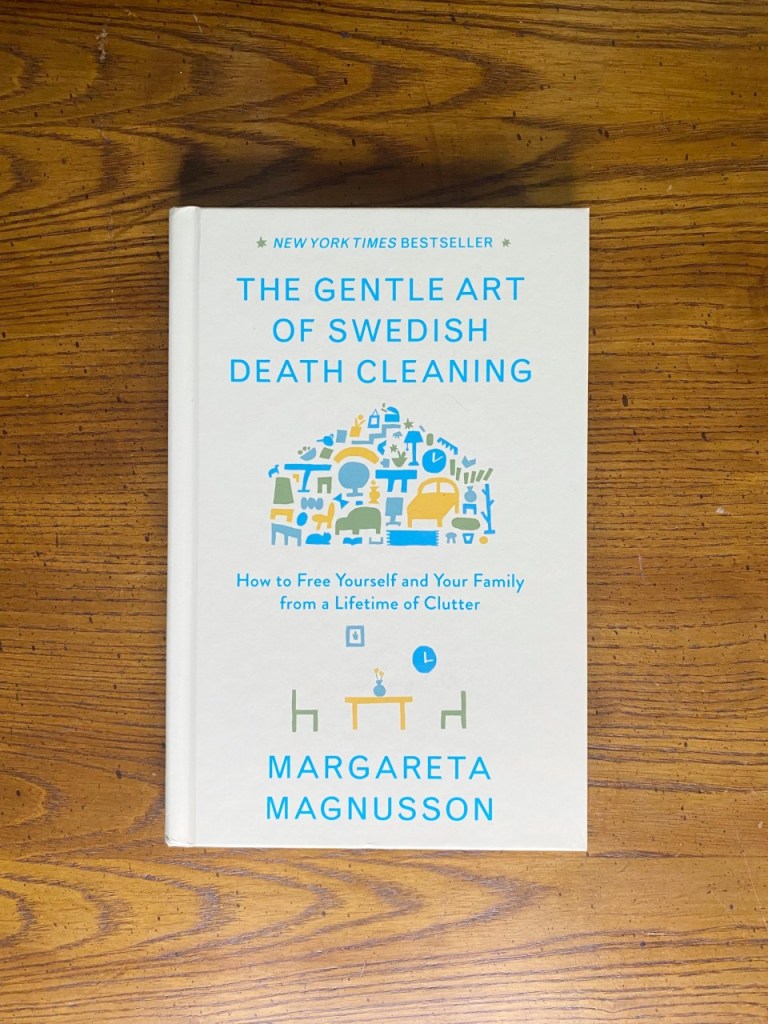
I have heard a lot about Margareta Magnusson’s book The Gentle Art of Swedish Death Cleaning, but I wanted to read it for myself. From what I learned before reading it, it was definitely something that resonated with me as someone who has a habit of regularly decluttering. The basic idea of Swedish Death Cleaning is to declutter and minimize your things leading up to your death in order to not leave a burdensome amount of stuff behind for your children or family members to deal with after you pass.

While reading this book I discovered 3 benefits of death cleaning and 7 tips as you embark on the journey of death cleaning. If you’re young, well that’s a relative term since none of us really know when we will die, don’t stop reading! You might find some of the benefits and tips helpful!

The first benefit in death cleaning is just acknowledging your mortality. When you face your mortality, you realize that your children or other family members will one day have to deal with the stuff you leave behind. It’s already stressful to lose a parent or loved one, dealing with their belongings can be an emotional and time-consuming task. It is good to acknowledge that whatever you leave behind will be someone else’s burden.

The next benefit is having a death cleaning mindset, which is you think more about how you can reuse and recycle things rather than bringing new things in.

The final benefit, you learn to appreciate things at the store instead of always having to bring the items home with you. Recognizing that anything you bring home will need to be later decluttered or handled by your children or family members after you pass will slow the inflow of things coming into your home.

Next I wanted to share some tips I learned about Death Cleaning. The first tip I learned was to not start with sentimental items. These items can really slow down your progress in decluttering, making it discouraging to continue on. By starting with items that don’t have sentimental attachment and there is not an emotional connection, you can get the momentum you need to encourage you to move forward.

The next tip is that it is easier to Death Clean when your home is organized. It’s never too early to start decluttering and organizing your spaces. It will make the process so much easier later on down the road. I think it is so beneficial to have a practice of regularly decluttering. We constantly have items coming into our homes. It’s much less overwhelming to deal with items a little over time. In addition to that, as we age it gets more difficult to maintain and manage our belongings. The fewer items we own, the easier it is to manage.

Tip number three is to take your time. This is why knowing about death cleaning is so important. If we acknowledge that it’s a process that needs to be done, then we will have plenty of time to go through our things. There might be circumstances where we are forced to go through things quickly – whether it’s an unexpected move or the loss of a loved one, but it is ideal to go through things little by little. This way you can be thorough.

Another tip I found helpful was to declutter items that are private that family members may not want to find. I am sure you can use your imagination on this one! I will give you an example from my decluttering experience. One time while decluttering my closet I found some old journals from my middle and high school years. It was mostly filled with angst ridden feelings that I guess were easiest for me to process on paper. Skimming through them I realized I really didn’t want to read these journals again, and I certainly didn’t want my kids to one day come across them, so I decided to get rid of them.

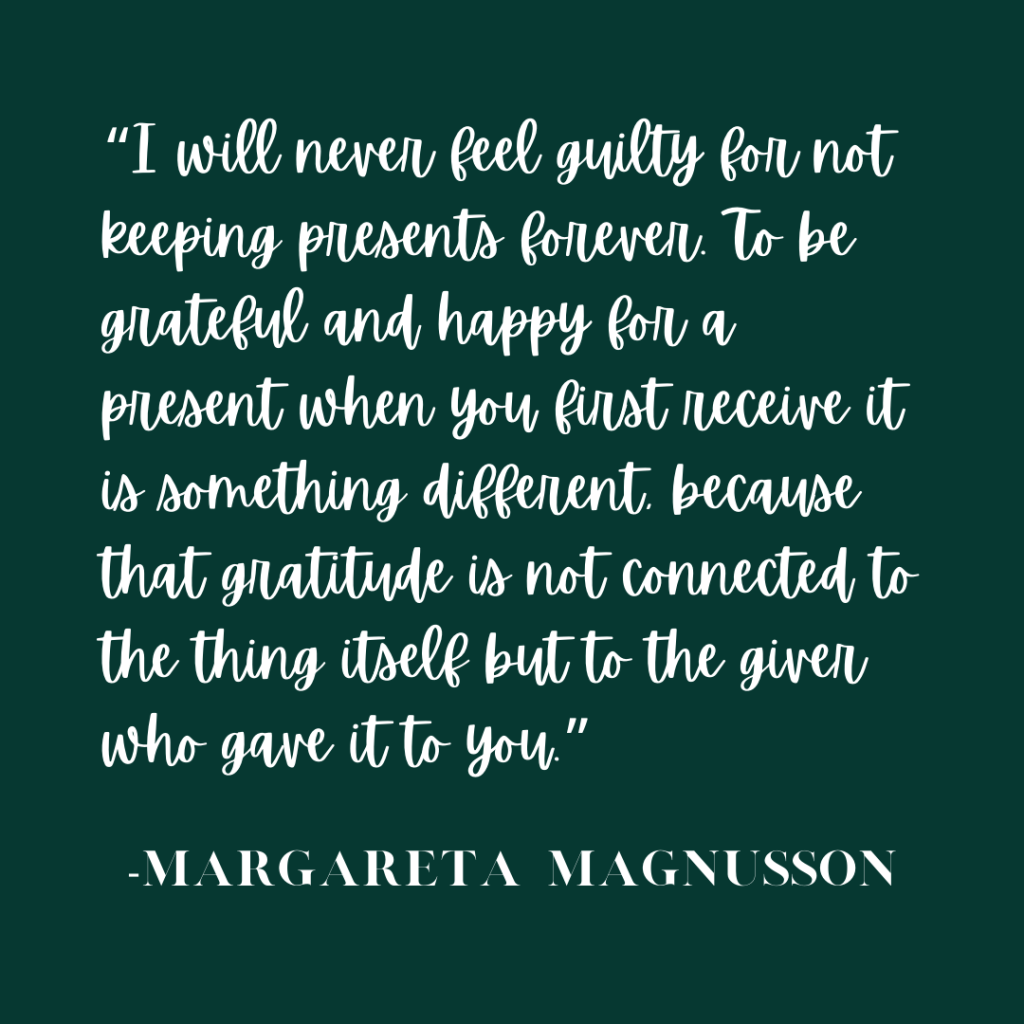
The next tip is to not feel bad about decluttering gifts! We can’t be expected to hold onto every gift we ever get for the rest of our lives. That would be ridiculous. Most people would not want their gifts to become a burden to you. For those gifts that you are no longer using or loving, it is okay to let them go. I really appreciated a quote from the book which was: “I will never feel guilty for not keeping presents forever. To be grateful and happy for a present when you first receive it is something different, because that gratitude is not connected to the thing itself but to the giver who gave it to you.”

The sixth tip is that you should save photos for last. Photos fall into that sentimental category, but in addition to that if this project is left undone before you pass it’s not quite as burdensome to family and friends. It can be a positive experience for them to be able to go through all the photos. 
The last tip is to have a “throw away” box. This is a box that you would literally write “throw away” on the outside of it so family members know that the contents of the box are really only meaningful or sentimental to you. This may be childhood toys, special letters or notes from family or friends, or maybe journals you kept.

I hope this was helpful to you! I highly recommend this book! It is a quick and easy read and there were definitely parts that made me laugh!

The video I made in conjunction with this blog post.