THE BENEFITS OF SLOW DECLUTTERING

For today’s Thoughtful Thursday post I wanted to talk about something that might not be a popular or trending idea with regards to decluttering. I wanted to encourage you that it is okay to declutter slowly, over time. It seems in the decluttering genre online, there is a lot of content around decluttering quickly. I see titles like “I decluttered 90% of my possessions in one day.” Or “Follow these easy steps to declutter quickly.” I think it is common in our culture today to want things done quickly and easily, but the most lasting and sustainable results will come from putting in the work. There is no magic pill, no shortcuts! You have to put in the reps!

There are several reasons why I think decluttering slowly could be more beneficial than decluttering quickly. The first reason is just a practical one: time. We all only have so much time in a day. Many of us have full and busy lives and don’t have large chunks of time to set aside to declutter. It is much easier to declutter a little bit at a time. If we just set aside even 10-15 minutes a week to declutter, we are more likely to get it done because that feels more manageable than spending half the day decluttering.

Another reason it is good to declutter slowly is the reality of decision fatigue. Just like we only have so much time in a day, we each only have so much brain bandwidth to make decisions. I’m sure we have all experienced days where we were exhausted just from all the little decisions (or big ones) we were making all day long. When decluttering a lot of items at once, that is obviously a lot of decisions. At some point we reach a place where our decisions aren’t as clear or confident as they were at the beginning of the day. When we declutter a little at a time, we give our brains time to rest. 

Adjacent to this idea that our decisions might not be as sharp when we declutter quickly is we are less likely to replace the stuff we decluttered when we declutter slowly. Our decisions are more informed and it gives us time to really determine what we are loving and using. Sometimes when we declutter quickly, we have regrets about some of the things we let go of and then we want to replace them. Not only is this is a waste of money, but also is not eco-friendly as some of those items may have ended up in a landfill. On the other hand, we may just feel the need to fill up our spaces when we declutter a lot at once. It can be a shock to go from having a lot of possessions to little possessions, and this could fuel a desire to purchase more.

Lastly, decluttering slowly builds decluttering muscles in a more sustainable way so that regular decluttering becomes a habit. Decluttering slowly gives you time to really learn the skill of decluttering. It gives you time to evaluate what you really use and love.

Don’t get me wrong, I think there is a place for decluttering large quantities at once. Maybe you are moving and need to declutter a lot at once, maybe a loved one has passed away and you need to go through their things and declutter a lot. My point here is that for the average home, it might serve you better to declutter slowly over time.

If you follow me on YouTube, you might have noticed I KEEP DECLUTTERING on my channel. I really thought I had gotten to a good homeostasis point, but I realize it is just because I am decluttering slowly that I am still going. Even with doing a no buy year and bringing less into my home this year, I am still finding things to declutter. I’m finding things over time that I realize I thought I used or I thought I really loved, but in reality I don’t. I have kind of wondered if maybe not bringing things into my home has given me the time, brain bandwidth, and awareness of my stuff to make more ruthless decisions! This is also a reminder that it may take several passes in each area of your home, so keep decluttering!

The video I shared on YouTube in conjunction with this blog post.

NO BUY YEAR JULY RECAP

Okay friends, this is the last Thursday of the month, so that means I’m sharing my thoughts on how my no buy year has been going so far and for this month. I didn’t share a post in June because things were just kind of going along smoothly and there really wasn’t much to share. I think it helped that I had two get-aways during that month – one to celebrate my husband’s birthday and then another to visit friends in Tucson, and so I think I was distracted from being tempted by buying things. With that said, I will say right up front that I failed AGAIN this month! I will share more about the details and also talk about why I think this month was so hard for me.

I shared in May that I purchased a couple items of clothing, so I felt like I failed in May. Although I was able to somewhat make the excuse that I purchased the items for my trip to Tucson. I didn’t have a caveat for trips in my rules because I didn’t even know I was going to plan that trip. Well, once again I purchased a couple of items of clothing. One was a skirt that was very similar to a skirt I borrowed from my daughter and really loved! And I decided to purchase a second item to get free shipping – now that’s just being wise with my money right?? But the only justification I have for this purchase is that the skirt was on sale and that really got me. Also, I purchased it from a boutique where they don’t restock items. Once they sell out it’s gone. I knew I would like it because I loved my daughter’s skirt. But I still consider this a fail for me for this month. I will say, the further I get into the year, the more difficult it becomes to stick to my rules.

I don’t want to make excuses as to why I cheated this month. I will take full ownership that I failed. One lesson I have learned in life (that is still hard for me as a recovering perfectionist) is that failure isn’t all that bad. Failure leads to learning and growth, that is if we allow it to. I always like to evaluate my failures so I can make better choices moving forward and so I can see the lesson in it. This month has been tough for me. There have been lots of changes happening, most of them are good changes but it’s difficult for me to deal with change. I have backed off on posting on YouTube as I have decided to pursue growing my organizing business again, and while this is a good thing, it is a change. There are a couple of other things going on in my personal life that are also creating changes, but again all good things! With these changes, it has caused my anxiety to spike and my overthinking and rumination to move into high gear. As I have mentioned before, shopping is definitely one of those vices I run to when I am feeling stressed. All month long I have struggled with looking at clothes online – walking right into the place of temptation – instead of choosing healthier ways to handle my stress. So the lesson learned is that I need to not mindlessly do things, but to be aware of when I am feeling that stress, or at least aware when I am starting to run back to familiar places for comfort.
One of the reasons I did a no buy year was in order to really deal with this habit I have of shopping to feel better or to alleviate stress. So I must be more on guard and aware of those moments so I can choose a healthier option for dealing with my stress. This is a difficult thing for me because I do tend towards perfectionism… can we really always make good and healthy choices, or is there a balance in there? Let me know your input down in the comments.

I did want to share a win with you today! Last week I went into Home Goods to look for some coffee syrup. Random side note here, but this is a great place to find coffee syrups at a discounted price! But I noticed while I was there, that I was not at all tempted to look through home decor, blankets, or pillows. While in the past I might have been tempted to look, this time I was not and it was quite the contrary… instead I really was repulsed by the idea of bringing more things home. I don’t know why I don’t feel this way about clothes yet! Make it make sense! BUT, back to my trip to Home Goods. I was browsing through the food, and then I went to the section with organizing tools, just to see what kinds of things are available in case this is somewhere I might want to shop for clients. This was on a Sunday, so the place was packed. People everywhere pushing carts full of stuff. I couldn’t help but feel like I had taken the proverbial “red pill” (IYKYK) and was aware of the truth. The truth that none of this stuff would make you happy. As a matter of fact, once you walk away with your purchase the dopamine hit is done. Did you know that dopamine is released during the actual shopping part – it’s the thrill of the hunt, which is human nature. But shopping is short-form dopamine, meaning that up feeling won’t last long. And then you are left with this item or these items that you now need to take care of – clean, organize, and maybe one day make a decision about decluttering it. It’s a silly cycle that happens if you think about it. You want that dopamine rush so you shop, but once you purchase it and bring it home that rush is over, then you declutter to make space for more stuff. I want off this crazy merry-go-round! Not that I will never buy things again, but it’s just good to be aware of all of this! And we work hard to make this money that we are basically using to buy stuff that we often don’t need and it creates more work for us!

Okay my friends, that is all I have to share for this month’s no buy year recap. As always, I love to hear your thoughts on my thoughts so let me know down in the comments.

Here is the YouTube video I shared in conjunction with this blog post.

DECLUTTERING CONFESSIONS

Okay friends, for today’s Thoughtful Thursday I wanted to share a few confessions about my decluttering practices. One thing I have been thinking a lot about is authenticity online. I think it is okay to have some boundaries online, but it is definitely a tough balance to keep some things private while still being authentic. There are parts of my life that I keep private because it has nothing to do with the content that I share. My aim with my blog and YouTube channel is to inspire and motivate people. My content is about cleaning, decluttering, and organizing. SO, with that said I want to share my confessions about decluttering as I think sometimes I think I can make it look simple.

My first confession: there are some items that I do not remove from my home right away. For the most part I actually remove all items I declutter from my home after collecting enough to take to a thrift shop. BUT, sometimes I have items that I am struggling to let go and I will stockpile those items in my laundry room cabinet. Typically these are items that I have a sentimental attachment to, but I do think it’s best to get rid of them. It does help to separate them out and keep them down there because I think it begins to break that attachment.

With regards to the stuff that I have decluttered, but really ends up in quarantine, I have a story to share with you. Recently I decluttered quite a bit of jewelry. This is one category that I really struggle to truly let go of it so I have quite the pile just quarantined in my laundry room. Unless I give it away to someone who I know will enjoy it. In this last round of decluttering I sent several pairs of large leather earrings to a friend who wanted them! But the other pieces I added to the growing pile that was still left in my laundry room. I decided to go through the jewelry really quickly to see if I was still feeling okay with letting it all go. I came across this bracelet that had the phrase “Choose Joy” inscribed on it. I actually purchased this bracelet along with a similar one that read “create” many years ago at a local boutique here in Austin. In general, I do not often wear bracelets. I find they just get in my way when I am trying to do everyday chores. I believe that is why I chose to declutter these bracelets. I was not wearing them often enough to warrant keeping them. But when I came across that “choose joy” bracelet, the meaning hit me a bit differently than when I purchased it. The artist who created this bracelet probably intended for the meaning to be a reminder to choose joy everyday. But this time when I read the message I thought to myself “choose joy” huh. Choose myself. Once again my name provides a double meaning for me.

I feel like one thing I have learned over the last several years is to quit putting myself last. Quit constantly putting everyone else’s needs and desires ahead of my own. Not in a selfish way, not in a rude way, but recognizing that it is okay to have needs and desires. Suddenly this bracelet’s message meant more to me than it previously did. AND, you guessed it, I did retrieve this bracelet from the declutter pile and I’ve been wearing it! So if you are really hesitating to follow through on decluttering something, or a category of things, it’s okay to wait until you are fully ready to let go!

My next decluttering confession is that I have had regrets on items that I have decluttered. But, honestly, it is only one category of things that I truly have regret for decluttering and that is the physical copy of Bible studies I have gone through. Usually after I am done with a Bible study I just recycle it unless it was something really meaningful and I thought I would revisit the information later. I wish that I had kept these as it might be a neat thing for my kids or grandkids to look through one day. I especially regret all of the inductive Bible study materials I got rid of. If you’re not familiar with this type of study, it is looking at the words used and cross referencing the Hebrew words for the Old Testament and the Greek for the New Testament. I have done this type of study for 15-20 books in the Bible over the years. I really wish I had kept all of those materials. BUT, I guess I can start over and save them moving forward!

My last decluttering confession is that I do experience guilt about the wasted money I spend on items I am decluttering. I have spoken about this before, but I recognize that it really is a privilege that I can declutter. I recognize that some people are more hesitant to declutter because they can’t easily financially replace items if they change their minds. I know that at one point in my life I used shopping as a way of coping with stress and anxiety. This is exactly why I chose to do a no buy year back in 2019, to reset these toxic habits. And I saw this habit creeping back in, especially over the past year, so I decided to do another no buy year this year. I do wish it had not taken me so long to learn that this was a coping mechanism. I don’t like how wasteful I was in the past, and I don’t like that I was on that consumerism hamster wheel. But all I can do is make better decisions moving forward!

I hope you found these decluttering confessions interesting! Let me know if you have any decluttering specific questions for me and I can address those in a future blog post. But as always, I would love to hear your thoughts on my thoughts today! Let me know down in the comments!

Here is the YouTube video I created in conjunction with this blog post.

FUN MINIMALISM GAME: SILENCING A ROOM

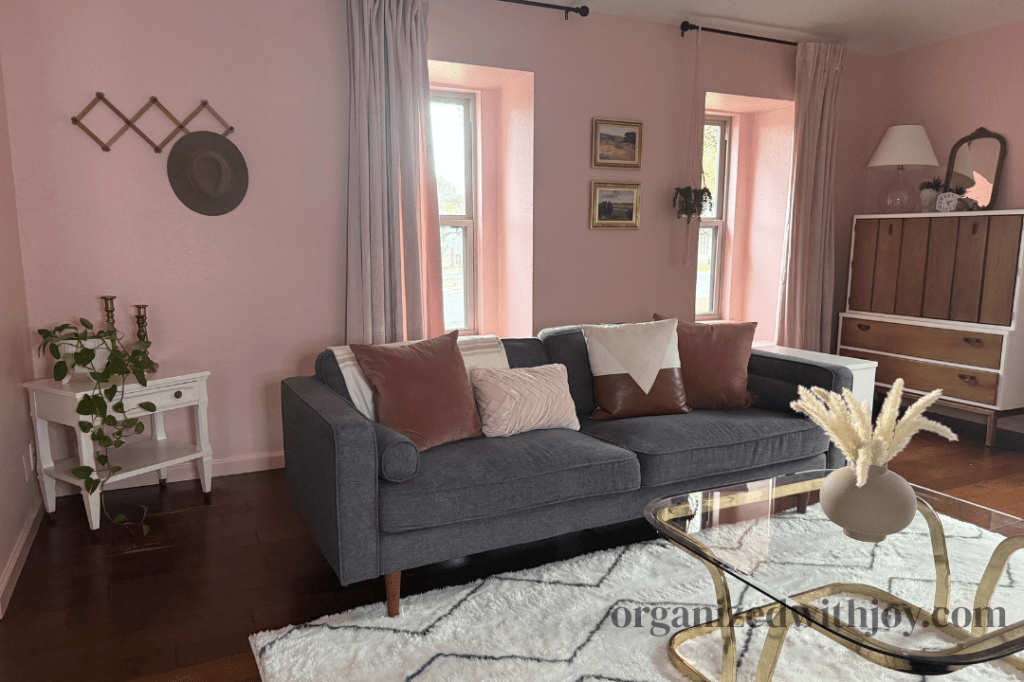
For today’s Thoughtful Thursday post I wanted to talk about a concept I recently learned about from another YouTuber. In her video she talked about the idea of silencing or quieting a room. I have been on this journey towards minimalism and decluttering for almost 10 years now and I’m always looking for different ways to level up in order to challenge myself further on this journey. The basic idea of silencing a room is to remove everything from the space (or most things) in order to reset it to square one, and then bring items back into the space as necessary.

I decided to try this technique for the first time in our living room. I know this might work better in a more functional space, like a bathroom or bedroom, but I decided it was a good space to start in our home since this space was fairly minimal to begin with. I did challenge myself to remove items from this space and to live with it for about a month to see how I feel. 

As I pursue minimalism, one of the challenges I have faced is finding the balance between creating spaces which are minimal and easy to maintain while also feeling cozy and inviting. Our living room is definitely one of those spaces I have been working on to create that perfect balance. I was surprised by how much I was able to remove from this space and as I have lived with it for a few days, I still feel like it feels cozy and not sterile.

I do think when we are pursuing minimalism it can be a slow process. I know for me I have decluttered our home slowly and in phases over the last 10 years. I have been married for almost 30 years, so I decided it took 20+ years to accumulate all of our possessions, so it might take a while to declutter them. Doing it slowly and in phases has helped me to not feel as overwhelmed. However, when we are slowly decluttering we may not notice our progress. I highly encourage you to take photos or videos of your spaces as you are on a decluttering journey so you can chronicle your progress. I’m thankful that I have a YouTube channel which has organically allowed me to keep track of this progress as I have so many videos on my channel of how my home has transformed over the past 5 years.

Here is one item I removed from my living room. I am not quite ready to declutter this piece, I was just removing it from the space for now.

Sometimes we can feel like we are not making much progress and that is why documenting with photos or videos can be helpful. But I wanted to share a story with you of something that really made me recognize my progress. Over the holidays I was at a friend’s home for a party. I always viewed this friend as being minimal and she and I have similar home decor taste. Granted I know her Christmas decor was up, but sitting in her living room I realized how minimal my home and home decor was compared to hers. Don’t get me wrong, her home is beautiful, clean, and organized, but the difference was striking to me. I had never noticed how much more decor she had than me being in her home before.

One of the greatest benefits of decluttering and pursuing minimalism is having less to take care of. Less to clean, less to organize, less to manage. When we have less to manage we are able to pursue other things. We have more time to invest in hobbies and relationships, which I find to be far more fulfilling than taking care of stuff.

I am excited to implement this concept in other spaces around my home in order to challenge myself to potentially declutter even more! The more we declutter, the more we build those muscles, and it gets easier! I shared a video over on my YouTube channel of the process of silencing my living room. If you would like to check it out I will link it below!

Here is the video I shared in conjunction with this blog post.

5 BENEFITS OF MINIMAL HOLIDAY DECOR

Okay friends, for today’s Thoughtful Thursday I wanted to share with you the 5 benefits of having minimal Christmas decor. I thought this was a great topic for this time of year as we all begin to get our holiday decor out! And before I get into that, just want to make a disclaimer and say I fully appreciate people who like to go maximalist for the holidays! If you enjoy having an abundance of decor for the Christmas season and it works for you then go for it! I just wanted to share the benefits of less!

The first benefit of minimal Christmas decor is that it saves you time! It takes less time to put up the decor and it also takes less time to take it down. Around the holidays is such a busy time of year with extra obligations and events to attend. There is shopping, wrapping, filling out Christmas cards, holiday parties, and end of the season children’s events to attend! Not to mention the extra baking and cooking this time of year! Having extra time is always a good thing, but especially around the holidays!

The second benefit is that you are able to fully enjoy the items you have to display. With a curated holiday collection of decor, you are able to appreciate each piece fully! You are able to focus on quality over quantity, and each piece becomes that much more special. For me, an extra side benefit of this is that you are more intentional about what you purchase for holiday decor, not overspending on decor during a season where there is more financial burden than the rest of the year.

The next benefit of minimal holiday decor is it prevents overstimulation. The holiday season can be a season of overstimulation! This season is a time where excess seems to be acceptable – eating, drinking, socializing, gifts, and of course decor! All of this excess can be very overstimulating. We all have a different bandwidth for how much we are able to handle before we feel overstimulated. I admit that I think I have a lower threshold than most. But with less to visually consume each day, the less you will be stimulated. This is honestly true for decor year round! Overstimulation can lead to stress as well, so this also can prevent additional stress in what can be an already stressful season.

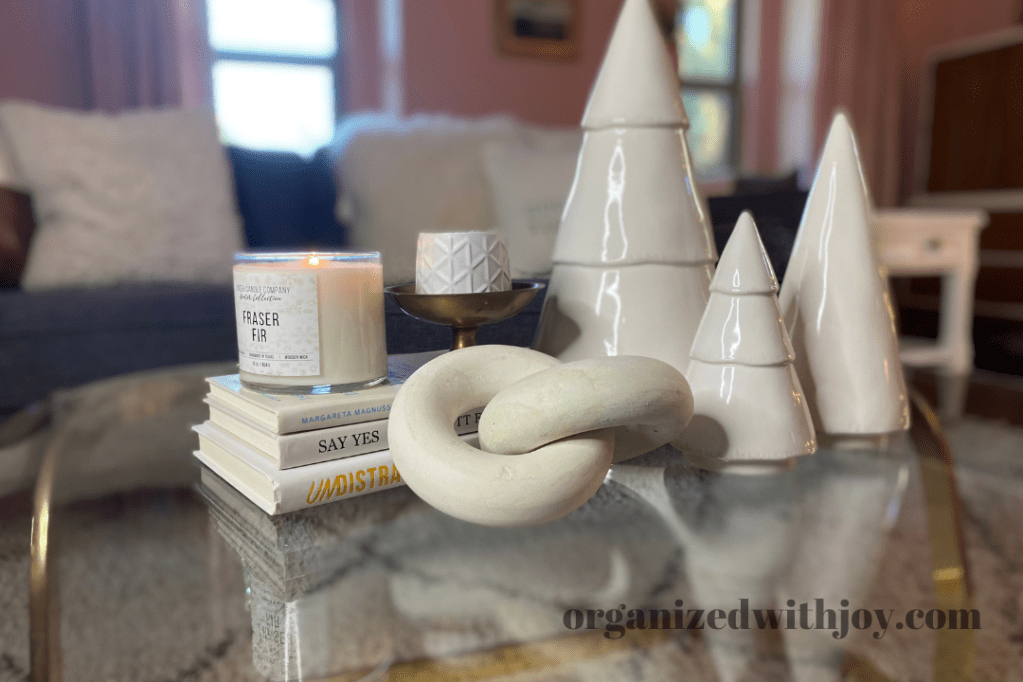
The fourth benefit is that minimal Christmas decor promotes creativity and personalization. With minimal decor, it affords you the opportunity to get creative. I like to arrange my holiday decor differently every year. This helps me to not be as tempted to purchase new decor each year. I like to find not only a different space to style my items around my home, but also styling them in a new way. I chose to style the white ceramic trees on my coffee table this year, which lead to me coming up with this whole white theme idea! Last year I styled these trees on my mantel {{see photo above.}} It also encourages personalization and uniqueness as you curate your collection intentionally and style it in a creative way. There is something to be said for being intentional with what you purchase and collecting unique pieces over time. 

Lastly, with minimal Christmas decor we are able to focus more on the holiday spirit – spending time with loved ones, enjoying holiday gatherings and traditions, or cooking and baking special holiday treats and meals. Focusing more on the essence of the season – family, friends, and memories, instead of getting lost in excessive decor will be more meaningful in the long run.

Here is the YouTube video I shared in conjunction with this blog post.

CURBING EXPECTATIONS

Okay friends, this week’s Thoughtful Thursday will be brief because I always share the content of these posts over on my YouTube channel in conjunction with sharing some sort of homemaking motivation and this week I did a lot of chatting in this video! I was decluttering and cleaning out my closet, so if you want to check that out I always have my YouTube videos linked at the bottom of each Thoughtful Thursday post. Perhaps this will make up for the extremely long one I shared last week! For this week’s topic I wanted to talk about a quote I shared over on Instagram earlier this week. It is a quote from Buddha and it says, “Don’t blame people for disappointing you. Blame yourself for expecting too much from them.”

I thought it was appropriate to discuss this idea to share while I’m cleaning out my closet because for a long time I really struggled with placing expectations on my husband. There were a lot of expectations I had, but today I will talk about this expectation that he would have the same desire for a clutter free environment and therefore put forth effort to declutter. I personally decided to stop having this expectation of him. I can lead by example, and I can do things to make decluttering more manageable for him, but I understand that he doesn’t really want to spend his free time decluttering.

We need to allow people to set boundaries and what they are capable or willing to do, recognizing that they will not always do things the way we want them to or the way we would do them. I like quoting Mel Robbins who brings up this idea often on social media and her podcast: she says “Let them.” We are not in control of other people and how they live their lives so we need to just let them. Let them live their lives the way they want to or need to live their lives. With most people, perhaps not with our spouse, we only see a small portion of their lives. We don’t know what they are going through. We don’t know what their social or emotional bandwidth is. We don’t know how much margin they have in their lives. So, to have expectations of people is really just not fair. We must have a perspective shift and take accountability for our REACTION to someone disappointing us.

On the other hand, it is okay for YOU to set your own boundaries as well. You are allowed to live your life the way you want to. Setting boundaries is not unkind. We are only responsible for our own choices and if we are intentional with our time and boundaries we will be able to sleep well at night even if others don’t agree with or understand our choices. Like I mentioned, no one knows what you go through on a daily basis, or what your bandwidth is. Only you know and get to choose how to spend your time based on your bandwidth.

The key here is perspective. We can lead happy and peaceful lives if we keep perspective. We have a choice on how to react or respond to the behavior of others. If someone disappoints you I think it is perfectly fine and healthy to have a conversation with that person. It’s okay to let someone know, especially if they are close to you, that they have disappointed you. But the key is to have an open mind with their response, allowing them to have boundaries. This isn’t a simple thing to do, but I have found I am much happier and at peace when I hold my expectations loosely.

The YouTube video I shared in conjunction with this post.

10 MINDSETS THAT WILL CHANGE THE WAY YOU DECLUTTER

Hey friends, today for my Thoughtful Thursday post I wanted to share with you some thoughts about decluttering. I know I have talked about decluttering quite a bit on my social media platforms. I have shown the process of decluttering, what I’m decluttering, and why I am decluttering items. But today I wanted to share with you mindsets that will change the way you declutter. Hopefully by sharing these mindsets it will give you a new perspective as you move forward in your decluttering journey. Today I am sharing 10 mindset shifts to help you declutter better!

The first thing I wanted to share with you is to have a positive perspective versus negative. Oftentimes when we approach decluttering we can feel like it is a negative thing: it’s difficult, time consuming, and maybe even tiring both physically and emotionally. When we have this mindset shift that decluttering is a positive thing, moving us towards our life goals, helping us deal with anxiety or other mental health issues, and making our external environment one we love to live in, we will be excited to start the process of decluttering.

Along those lines, another mindset shift around decluttering is to focus on what you are working towards. What is the end result you want? When you create a vision for your life and have that picture in your mind it can spur you on to take the necessary steps to achieve that life you are working towards.

The third mindset shift I wanted to share is to focus on what stays instead of what goes. Sometimes it can be helpful to choose the items you love and know you use regularly and set those aside first. Then you can evaluate what is left. I have done this with clothing for instance where I choose my top favorites, then evaluate if I really need to keep what is leftover. When we focus on what is staying it can help us to appreciate what we have and have an abundance mindset versus a mindset of lack.

Another mindset shift that is similar to that is to think of decluttering as curating. You are curating your collections – anything from clothes to kitchen items. When we think of curation, we may think of a museum. Museum curators are intentional and thoughtful about what they bring in. So much like this curating, it is an intentional process of only surrounding yourself with the things you love and use and removing everything else so it’s easier to enjoy the items you own.

The fifth mindset I wanted to share with you is to focus on the inflow as well as the outflow. Sometimes we don’t realize how important it is to change our spending habits as we work towards decluttering our homes. If we don’t change the inflow, then we will quickly come back to square one and the decluttering progress we made will have made little difference. Sometimes we must be ruthless with ourselves and implement a spending freeze or a no buy period in order to change our habits.

Another mindset shift is realizing you do not equal your stuff. Your value is not in the clothes you wear, the car you drive, or the stuff you own. Finding our value in something more important like in our faith, in our ethics, or in the way we live our lives makes more sense. If we find our value in our stuff, this is a very unpredictable thing to put our value in as we could lose our stuff or lose our jobs and not be able to continue to buy more items.

Something else I wanted to remind you of is having the mindset that the money is long gone. You cannot get your money back after you have purchased and then used an item. Some people find it difficult to declutter because of the money they spent on an item. If an item is sitting in the back of a drawer or cabinet going unused for years, it does not help us financially to hold onto it. Let go of the guilt you may have for spending money on items and then make better decisions moving forward in the future.

Speaking of guilt, let go of all of the guilt around getting rid of items. Whether it is guilt over spending money on the item, or maybe it was a gift given to you and you feel bad getting rid of it, or perhaps it’s something you inherited. If the item is no longer serving you, let go of the guilt and let go of the item.

The ninth mindset change I wanted to share that is adjacent to the feelings of guilt is that memories are not stored in things. You can have memories of a certain time in life, or of a person without holding onto items. Sometimes it can help to take a photo of something if you are struggling to let go because you have memories attached to the item. I do recognize that sometimes tangible things can spark our memory of a time or person, but ultimately the item itself does not hold the memory. The memory is in your mind!

Lastly, I wanted to share that decluttering doesn’t have to be a sprint. In spite of what Marie Kondo told us, we do not have to declutter our whole house in one day! I understand that different decluttering processes work for different people, but sometimes this mindset that we have to declutter all at once or set aside a big chunk of time to get decluttering done prevents us from getting started in the first place. If we have the mindset that we can do a little at a time it will feel more manageable. Oftentimes once you get started the ball starts rolling and you want to continue on, but you can have the mindset that it can be a slow and steady process!

WHY DECLUTTERING ISN’T ENOUGH

Well, it has been quite a while since I have posted here on my blog! I have been focusing on my other social media platforms – YouTube, Instagram, and Tik Tok. I have been thinking about how I would like to share more often here on my blog. On my YouTube channel every Thursday I share in a video series called Thoughtful Thursday where I share cleaning, organizing, and/or decluttering motivation and in the voiceover I share my thoughts on a topic. This week my topic was pertinent to my website, so I decided to go ahead and share the information that I shared in that video. But it got me to thinking that I would love to start sharing my Thoughtful Thursday thoughts here on my blog as well, even if it isn’t specific to cleaning, organizing, or decluttering. So, you can look forward to seeing my thoughts each Thursday!

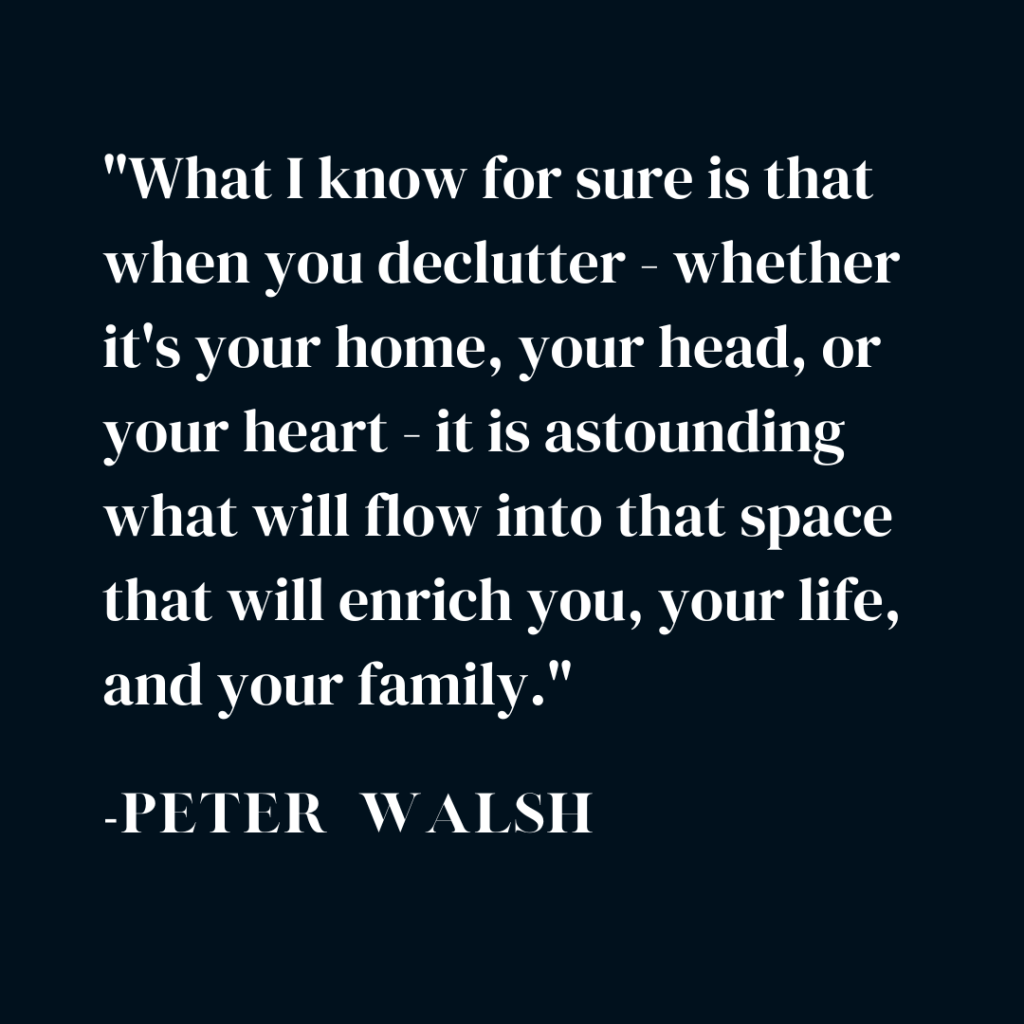
So, for this week’s Thoughtful Thursday I wanted to share with you why decluttering isn’t enough to create a clutter free home. Over the weekend I was thinking about how much time, energy, and effort it takes to keep up with our stuff – caring for, cleaning, and organizing it. I came across a quote from Peter Walsh, a professional organizer and author, probably best known for the TLC show Clean Sweep. I shared this quote over on my Instagram feed earlier this week: “What I know for sure is that when you declutter – whether it’s your home, your head, or your heart – it is astounding what will flow into that space that will enrich you, your life, and your family.”

This quote has inspired me to continue decluttering my home, even though in some ways it seems like I have nothing left to declutter! When we declutter, we make space for other things that will enrich our lives. I also loved his point that it’s not just our physical stuff that takes up space – but also mental and emotional clutter can prevent us from experiencing other beautiful things in life. We must be self aware, realizing what we spend our time and brain space thinking about and telling ourselves. I talk a lot about the importance of self talk over on my YouTube channel, as well as on my Tik Tok page. It is meaningful what you say to yourself. Also, if there are unresolved emotional issues in life, I encourage you to not ignore them but deal with those issues. Whether that’s reconciling in relationships, healing from past hurts or trauma, or just dealing with day to day emotions. This may require seeking professional help, and I can tell you from experience that this is so worth it. When we make time to deal with our emotional “clutter,” if you will, it frees up space in our lives for something else!

I did want to camp out on the physical clutter aspect today. I think one thing many of us don’t realize is that decluttering is usually not enough to keep a clutter free home. First of all, decluttering is an ongoing process. As long as items are still coming into our homes, we will have a need to assess what we are using and loving. Over time, as we go through different stages of life – for ourselves and especially our children – we will need to evaluate what we are still using.

In addition to this, I think one of the biggest reasons people feel like their homes are still cluttered despite decluttering, is because of the inflow. Things come into our homes organically – if nothing else junk mail, and kids’ papers. But we may also be contributing to this through our shopping habits. Think about how easy it is for something to come into your home. Especially if you do online shopping. You can shop from the comfort of your sofa, or even your bed. Within a few clicks you are done and the item is on its way directly to your front door. Whereas if you want to go through the decluttering process you must set aside time to evaluate your items, make decisions, sort the items, bag or package up the item for donation, drive to a donation center, or go through the steps it takes to sell an item online – taking a photo, writing a description, etc. It is actually much more difficult to get rid of items than to acquire them. This is something to keep in mind while shopping.

I have shared about my no spend year back in 2019, and this really opened my eyes to my spending habits. I am so thankful for that experience as it has helped me to be far more intentional about what comes into my home. Related to this, in order to keep the inflow in check, I do not purchase new things for each season – like new decor or new clothes. I like to curate my collection of decor and wardrobe intentionally and purchase items that speak to me. I may add some new items for a particular season, but I don’t shop for each new season.

In addition to this, is how easily we accumulate things because of free items or sales. I have learned that it is okay to say no to free items if it is not something I will love or use. It took time to learn, but now I am much more particular about what is allowed in my home.  I have also learned not to get sucked into a good deal. Just because something is on sale or seemingly a good deal, doesn’t mean I need it or it will be useful to me.

Something else that will make an impact in your decluttering process is accepting that it’s okay to have open spaces in your home. Now, I recognize that this may not resonate with everyone – I know some people are maximalists and like every nook and cranny to have something in it, well maybe this blog post is not for you anyway! Once you get to the point where you have open spaces, then you may be seeing the difference in your home on your decluttering journey. Sometimes we feel the need to fill the space back up, and obviously this is going to be counterproductive if you are getting rid of items just to fill the space back up again.

If you are on a decluttering journey, I hope these ideas were helpful to you. It’s really not enough to just declutter our spaces. We must change our spending habits as well in order to truly make an impact. I know for me, I just got tired of the cycle of stuff going out, stuff coming in. Slowly but surely I am seeing more open spaces in my home. It has helped greatly with my anxiety levels, not feeling overwhelmed with stuff in my space and just not having to take care of as much stuff as I once did. I am still working on it! I am thankful for the space I have now for other things to flow into my life, as Peter Walsh says.

Here is the YouTube video I made in conjunction with this post!

Reducing Visual Clutter

Does your external environment cause you anxiety? Do you struggle to focus because of external clutter? Today I wanted to talk about visual clutter, the impact it has on us, and how to reduce it.

For many people, visual clutter is distracting. The reason is because our brain is constantly processing our environment. Visual clutter can have an impact on our mental and emotional health, resulting in us not being as efficient and productive as we could otherwise be.  Clutter has been linked to cortisol production, the stress hormone. Research from a 2009 study out of UCLA’s Center on Everyday Lives of Families (CELF) has shown that women who perceive their homes to be cluttered tend to have unhealthy patterns of cortisol levels. Interestingly, men did not have the same cortisol response with regard to clutter. This could potentially be because women tend to take on more of the household chores even if they are also working full time. Clutter is also linked to lack of self control, resulting in unhealthy eating habits. According to a Cornell University study from 2016, stress triggered by clutter may also trigger coping and avoidance strategies, like eating junk food, oversleeping or binge-watching Netflix.

So what can we do to reduce visual clutter? I wanted to share some ideas for you to reduce visual clutter in your home today.

First, the obvious one: declutter your possessions. When you have less, it is easier to clean, store, and organize your items. This can be easier said than done, so I suggest doing this slowly over time. If we try to declutter all of our items at once, we can get overwhelmed and experience decision fatigue. Slowly but surely as you declutter your possessions, you will have less visual clutter.

The next one goes along with the first. Be intentional with what you keep and what you bring into your home. When you are intentional with what comes into your home, you have an idea of where the item will go and how you will use the item or what purpose the item will fulfill to you. Sometimes people get into the habit of purchasing anything they find beautiful without intentionally thinking about its purpose. This is when it gets difficult to find a place for everything we bring into our homes. I have learned to enjoy and appreciate items visually at the store, acknowledging that you like it and it is beautiful,  without having to take the item home with me.

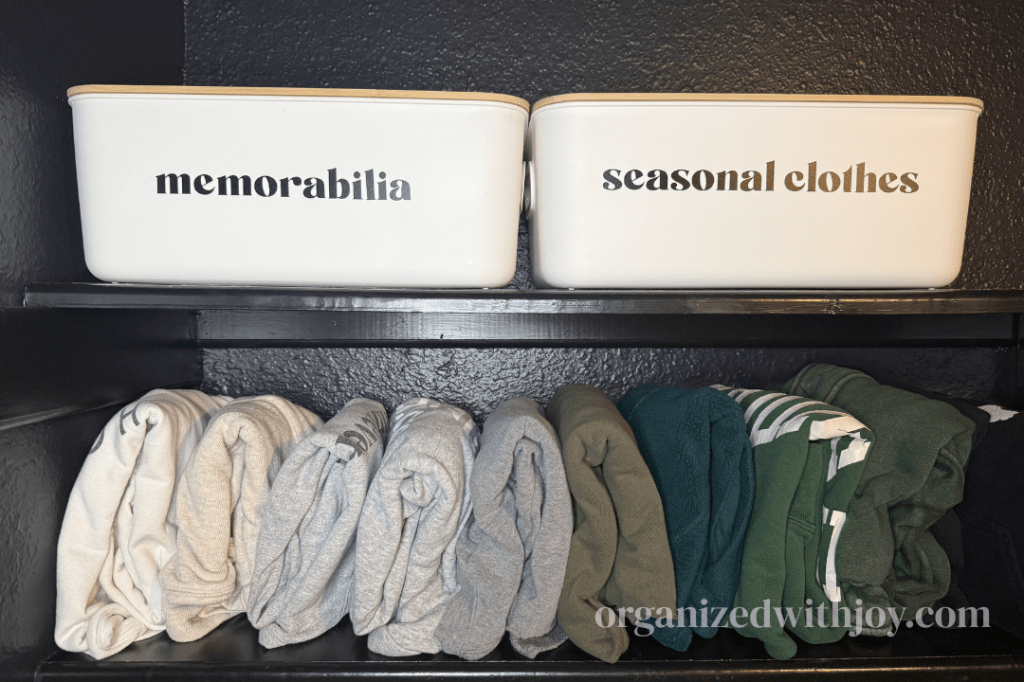
Next, group like items together in bins or baskets. When smaller items are stored away in bins or baskets, there is less visual clutter.

Choose uniformity when organizing and storing items. Get uniform food storage containers, cleaning bottles, and storage bins. When you have uniform jars, bins, and bottles you eliminate bright colored packaging, making your space feel more calm.

Have a place for everything. If you have a home for each of the items you own, they are less likely to get left lying around your home. When things are put in their proper place, your home feels less chaotic and less cluttered.

Another principle you can implement to reduce visual clutter in your home is maybe one (or a few) is better than an abundance. Throw pillows are a good example here (although admittedly I likely own too many of these!!) Maybe having 2 on your sofa is better than having the entire sofa lined with pillows. Or perhaps it’s home decor. Maybe having a small vignette of 3 items grouped together is better than the entire piece of furniture being covered in home decor.

Lastly, storing items away in a cabinet or drawer instead of leaving it out can reduce visual clutter. For me, I like to have a spot in my cabinet to store things like our toaster, the blender, and other large appliances. In the bathroom, you can have space for your items such as make up, a hair brush, toothbrush, and facial products in your bathroom drawers or cabinets instead of housing them on top of the counter. This will immediately reduce visual clutter in these spaces.

I hope this gave you some practical ideas on how you can reduce visual clutter in your home today!

The YouTube video I made in conjunction with this blog post.

Six Decluttering Tips To Give You Momentum

Decluttering can be difficult and daunting. Sometimes it’s just getting started that is the hardest part! I wanted to share with you six tips to help you with the decluttering process. At the end of this blog post I will share with you a PDF printable document with a list of spaces in your home that you can declutter!

The first tip is to get rid of old things you are replacing immediately. If you are replacing an item, whether it’s a broken toaster, or a worn out set of dishes, immediately put the old items in the donation bin. You don’t even have to think about if you should or shouldn’t since you are replacing it with a new item. If you don’t get rid of it immediately, you may end up forgetting and having duplicates of the same type of item in your home.

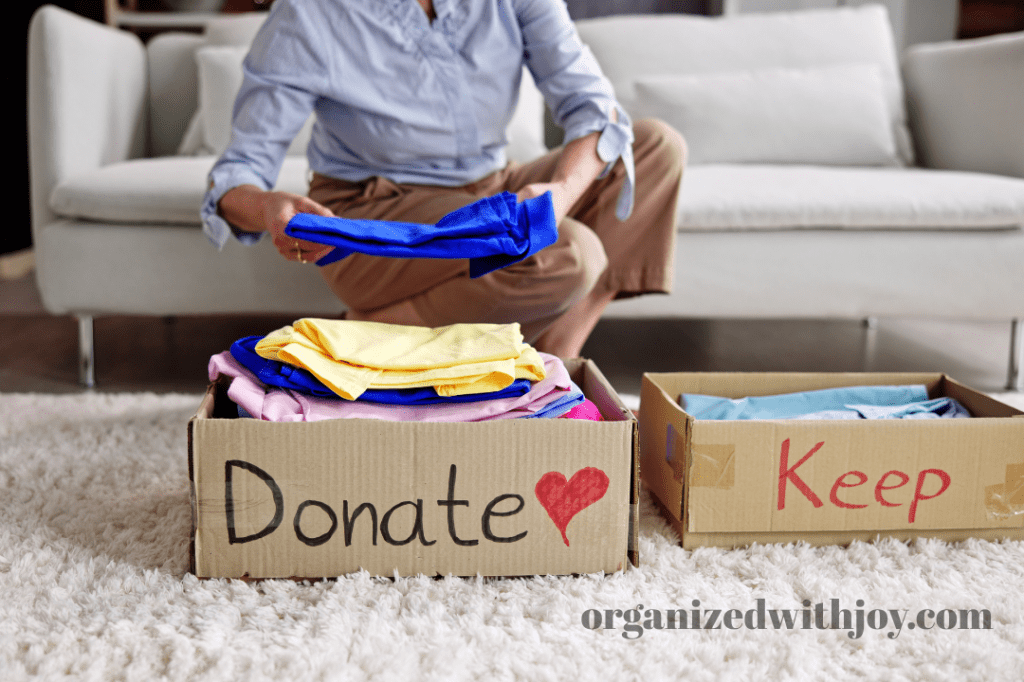
The second tip is don’t second guess yourself – once it’s in the donation box, it stays there. It can be tempting to revisit the donation bin and second guess if you made the right decision. I would suggest if you have items that you are on the fence about to have a separate bin where you can store these items for a fixed amount of time (usually 6 months is a good amount of time), then move them to the donation bin once you realize that you didn’t miss the items. Usually there is a reason you initially put an item in the donation bin, so don’t second guess that gut instinct.

The third tip is don’t declutter other people’s stuff – you’re not responsible for it! Allow other people – whether that’s a spouse, children, or other family members living with you – to declutter their own items. It’s very important to allow people to make decisions about their own possessions. If you declutter someone else’s things, you risk having tension in the relationship and there is a good chance that they will bring more things into the space when you declutter their items without permission.

The fourth tip is to start with easy/non-sentimental items. It can be very time-consuming and therefore discouraging to start with decluttering sentimental items. When decluttering items that you don’t have a sentimental attachment to, or they are easier to replace, it makes the decluttering process go more quickly. Oftentimes with decluttering, you just need momentum to continue the process. Starting with something like decluttering kitchen items will make it easy and quick to make decisions giving you confidence moving forward.

The fifth tip is to set a timer. This makes it feel easier, like you’re not going to spend the entire day decluttering. Setting a timer allows your brain to know that you will only be working on this project for a finite amount of time. Sometimes decluttering projects can feel overwhelming, but you don’t have to declutter everything in one space all at once. Decluttering a few items is better than none.

The sixth and final tip is to have fun! Don’t overcomplicate it! Can decluttering be fun?? A couple of months ago, I played the Minimalism Game to declutter my home. If you’re not familiar with this game, you spend one month focusing on decluttering. On day one you declutter one item, on day two two items, on day three three items, and so on and so forth through the whole month. You end up decluttering over 400 items! This was a fun way to get things decluttered from my home. You could also enlist your family members’ help for items that belong to the whole family – like movies or games. Maybe take a vote on each one, and the majority wins! Or perhaps you could have a contest with other family members to see who can fill a box or bag of items to declutter the fastest! There are many creative ways to declutter that are fun and make it not as stressful as it could otherwise be!

I hope these tips gave you some inspiration on how you can declutter in your home today! Use this free printable to give you ideas on different spaces in your home that may need to be decluttered.