Okay friends, for today’s Thoughtful Thursday post I’m going to share about something I have wanted to share about for a while, but have avoided this topic. I wanted to talk about the “tradwife” movement. First of all, I will say my girlfriends and I have joked we are the OG tradwives! We have been tradwives since the 90s! Okay, the 1950s wives were the TRUE, TRUE OG tradwives! But one of the reasons I have hesitated discussing this topic is because I’m not exactly sure how I feel about it. I’m not sure if I have a strong or passionate opinion to share because I’m still parsing out what my beliefs are regarding this movement. So I will share some pros and cons.

So, first off, for those of you who don’t know what a tradwife is or have never heard this term, let me define it for you. “Trad” is short for the word traditional, so this is just a term to describe women who embrace and practice traditional gender roles in marriage (or in their relationship). This dates back to the 1950s when a majority of women stayed at home to pursue homemaking and take care of her family instead of having a career. This lifestyle, or aesthetic, began to rise in popularity around mid-2018 when young moms were not only choosing this lifestyle but also sharing it on social media. And if you did a quick search on YouTube, Tik Tok, or Instagram you would find some pretty extreme versions of this!
But being a tradwife isn’t just about homemaking with excellence, it’s also a cultural way of life and many of them are rooted in religious organizations like Christianity and Mormonism and therefore also have religious values, conservative politics, and believe in choice feminism. I have been a homemaker for many years. I honestly have absolutely loved every aspect of staying home with children and homemaking duties. In addition to that, I have mentioned before that I am a Christian, or I really like to call myself a follower of Jesus. I do have traditional Christian values. So, maybe it’s obvious that I believe in this lifestyle. Like I mentioned at the top of this conversation, I was an OG tradwife before it was cool! Before people were sharing this kind of content online.

I do think there are a lot of pros to leading this lifestyle and I will say for me and my family it has worked really well. Part of that is because of my passion for homemaking. In addition to that my husband has been successful in his career and has always been able to provide for our family financially on his income, so that has also contributed to the success for our family. But, with all that said, I know that this doesn’t work for everyone and hang tight because I will get to the cons in just a bit!
One of the biggest pros for this lifestyle is the benefits of having clearly defined roles. I think there is a lot less fighting and negotiating about chores. We both knew what our role was to add value to our family and it was easy to just stay in that lane. In addition to that I was really grateful to be there for all of the milestone moments with my kids, big and small. First steps, first days of school, being there after school to talk, field trips, and more! Another big benefit is being able to invest in our health by cooking every night. It takes a lot of bandwidth to meal plan, shop for, and cook dinners. When you have a 40 hour a week job this is something that is tough to do. I have also found that staying at home afforded me the time to keep our home tidy, decluttered, and organized. It also allowed me to stay healthy through fitness goals, and spiritually and mentally healthy through Bible studies, meeting with friends, and participating in other enriching organizations. The clear-defined roles promote us working as a team with delegated responsibilities.

Another benefit of pursuing a traditional homemaking role is that you must be conscientious about how you spend your money. It has not always been easy to live on one income and save for our future at the same time. Because of this we have had to be intentional with how we spend our money.
Okay, so all of this sounds amazing right?? Well, like I mentioned, I think this works for some families. Some women don’t feel fulfilled in homemaking or are passionate about homemaking tasks. Some women have passions pursuing a career outside of the home and that’s okay! In my opinion, this is why I think being a tradwife is in alignment with feminism – we should have freedom to choose what we want to do with our lives without judgment. Journalist Wendy Squires stated it this way: “The last thing we need as women is for some of us to feel superior and judgemental of others. Putting women down is the patriarchy’s job, not feminism’s.” I know some women believe this lifestyle is not in alignment with feminism because of the patriarchy.
Uh oh, okay, I said the “P word.” The patriarchy. This idea is the primary reason why I hesitated to address this whole idea of tradwives! I know this is a controversial topic with a lot of nuance. I do think there is a metanarrative in westernized culture of patriarchy. This idea of men having primary control or power in different aspects of society is deeply embedded in our history. There are some aspects of the patriarchy that are not true for everyone (like every family or every subculture) – like the idea of women being manipulated into becoming dependent on a man, and then the man using whatever tactics he has to, including violence, to maintain control over women and society. BUT, I did want to bring up this idea because I think it is a danger for some women to become fully financially dependent on a man. Can it work for some couples? Yes. I am just suggesting that the younger generation of women need to be educated on this before making a decision to become a full time homemaker. I think this dynamic can work within the context of mutual respect and sacrificial love.

Some women choose this path and then can get stuck in a toxic or even abusive marriage because they are financially dependent on their spouse. Also, when only one spouse makes the income it can SEEM like that money is “THEIR” money since they technically earned the income, however this discounts all the work and contribution the homemaking spouse provides to the family. This is something that can cause tension in the marriage particularly around how to spend the money. There is so much more I could say on this topic of the value of women having financial independence and the patriarchy, but I will save that for another Thoughtful Thursday post when I feel more brave and feel I have a stronger stance on it all. It’s a complicated issue that is nuanced, and I will just leave it at that!
Another potential con to this lifestyle is that it can be easy to take one another for granted. When you have clear-defined roles, you begin to expect your spouse to perform their duties and you perform yours. It’s easy to forget to thank your spouse for their contribution to your family. Along those lines, it can also be easy to play the “who does more” game. With clear-defined roles, typically your roles are very different. It can be easy to feel like you are contributing more.

A couple other potential problems with this lifestyle are you don’t have as many opportunities to practice negotiating and compromising with your spouse and with clear-defined roles there are certain things you don’t challenge yourself to learn because those skills are not required of you since your spouse does that task. When we have clearly-defined roles we don’t fight about who is going to do what, but because of that you don’t practice talking through things and you may have to talk through big or hard things without the practice from compromising on the everyday benign things. Also, it can be easy to never learn or try to do some of the tasks your spouse is responsible for, leaving you very vulnerable if for whatever reason you find yourself single again.
Another con is if women solely chose this lifestyle because of societal pressure within their culture, for instance many religious cultures value women staying at home to care for the family. Like I mentioned, homemaking isn’t for everyone! Some women don’t have the passion for, skillset, gifts and talents to pursue homemaking. If they follow that path because of pressure they may find that they don’t feel fulfilled or they don’t find purpose in their lives. Every woman should have to right to choose if this lifestyle works for them without societal pressure on either side – either because your family or religious culture makes you feel like you should stay home, or if you feel unvalued because westernized society as a whole tends to place value on financial success.
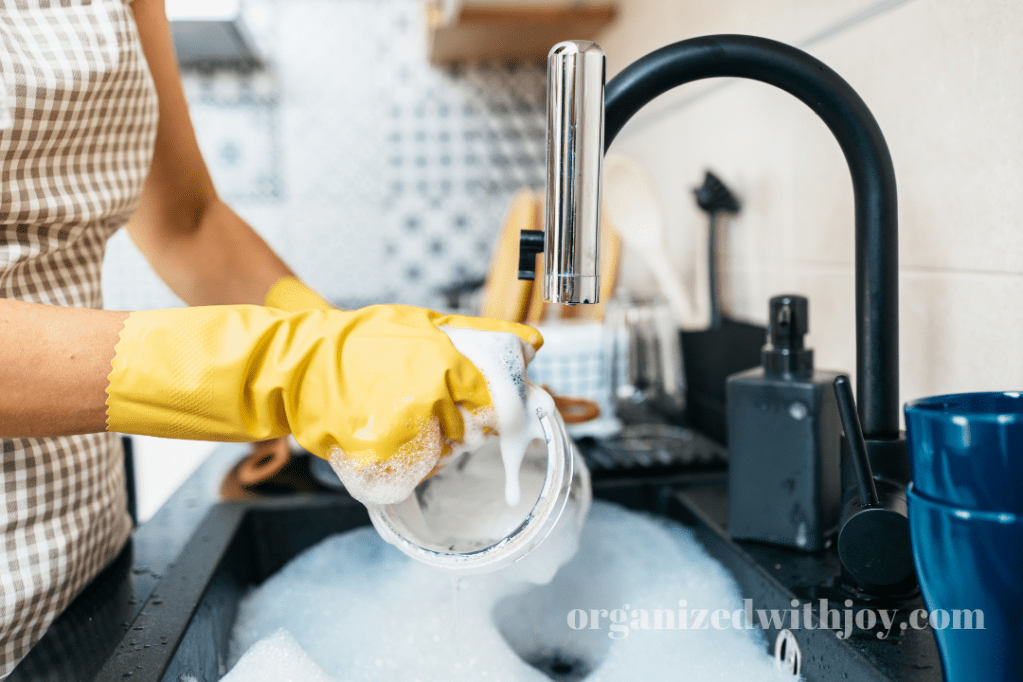
Ultimately I don’t think there is anything wrong with the tradwife movement, as long as women feel passionate about homemaking and are educated about the risks of financial dependence. Tradwives have been around for decades, honestly the internet has just given a cute name for it and social media has created a subculture out of it. Like I mentioned this is such a nuanced topic and I’m not prepared to do a full deep dive quite yet! But I absolutely would love to hear your thoughts on this topic! I love to hear different opinions to help me flesh out my own opinions on a topic!




 organized with joy