Okay friends, for today’s Thoughtful Thursday post I wanted to talk about an idea I recently heard on a podcast. The host of the podcast was discussing with the interviewee about hardships in life and he suggested that instead of asking “why?” when we are going through trials we should ask “what?” Not why is this happening to me? But what should I do next? What could I learn from this? What is the purpose of this trial in my life?
I think it is human nature to ask “why me” when we are going through a difficult time in life. It’s human nature to want to understand why, to search for reasons. But the truth is we will likely never know why. Bad things happen to good people all of the time. We are wasting our energy, spinning our wheels, if we are just focused on trying to figure out why. If we shift our energy to answering “what” I think we will not only give purpose to our pain, but also we will find peace and contentment amidst the trial as we change our perspective. When we ask “what?” instead of “why?” We can focus on practical, actionable things which are more productive.
When we are going through something difficult in life, asking “why is this happening to me?” may lead to feelings of frustration or helplessness. Instead, asking “What can I do to improve this situation?” directs energy toward creating solutions and taking ownership. In this way, “what?” questions empower us by reinforcing the idea that, while we may not control external events, we can control our responses to them.
In personal growth and self reflection, asking “what?” questions can be transformative. When you ask questions like “why am I like this?,” “why do I keep doing x, y, or z?,” “why can’t I be more like this person or that person?” this keeps us caught in self doubt and insecurity. If we focus on what questions like “what can I learn from this?” or “what is in my control to change?” or “what small step can I take today towards becoming who I want to be?” encourages constructive thinking and leads us towards actionable goals.
“What?” questions can be helpful in relationships as well. In relationships “what?” questions tend to deepen understanding and empathy. “Why?” questions may feel accusatory and provoke defensiveness instead of mutual understanding. For example if you have a friend who is notoriously late and say, “Why are you always so late?” this can be perceived as an attack on their character instead of focusing on the issue at hand. If you say something like, “What usually causes you to be late?” it opens up the conversation to the actual issue at hand instead of perceived personal flaws.
Asking “what?” questions instead of “why?” questions helps us to feel more in control and there are actionable things we can do to change our circumstances or our perspective. When we focus on the “why” we stay in a defeatist mindset where we feel sorry for ourselves and just sulk about our circumstances which is not productive. Next time you catch yourself thinking a “why?” question, see if you can reframe to a “what?” question!
This is the YouTube video I shared in conjunction with this blog post.
Okay friends, this week’s Thoughtful Thursday will be brief because I always share the content of these posts over on my YouTube channel in conjunction with sharing some sort of homemaking motivation and this week I did a lot of chatting in this video! I was decluttering and cleaning out my closet, so if you want to check that out I always have my YouTube videos linked at the bottom of each Thoughtful Thursday post. Perhaps this will make up for the extremely long one I shared last week! For this week’s topic I wanted to talk about a quote I shared over on Instagram earlier this week. It is a quote from Buddha and it says, “Don’t blame people for disappointing you. Blame yourself for expecting too much from them.”
I thought it was appropriate to discuss this idea to share while I’m cleaning out my closet because for a long time I really struggled with placing expectations on my husband. There were a lot of expectations I had, but today I will talk about this expectation that he would have the same desire for a clutter free environment and therefore put forth effort to declutter. I personally decided to stop having this expectation of him. I can lead by example, and I can do things to make decluttering more manageable for him, but I understand that he doesn’t really want to spend his free time decluttering.
We need to allow people to set boundaries and what they are capable or willing to do, recognizing that they will not always do things the way we want them to or the way we would do them. I like quoting Mel Robbins who brings up this idea often on social media and her podcast: she says “Let them.” We are not in control of other people and how they live their lives so we need to just let them. Let them live their lives the way they want to or need to live their lives. With most people, perhaps not with our spouse, we only see a small portion of their lives. We don’t know what they are going through. We don’t know what their social or emotional bandwidth is. We don’t know how much margin they have in their lives. So, to have expectations of people is really just not fair. We must have a perspective shift and take accountability for our REACTION to someone disappointing us.
On the other hand, it is okay for YOU to set your own boundaries as well. You are allowed to live your life the way you want to. Setting boundaries is not unkind. We are only responsible for our own choices and if we are intentional with our time and boundaries we will be able to sleep well at night even if others don’t agree with or understand our choices. Like I mentioned, no one knows what you go through on a daily basis, or what your bandwidth is. Only you know and get to choose how to spend your time based on your bandwidth.
The key here is perspective. We can lead happy and peaceful lives if we keep perspective. We have a choice on how to react or respond to the behavior of others. If someone disappoints you I think it is perfectly fine and healthy to have a conversation with that person. It’s okay to let someone know, especially if they are close to you, that they have disappointed you. But the key is to have an open mind with their response, allowing them to have boundaries. This isn’t a simple thing to do, but I have found I am much happier and at peace when I hold my expectations loosely.
The YouTube video I shared in conjunction with this post.
Okay friends, for today’s Thoughtful Thursday post I’m going to share about something I have wanted to share about for a while, but have avoided this topic. I wanted to talk about the “tradwife” movement. First of all, I will say my girlfriends and I have joked we are the OG tradwives! We have been tradwives since the 90s! Okay, the 1950s wives were the TRUE, TRUE OG tradwives! But one of the reasons I have hesitated discussing this topic is because I’m not exactly sure how I feel about it. I’m not sure if I have a strong or passionate opinion to share because I’m still parsing out what my beliefs are regarding this movement. So I will share some pros and cons.
So, first off, for those of you who don’t know what a tradwife is or have never heard this term, let me define it for you. “Trad” is short for the word traditional, so this is just a term to describe women who embrace and practice traditional gender roles in marriage (or in their relationship). This dates back to the 1950s when a majority of women stayed at home to pursue homemaking and take care of her family instead of having a career. This lifestyle, or aesthetic, began to rise in popularity around mid-2018 when young moms were not only choosing this lifestyle but also sharing it on social media. And if you did a quick search on YouTube, Tik Tok, or Instagram you would find some pretty extreme versions of this!
But being a tradwife isn’t just about homemaking with excellence, it’s also a cultural way of life and many of them are rooted in religious organizations like Christianity and Mormonism and therefore also have religious values, conservative politics, and believe in choice feminism. I have been a homemaker for many years. I honestly have absolutely loved every aspect of staying home with children and homemaking duties. In addition to that, I have mentioned before that I am a Christian, or I really like to call myself a follower of Jesus. I do have traditional Christian values. So, maybe it’s obvious that I believe in this lifestyle. Like I mentioned at the top of this conversation, I was an OG tradwife before it was cool! Before people were sharing this kind of content online.
I do think there are a lot of pros to leading this lifestyle and I will say for me and my family it has worked really well. Part of that is because of my passion for homemaking. In addition to that my husband has been successful in his career and has always been able to provide for our family financially on his income, so that has also contributed to the success for our family. But, with all that said, I know that this doesn’t work for everyone and hang tight because I will get to the cons in just a bit!
One of the biggest pros for this lifestyle is the benefits of having clearly defined roles. I think there is a lot less fighting and negotiating about chores. We both knew what our role was to add value to our family and it was easy to just stay in that lane. In addition to that I was really grateful to be there for all of the milestone moments with my kids, big and small. First steps, first days of school, being there after school to talk, field trips, and more! Another big benefit is being able to invest in our health by cooking every night. It takes a lot of bandwidth to meal plan, shop for, and cook dinners. When you have a 40 hour a week job this is something that is tough to do. I have also found that staying at home afforded me the time to keep our home tidy, decluttered, and organized. It also allowed me to stay healthy through fitness goals, and spiritually and mentally healthy through Bible studies, meeting with friends, and participating in other enriching organizations. The clear-defined roles promote us working as a team with delegated responsibilities.
Another benefit of pursuing a traditional homemaking role is that you must be conscientious about how you spend your money. It has not always been easy to live on one income and save for our future at the same time. Because of this we have had to be intentional with how we spend our money.
Okay, so all of this sounds amazing right?? Well, like I mentioned, I think this works for some families. Some women don’t feel fulfilled in homemaking or are passionate about homemaking tasks. Some women have passions pursuing a career outside of the home and that’s okay! In my opinion, this is why I think being a tradwife is in alignment with feminism – we should have freedom to choose what we want to do with our lives without judgment. Journalist Wendy Squires stated it this way: “The last thing we need as women is for some of us to feel superior and judgemental of others. Putting women down is the patriarchy’s job, not feminism’s.” I know some women believe this lifestyle is not in alignment with feminism because of the patriarchy.
Uh oh, okay, I said the “P word.” The patriarchy. This idea is the primary reason why I hesitated to address this whole idea of tradwives! I know this is a controversial topic with a lot of nuance. I do think there is a metanarrative in westernized culture of patriarchy. This idea of men having primary control or power in different aspects of society is deeply embedded in our history. There are some aspects of the patriarchy that are not true for everyone (like every family or every subculture) – like the idea of women being manipulated into becoming dependent on a man, and then the man using whatever tactics he has to, including violence, to maintain control over women and society. BUT, I did want to bring up this idea because I think it is a danger for some women to become fully financially dependent on a man. Can it work for some couples? Yes. I am just suggesting that the younger generation of women need to be educated on this before making a decision to become a full time homemaker. I think this dynamic can work within the context of mutual respect and sacrificial love.
Some women choose this path and then can get stuck in a toxic or even abusive marriage because they are financially dependent on their spouse. Also, when only one spouse makes the income it can SEEM like that money is “THEIR” money since they technically earned the income, however this discounts all the work and contribution the homemaking spouse provides to the family. This is something that can cause tension in the marriage particularly around how to spend the money. There is so much more I could say on this topic of the value of women having financial independence and the patriarchy, but I will save that for another Thoughtful Thursday post when I feel more brave and feel I have a stronger stance on it all. It’s a complicated issue that is nuanced, and I will just leave it at that!
Another potential con to this lifestyle is that it can be easy to take one another for granted. When you have clear-defined roles, you begin to expect your spouse to perform their duties and you perform yours. It’s easy to forget to thank your spouse for their contribution to your family. Along those lines, it can also be easy to play the “who does more” game. With clear-defined roles, typically your roles are very different. It can be easy to feel like you are contributing more.
A couple other potential problems with this lifestyle are you don’t have as many opportunities to practice negotiating and compromising with your spouse and with clear-defined roles there are certain things you don’t challenge yourself to learn because those skills are not required of you since your spouse does that task. When we have clearly-defined roles we don’t fight about who is going to do what, but because of that you don’t practice talking through things and you may have to talk through big or hard things without the practice from compromising on the everyday benign things. Also, it can be easy to never learn or try to do some of the tasks your spouse is responsible for, leaving you very vulnerable if for whatever reason you find yourself single again.
Another con is if women solely chose this lifestyle because of societal pressure within their culture, for instance many religious cultures value women staying at home to care for the family. Like I mentioned, homemaking isn’t for everyone! Some women don’t have the passion for, skillset, gifts and talents to pursue homemaking. If they follow that path because of pressure they may find that they don’t feel fulfilled or they don’t find purpose in their lives. Every woman should have to right to choose if this lifestyle works for them without societal pressure on either side – either because your family or religious culture makes you feel like you should stay home, or if you feel unvalued because westernized society as a whole tends to place value on financial success.
Ultimately I don’t think there is anything wrong with the tradwife movement, as long as women feel passionate about homemaking and are educated about the risks of financial dependence. Tradwives have been around for decades, honestly the internet has just given a cute name for it and social media has created a subculture out of it. Like I mentioned this is such a nuanced topic and I’m not prepared to do a full deep dive quite yet! But I absolutely would love to hear your thoughts on this topic! I love to hear different opinions to help me flesh out my own opinions on a topic!
Here is the YouTube video I shared in conjunction with this post.
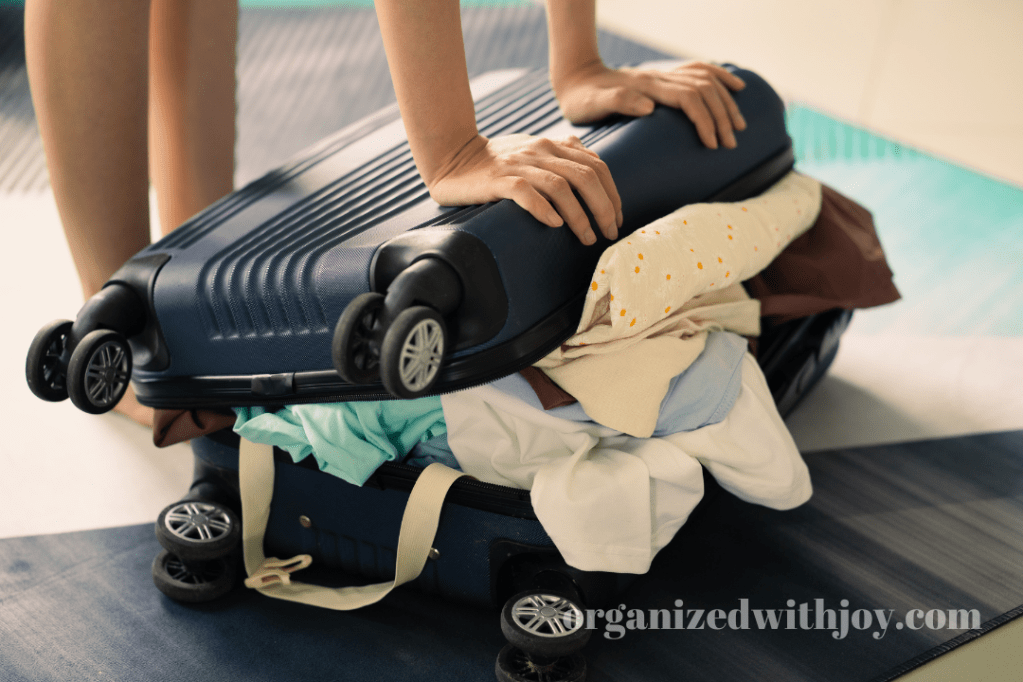
For those of you who don’t know, this year I have been taking a lot of trips. I wanted to focus on travel this year in part because there were events happening that required me to travel, so I just decided it would be my year of travel, and it felt appropriate because I’m turning 50 next month! With all this travel I have been thinking about baggage. Literal baggage, but the analogies of emotional baggage. So that is what I wanted to talk about for today’s Thoughtful Thursday.
Okay, perhaps I’m digging a little too deep to connect this analogy, but stick with me. This last trip I took I had to wait at the airport for quite a while before my flight left because my sister had to drop me off earlier than I expected when I ordered the tickets. And truly it was fine because I had a lot to catch up on from being away. But as I sat at the airport with my baggage under foot I was thinking about how difficult it was to do anything. If I wanted to go get coffee, I had to take it with me. If I needed to use the restroom, it came with me. I started thinking about how it was parallel to our emotional baggage in how it slows us down.
Physical baggage is tangible and measurable. Our bags are heavy or light depending on how much and what we pack. Emotional baggage is similar but it is all of our unresolved feelings, past traumas, regrets, and grudges we carry. Just as a heavy piece of luggage can cause back pain and fatigue, emotional baggage can lead to emotional pain and mental fatigue or if prolonged, lead to anxiety or depression. I didn’t do a great job packing my bags because I knew I would have plenty of time in the airport to do that. As I sat there unpacking and repacking everything more neatly I thought how often do I do this with my emotional baggage. I unpack everything – maybe with a friend or a therapist, or even just journaling. But do I ever decide there are things I need to let go of and no longer hold onto. Are there things that if I let go of them, my load would be lighter as I walked through life.
Are you an over-packer when you go on trips? I used to be an over-packer and wanted to account for everything and anything that could happen. But as the year went on and I went on more trips I started to learn what I really needed and my anxiety about not having what I MIGHT need started to calm down. I realized that it wasn’t worth carrying around ALL that extra stuff just in case. I got to the point where I preferred to take the risk of not having what I needed in order to have a lighter load. Are we holding onto things in life that are making our load too heavy? Both physical and emotional baggage can be an unnecessary burden we carry. When you are an over-packer you have unused items that become a physical burden, and when we hold onto emotional baggage we burden ourselves with these things that no longer serve a purpose. We can hold onto old grudges, past failures, or fears of rejection, which makes it difficult to experience life to the fullest in the present. Whether it’s physical or emotional baggage, letting go often involves unpacking everything, sorting through, deciding what is essential, and then letting go of the excess.
There is danger in ignoring the weight of our baggage both physical and emotional. When we carry a heavy bag for too long it can cause physical harm, and potentially long term damage if we don’t listen to our bodies. Similarly, when we carry emotional baggage for too long, the result can manifest in harmful ways such as anger, anxiety, or depression. This can affect our relationships, job performance, erode our self esteem, which can have long term effects on our lives. We must acknowledge and deal with the baggage because left unchecked it can end up controlling our lives, dictating how successful we are and our overall happiness in life.
The process of letting go, for both physical baggage or emotional baggage can transform any journey. Traveling light allows us to move freely, explore more easily, and feel less weighed down by possessions. In the same way, letting go of emotional baggage creates space for new experiences and personal growth. We can live more fully in the present and experience deeper connections with our loved ones. We can pursue goals more easily not being held back by our past.
Here is the YouTube video I shared in conjunction with this blog post.
Hey friends, for today’s Thoughtful Thursday post I wanted to talk about the value of intentional living. {{Scroll to the bottom to find the link to my YouTube video I’m sharing in conjunction with this post. I’m sharing some footage I took while driving to Portland with my son and then while we were in Portland.}} It can be so easy to fill our schedules to the brim. We live in a culture characterized by distractions, demands (both in our physical world and online), and fast paced living. I’m realizing the value of living intentionally to give me that space to really enjoy and savor each moment. There was a time in my life, when my kids were younger, that I felt like I was rushing through moments as I had my eyes on the horizon towards the next thing. Now I’m learning the value of consciously choosing how to spend my time, energy, and resources so that they are in alignment with my values, goals, and priorities. We don’t have to live on autopilot, living in a passive way and allowing the distractions and demands to dictate what we do. Instead as we focus on living intentionally we can cultivate a greater sense of fulfillment and purpose in life.
What does it mean to live with intention? When I looked up the definition on the Merriam-Webster website the definition that resonated with me was: a determination to act in a certain way; resolve. I like that idea of resolve. When we resolve to do something it’s not always the easy path or what we really want to do, but rather it’s what we choose to do. But a surprising definition entry was: a process or manner of healing of incised wounds. Wow. This really struck me. I thought about how when we are busy we have no time to process things. We have no space to heal emotionally or sometimes even physically. When we live with intention it leaves the margin we need to heal. When we leave this margin we are able to reflect on and evaluate what matters most to us so that we can align our daily choices with those values and priorities. We don’t have to follow social expectations or family pressure, but instead can decide what are those inner values and make choices that align with our long term well-being, goals, and happiness.
This doesn’t necessarily mean a meticulously planned out day, week, or life. It’s not about adhering to some rigid routines you put in place, instead it’s about being proactive on how you spend your time and not allow your choices to be influenced by external pressures and circumstances and instead by your own thoughtful choices that come from a place of your authentic self. Life is unpredictable, and things don’t always go our way. Challenges and setbacks are inevitable. Living with intention doesn’t mean we are exempt from difficulties in life, but actually helps us to be more equipped to deal with struggles as we can adapt, pivot, and continue to make choices that align with our values and priorities. Already having these values and priorities on the forefront of our minds can act as a compass as we navigate through challenging or unexpected circumstances. When we have not evaluated values, goals, and priorities, it can be all too easy to be reactive, giving into frustration and potentially reacting impulsively in stressful or unexpected circumstances in life.
Another key element to living intentionally is letting go of perfectionism. Perfectionism is not only not necessary, but it’s also not attainable. Living with this desire for perfection is also unhealthy. We weren’t created for perfection. Living with intention allows us to focus on progress over perfection. When we fall into the trap of believing there is some idealized version of life, it often leads to stress, anxiety, and burnout. By letting go of perfection, we can focus on making consistent choices that lead us towards our goals, values, and priorities, and embracing that we will not always do things flawlessly. This mindset allows us to embrace that life isn’t perfect, but instead those failures can foster resilience and encourage growth.
Mindfulness is another important aspect of living with intention. By practicing mindfulness we can become more attuned to our thoughts and emotions. This deeper awareness allows for self reflection which can help us stay on our intended path. Being mindful also encourages us to live in the present. We must be aware of the many distractions around us so we don’t get caught up in the busyness of life and miss the opportunities to engage with the present.
There are lots of things I have learned through focusing on living intentionally, but I will just share the top three things with you. The first thing I have learned in slowing down and living with more intention, is the value of being in nature. Time in nature is never wasted. For me being surrounded by God’s beauty refuels my soul and gives me energy! There is a John Muir quote that I really love. He said “Life I am so moved by nature. I have been known to cry while driving into the mountains, staring at a waterfall, or walking through the forest.
The other thing I have learned is to really value cultivating relationships that are supportive and meaningful. This involves being present with loved ones, offering my full attention (like putting my phone away when we are together), and spending quality time with one another. It’s not always easy to prioritize relationships. It takes intention to be authentic and vulnerable, creating space to develop intimacy with one another. It also includes setting healthy boundaries, and really evaluating who you spend your time with. There may be people who don’t contribute positively to your life. You may find you need to step away from these draining or even toxic relationships. By surrounding yourself with people who uplift and inspire you, you create an environment that supports your intentional path.
Lastly, living with intention is more likely to provide us with opportunities to do things outside of our comfort zone. By its nature, intentional living promotes growth, expansion, and change. When we stop living on autopilot and living in the rut of societal expectations, we can do things that in the past we have felt uncomfortable doing. The more I do things outside of my comfort zone, the more I realize that this is where life is truly lived! Helen Keller said, “Life is either a daring adventure or nothing.” And I couldn’t agree more! When we just run on the treadmill of life we aren’t really living!
Well friends, I hope this post about living intentionally encouraged you today. I always love hearing from you in the comments, so please share your thoughts on my thoughts. I also wanted to share an update on my son: he is doing amazing in Portland! He is loving his job and making new friends. I’m so incredibly proud of him and so glad I was able to be there for him in this big life transition! Click on the link below if you want to check out my video sharing the process of moving him!









 organized with joy